


Time to add a new priority target for child injury prevention? The case for an excess burden associated with sport and exercise injury: population-based study
- PMID: 24993758
- PMCID: PMC4091508
- DOI: 10.1136/bmjopen-2014-005043
Time to add a new priority target for child injury prevention? The case for an excess burden associated with sport and exercise injury: population-based study
Abstract
Objective: To determine the population-level burden of sports injuries compared with that for road traffic injury for children aged <15 years in Victoria, Australia.
Design: Retrospective observational study.
Setting: Analysis of routinely collected data relating to non-fatal hospital-treated sports injury and road traffic injury cases for children aged <15 years in Victoria, Australia, over 2004-2010, inclusive.
Participants: 75 413 non-fatal hospital-treated sports injury and road traffic injury cases in children aged <15 years. Data included: all Victorian public and private hospital hospitalisations, using the International Statistical Classification of Diseases and Health Related Problems, 10th Revision, Australian Modification (ICD-10-AM) activity codes to identify sports-related cases and ICD-10-AM cause and location codes to identify road traffic injuries; and injury presentations to 38 Victorian public hospital emergency departments, using a combination of activity, cause and location codes.
Main outcome measures: Trends in injury frequency and rate were analysed by log-linear Poisson regression and the population-level injury burden was assessed in terms of years lived with disability (YLD), hospital bed-days and direct hospital costs.
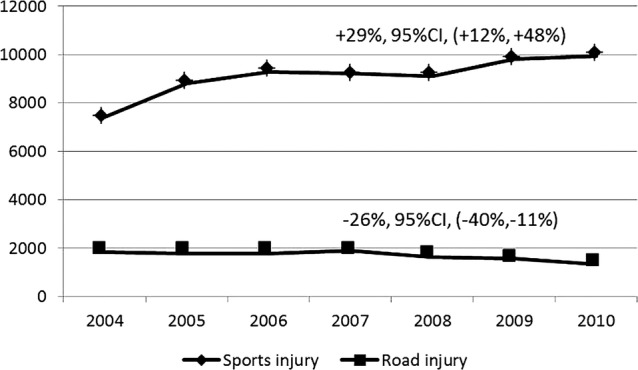
Results: Over the 7-year period, the annual frequency of non-fatal hospital-treated sports injury increased significantly by 29% (from N=7405 to N=9923; p<0.001) but the frequency of non-fatal hospital-treated road traffic injury decreased by 26% (from N=1841 to N=1334; p<0.001). Sports injury accounted for a larger population health burden than did road traffic injury on all measures: 3-fold the number of YLDs (7324.8 vs 2453.9); 1.9-fold the number of bed-days (26 233 vs 13 886) and 2.6-fold the direct hospital costs ($A5.9 millions vs $A2.2 millions).
Conclusions: The significant 7-year increase in the frequency of hospital-treated sports injury and the substantially higher injury population-health burden (direct hospital costs, bed-day usage and YLD impacts) for sports injury compared with road traffic injury for children aged <15 years indicates an urgent need to prioritise sports injury prevention in this age group.
Keywords: Epidemiology; Public Health; Sports Medicine.
Published by the BMJ Publishing Group Limited. For permission to use (where not already granted under a licence) please go to http://group.bmj.com/group/rights-licensing/permissions.
Figures
References
-
- Murray C, Vos T, Lozano R, et al. Disability-adjusted life years (DALYs) for 291 diseases and injuries in 21 regions, 1990–2010: a systematic analysis for the Global Burden of Disease Study 2010. Lancet 2012;380:2197–223 - PubMed
-
- World Health Organization. World report on child injury prevention. Switzerland: World Health Organization, 2008. http://www.who.int/violence_injury_prevention/child/injury/world_report/en/ (accessed 19 Aug 2013). - PubMed
-
- Du W, Finch C, Hayen A, et al. Trends in hospitalisation rates for road traffic injuries in child motor vehicle passengers in New South Wales, July 1998–June 2005. Med J Aust 2007;187: 515–18 - PubMed
-
- World Health Organization. Global status report on road safety 2013: supporting a decade of action. Switzerland: World Health Organization, 2013
Publication types
MeSH terms
LinkOut - more resources
Full Text Sources
Other Literature Sources
Medical
