


Treatment effect of memantine on survival in dementia with Lewy bodies and Parkinson's disease with dementia: a prospective study
- PMID: 24993765
- PMCID: PMC4091277
- DOI: 10.1136/bmjopen-2014-005158
Treatment effect of memantine on survival in dementia with Lewy bodies and Parkinson's disease with dementia: a prospective study
Abstract
Objective: To investigate the effect on survival of treatment with memantine in patients with dementia with Lewy bodies (DLB) and Parkinson's disease with dementia (PDD).
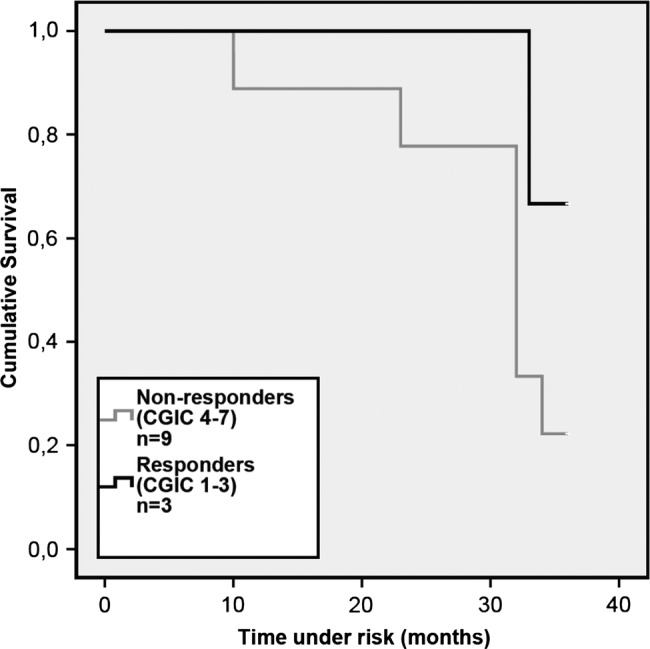
Methods: 75 patients with DLB and PDD were included in a prospective double-blinded randomised placebo-controlled trial (RCT) of memantine, of whom long-term follow-up was available for 42. Treatment response was recorded 24 weeks from baseline and measured by Clinical Global Impression of Change (CGIC). The participants were grouped as responders (CGIC 1-3) or non-responders (CGIC 4-7). The 24-week RCT was followed by open-label treatment and survival was recorded at 36 months.
Results: After 36-month follow-up, patients in the memantine group had a longer length of survival compared with patients in the placebo group (log rank x²=4.02, p=0.045). Within the active treatment group, survival analysis 36 months from baseline showed that the memantine responders, based on CGIC, had higher rates of survival compared with the non-responders (log rank x²=6.595, p=0.010). Similar results were not seen in the placebo group.
Conclusions: Early treatment with memantine and a positive clinical response to memantine predicted longer survival in patients with DLB and PDD. This suggests a possible disease-modifying effect and also has implications for health economic analysis. However, owing to the small study sample, our results should merely be considered as generating a hypothesis which needs to be evaluated in larger studies.
Trial registration number: ISRCTN89624516.
Published by the BMJ Publishing Group Limited. For permission to use (where not already granted under a licence) please go to http://group.bmj.com/group/rights-licensing/permissions.
Figures


References
-
- Lippa CF, Duda JE, Grossman M, et al. DLB and PDD boundary issues: diagnosis, treatment, molecular pathology, and biomarkers. Neurology 2007;68:812–19 - PubMed
-
- Aarsland D, Ballard CG, Halliday G. Are Parkinson's disease with dementia and dementia with Lewy bodies the same entity? J Geriatr Psychiatry Neurol 2004;17:137–45 - PubMed
-
- Ballard C, Kahn Z, Corbett A. Treatment of dementia with Lewy bodies and Parkinson's disease dementia. Drugs Aging 2011;28:769–77 - PubMed
Publication types
MeSH terms
Substances
LinkOut - more resources
Full Text Sources
Other Literature Sources
Medical
