


Five-year nationwide follow-up study of active surveillance for prostate cancer
- PMID: 24993868
- PMCID: PMC4280355
- DOI: 10.1016/j.eururo.2014.06.010
Five-year nationwide follow-up study of active surveillance for prostate cancer
Abstract
Background: Active surveillance (AS) is an important yet underutilized strategy to reduce prostate cancer (PCa) overtreatment.
Objective: To examine the 5-yr outcomes of AS in a population-based setting.
Design, setting, and participants: From the National Prostate Cancer Register of Sweden, we identified 11 726 men ≤70 yr diagnosed with very low-risk to intermediate-risk PCa from 2003 to 2007 who completed 5 yr of follow-up. Of these men, 1729 (15%) chose AS for the primary management strategy.
Outcome measurements and statistical analysis: We calculated the probability of discontinuation of AS over time, and Cox proportional hazards models were used to determine factors associated with discontinuation. Reasons for discontinuation were assessed by data extraction from medical charts.
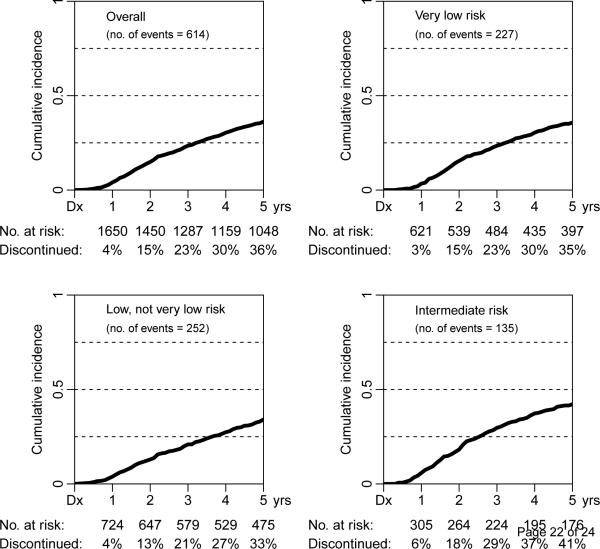
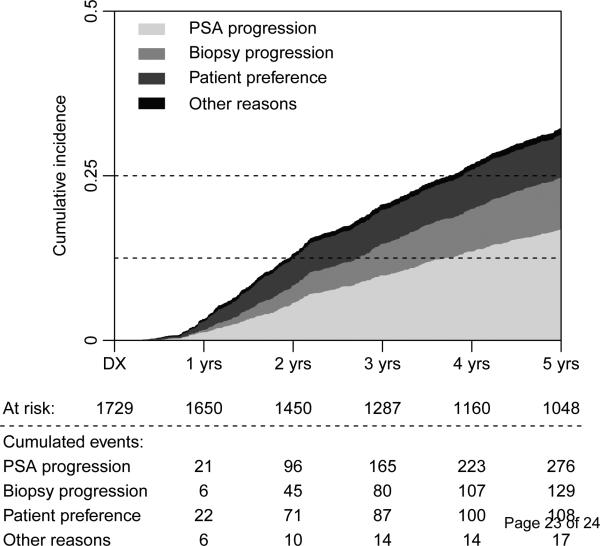
Results and limitations: By 5 yr, 64% of the men remained on AS. Predictors of discontinuation were younger age, fewer comorbidities, more education, higher prostate-specific antigen (PSA), and clinical stage T2 disease; marital status did not predict discontinuation. In a subset with data on the reason for discontinuation (86%), 20% of men discontinued because of patient preference, 52% because of PSA progression, 24% because of biopsy progression, and 3% for other reasons.
Conclusions: In a population-based setting, the majority of men remained on AS at 5 yr. However, one-fifth of the men who discontinued AS did so for nonbiologic reasons. Thus, there is a need for support and counseling for men to continue AS in the absence of signs of progression to improve adherence to AS and decrease overtreatment.
Patient summary: Active surveillance (AS) is an important option to delay or avoid treatment for men with favorable prostate cancer features. This study shows that at 5 yr, 64% of men across an entire population remained on AS. We concluded that AS is a durable option and that counseling may be useful to promote adherence for men without progression.
Keywords: Active surveillance; Adverse pathology; Predictors; Prostate cancer; Upgrading.
Copyright © 2014 European Association of Urology. Published by Elsevier B.V. All rights reserved.
Figures
Comment in
-
Active surveillance: protocol makes perfect.Eur Urol. 2015 Feb;67(2):239-40. doi: 10.1016/j.eururo.2014.06.048. Epub 2014 Jul 10. Eur Urol. 2015. PMID: 25018039 No abstract available.
-
Re: Five-year nationwide follow-up study of active surveillance for prostate cancer.J Urol. 2015 Jun;193(6):1981. doi: 10.1016/j.juro.2015.03.043. Epub 2015 Mar 14. J Urol. 2015. PMID: 25986791 No abstract available.
References
-
- Loeb S, Berglund A, Stattin P. Population based study of use and determinants of active surveillance and watchful waiting for low and intermediate risk prostate cancer. J Urol. 2013;190:1742–9. - PubMed
-
- [May 28, 2014];National Prostate Cancer Register of Sweden. http://npcr.se/.
-
- Dall'era MA, Albertsen PC, Bangma C, et al. Active surveillance for prostate cancer: a systematic review of the literature. Eur Urol. 2012;62:976–83. - PubMed
Publication types
MeSH terms
Substances
Grants and funding
LinkOut - more resources
Full Text Sources
Other Literature Sources
Medical
Research Materials
Miscellaneous
