


Comparison of virological profiles of respiratory syncytial virus and rhinovirus in acute lower tract respiratory infections in very young Chilean infants, according to their clinical outcome
- PMID: 24994006
- PMCID: PMC7185600
- DOI: 10.1016/j.jcv.2014.06.004
Comparison of virological profiles of respiratory syncytial virus and rhinovirus in acute lower tract respiratory infections in very young Chilean infants, according to their clinical outcome
Abstract
Background: Respiratory syncytial virus (RSV) and rhinovirus (HRV) are the main cause of acute lower respiratory tract infections (ALRTIs) in infants. Viral and host-related risk factors for severe disease have also not been clearly established.
Objective: To assess whether certain viral features of RSV and, or HRV are associated with severe ALRTI.
Study design: RSV and HRV were studied in nasopharyngeal samples of infants by immunofluorescence, Luminex(®) and/or real-time RT-PCR assays. Quantitation and genotyping of RSV and HRV by PCR were done.
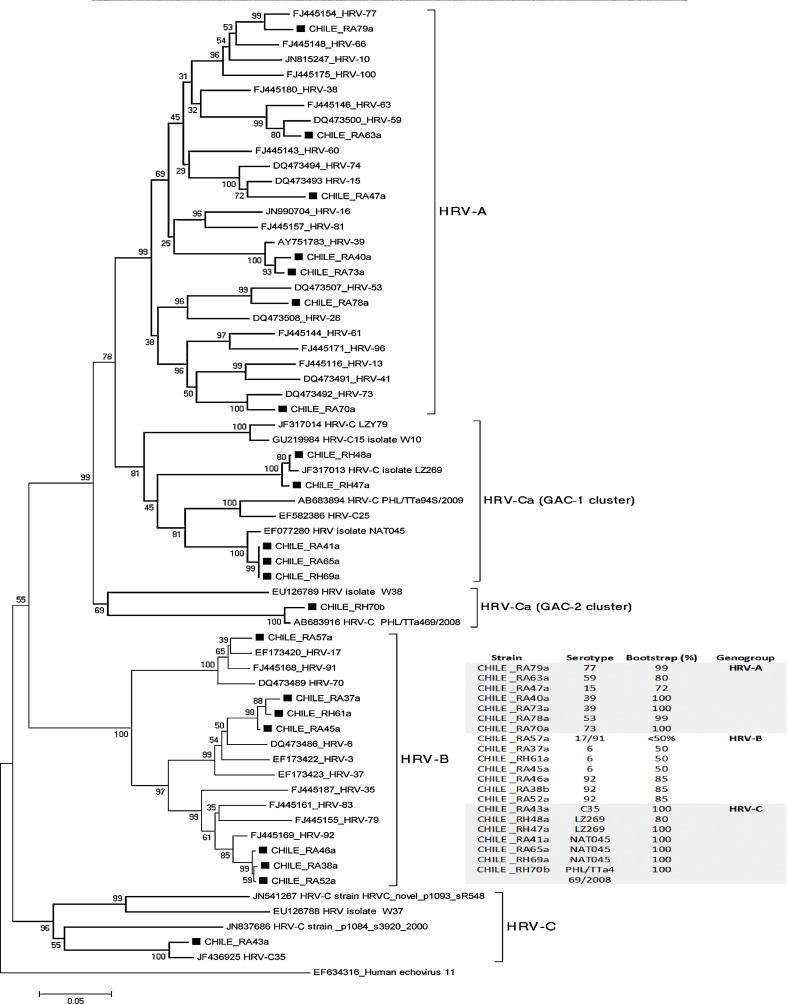
Results: Of 124 virus positive specimens, 74 (59.7%) had RSV; 22 (17.7%) HRV and 28 (22.6%) RSV-HRV co-infection. Hospitalization was required in 57/74 RSV infants (77.0%); in 10/22 HRV cases (45.5%) (p=0.006) and in 15/28 co-infected by both viruses (53.6%) (p=0.003). Severe cases were 33/74 (44.6%) RSV infections, 2/22 HRV cases (9.1%), (p<0.002) and 6/28 (21.4%) patients co-infected by RSV-HRV (p<0.026). Three genotypes (NA1, B7, B9) of RSV circulated during the study. In 33 severe infants, NA1 was detected in 19 cases (57.6%); B7 in 13 (39.4%) and B9 in 1 (3.0%) (p<0.01; OR=10.0). RSV loads were similar between outpatients and hospitalized infants (p=0.7) and among different severities (p=0.7). NA1 loads were higher than other strains (p=0.049). Three geno-groups of HRV circulated homogeneously.
Conclusion: In very young infants, RSV cause more severe disease than HRV. Co-infection does not increase the severity of illness. NA1 RSV genotype was associated with major frequency of hospitalization, severe respiratory disease and higher viral load.
Keywords: ALTRI; Respiratory syncytial virus; Rhinovirus; Severe infantile respiratory infection.
Copyright © 2014 Elsevier B.V. All rights reserved.
Figures
References
-
- Zorc J.J., Hall C.B. Bronchiolitis: recent evidence on diagnosis and management. Pediatrics. 2010;125:342–349. - PubMed
-
- Palomino M.A., Larrañaga C., Villagra E., Camacho J., Avendaño L.F. Adenovirus and respiratory syncytial virus-adenovirus mixed acute lower respiratory infections in Chilean infants. Pediatr Infect Dis J. 2004;23:337–341. - PubMed
Publication types
MeSH terms
LinkOut - more resources
Full Text Sources
Other Literature Sources
