


Myelin oligodendrocyte basic protein and prognosis in behavioral-variant frontotemporal dementia
- PMID: 24994843
- PMCID: PMC4141997
- DOI: 10.1212/WNL.0000000000000668
Myelin oligodendrocyte basic protein and prognosis in behavioral-variant frontotemporal dementia
Abstract
Objective: To determine the prognostic utility of tauopathy-associated single nucleotide polymorphisms (SNPs) in sporadic behavioral-variant frontotemporal dementia (bvFTD).
Methods: Eighty-one patients with sporadic bvFTD were genotyped for tauopathy-associated SNPs at rs8070723 (microtubule-associated protein tau [MAPT]) and rs1768208 (myelin-associated oligodendrocyte basic protein [MOBP]). We performed a retrospective case-control study comparing age at onset and disease duration between carriers of ≥1 polymorphism allele and noncarriers for these SNPs. Subanalyses were performed for autopsied subgroups with tauopathy (n = 20) and TDP-43 proteinopathy (n = 12). To identify a potential biological basis for disease duration, neuroimaging measures of white matter integrity were evaluated (n = 37).
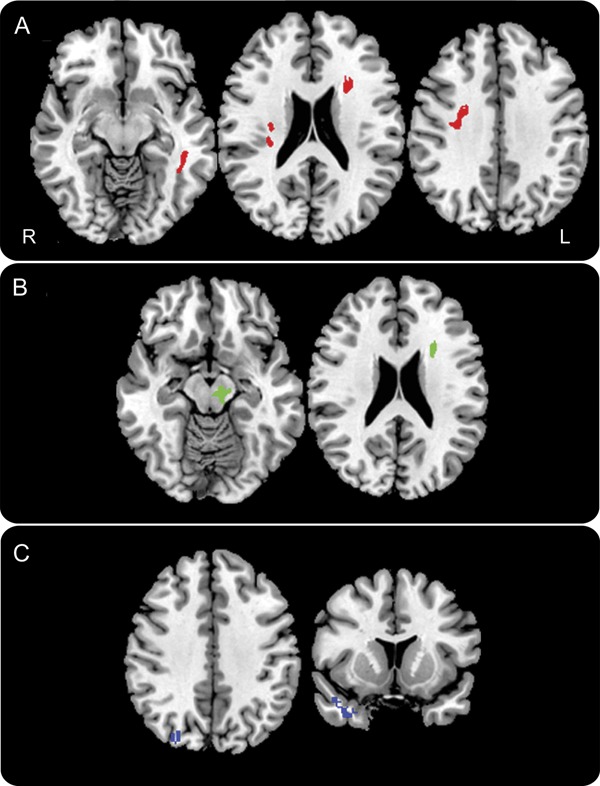
Results: Carriers of risk allele (T) in rs1768208 (i.e., MOBP RA+) had a shorter median disease duration (TC/TT = 5.5 years, CC = 9.5 years; p = 0.02). This was also found in the subset of cases with autopsy-confirmed tauopathies (p = 0.04) but not with TDP-43 proteinopathies (p > 0.1). By comparison, polymorphisms at rs8070723 (MAPT) had no effect on disease duration (p > 0.1), although carriers of protective allele (G) in rs8070723 had a younger median age at onset (AG/GG = 54.5 years, AA = 58 years; p < 0.01). MOBP RA+ patients had increased radial diffusivity in the superior corona radiata and midbrain, and reduced fractional anisotropy in the superior corona radiata as well as superior and inferior longitudinal fasciculi compared with noncarriers (p < 0.01).
Conclusions: The rs1768208 risk polymorphism in MOBP may have prognostic value in bvFTD. MOBP RA+ patients have more severe white matter degeneration in bvFTD that may contribute to shorter disease duration. Future studies are needed to help confirm these findings.
© 2014 American Academy of Neurology.
Figures

References
-
- Rascovsky K, Hodges GM, Knopman D, et al. Determinants of survival in autopsy-confirmed patients with behavioral variant frontotemporal dementia (bvFTD): second report of the international bvFTD criteria consortium (FTDC). Alzheimers Dement 2011;7:S761–S762
Publication types
MeSH terms
Substances
Grants and funding
- P30 AG010124/AG/NIA NIH HHS/United States
- AG15116/AG/NIA NIH HHS/United States
- AG038490/AG/NIA NIH HHS/United States
- P50 NS053488/NS/NINDS NIH HHS/United States
- P01AG017586/AG/NIA NIH HHS/United States
- NS044266/NS/NINDS NIH HHS/United States
- R01 NS044266/NS/NINDS NIH HHS/United States
- P01 AG032953/AG/NIA NIH HHS/United States
- R01 AG015116/AG/NIA NIH HHS/United States
- P01NS053488/NS/NINDS NIH HHS/United States
- P01 AG017586/AG/NIA NIH HHS/United States
- R01 AG038490/AG/NIA NIH HHS/United States
- K01 AG043503/AG/NIA NIH HHS/United States
- P01AG032953/AG/NIA NIH HHS/United States
- AG043503/AG/NIA NIH HHS/United States
- K23 NS088341/NS/NINDS NIH HHS/United States
LinkOut - more resources
Full Text Sources
Other Literature Sources
