. 2014 May 21;9(1):247.
doi: 10.1186/1556-276X-9-247. eCollection 2014.

Dendrimers: synthesis, applications, and properties

Affiliations

Dendrimers: synthesis, applications, and properties

Elham Abbasi et al. Nanoscale Res Lett. .

Abstract

Dendrimers are nano-sized, radially symmetric molecules with well-defined, homogeneous, and monodisperse structure that has a typically symmetric core, an inner shell, and an outer shell. Their three traditional macromolecular architectural classes are broadly recognized to generate rather polydisperse products of different molecular weights. A variety of dendrimers exist, and each has biological properties such as polyvalency, self-assembling, electrostatic interactions, chemical stability, low cytotoxicity, and solubility. These varied characteristics make dendrimers a good choice in the medical field, and this review covers their diverse applications.

Keywords: Dendrimer; Nanoscale; PAMAM; Pseudorotaxane.


Figures
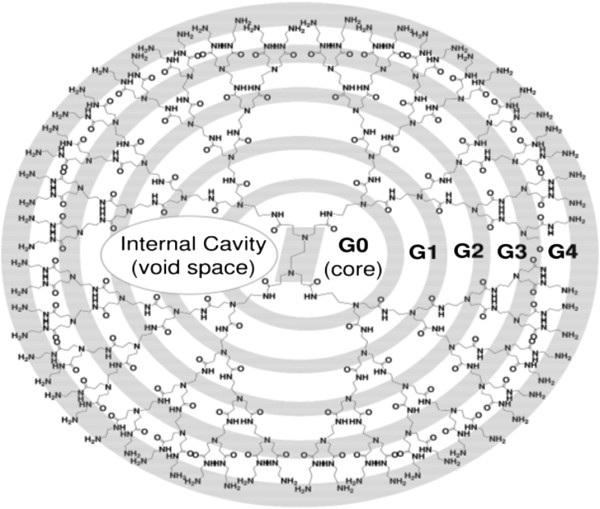
Figure 1
Figure 1
Schematic representation of a generation G4 dendrimer with 64 amino groups at the periphery. This dendrimer starts from an ethylene diamine core; the branches or arms were attached by exhaustive Michael addition to methyl acrylate followed by exhaustive aminolysis of the resulting methyl ester using ethylene diamine [20].
Figure 2
Figure 2
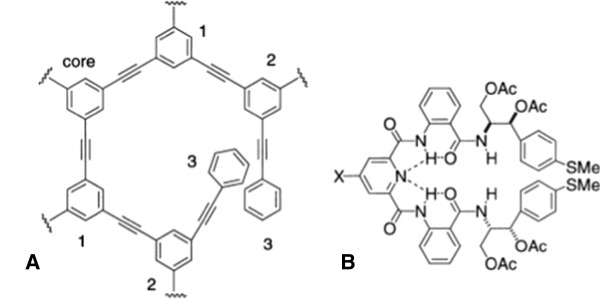
Types of dendrimers. (A) More type dendrimers consisting of phenyl acetylene subunits at the third-generation different arms may dwell in the same space, and the fourth-generation layer potential overlaps with the second-generation layer. (B) Parquette-type dendrons are chiral, non-racemic, and with intramolecular folding driven by hydrogen bonding [24].
Figure 3
Figure 3
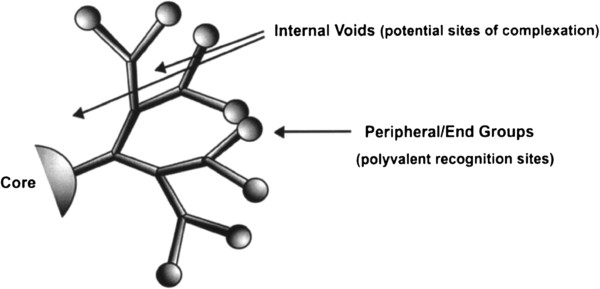
Three main parts of a dendrimer: the core, end-groups, and subunits linking the two molecules.
Figure 4
Figure 4
Cascade reaction sequences developed for the synthesis of ‘non-skid-chain like’ polyazamacrocyclic compounds [40].
Figure 5
Figure 5
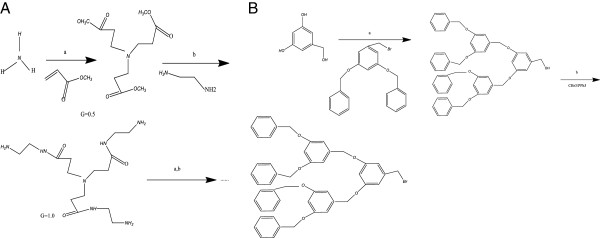
Approaches for the synthesis if dendrimers. (A) Divergent approach: synthesis of radially symmetric polyamidoamine (PAMAM)dendrimers using ammonia as the trivalent core; the generations are added at each synthetic cycle (two steps), leading to an exponential increase in the number of surface functional groups [37]. (B) Convergent approach: synthesis of dendrons or wedges or branches that will become the periphery of the dendrimer when coupled to a multivalent core in the last step of the synthesis [13].
Figure 6
Figure 6
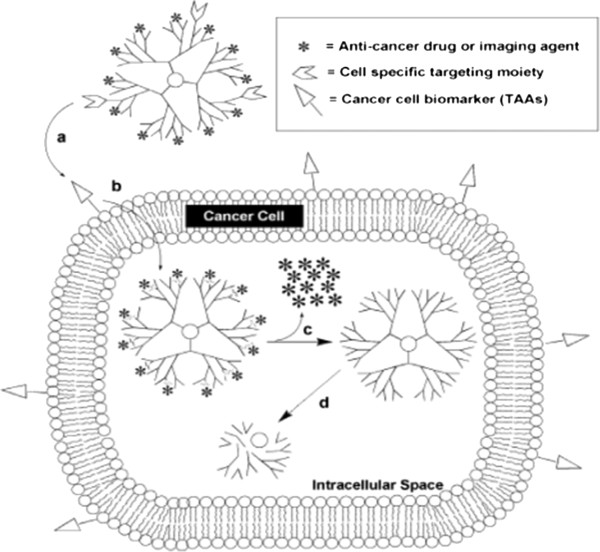
Requirements for dendrimer-based, cancer-targeted drug delivery. (A) Dendrimers with multiple surface functional groups can be directed to cancer cells by tumor-targeting entities that include folate or antibodies specific for tumor-associated antigens (TAAs). (B) The next step is ingestion into the cell which, in the case of folate targeting, occurs by membrane receptor-mediated endocytosis. (C) Once inside the cell, the drug generally must be released from the dendrimer, which, for the self-immolative method, results in the simultaneous disintegration of the dendritic scaffold (D).
Figure 7
Figure 7
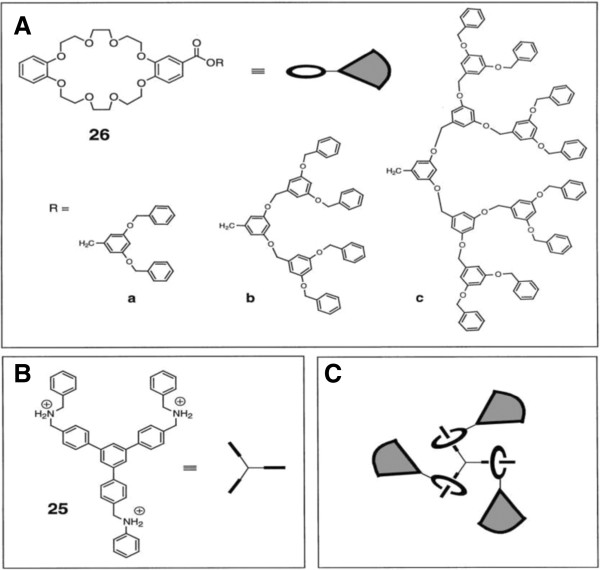
Gibson's self-assembling dendrimers using pseudorotaxane formation. (A) Crown ethers with dendritic substituents. (B) Triammonium ion core. (C) Schematic of tridendron formed by triple pseudorotaxane self-assembly.
Figure 8
Figure 8
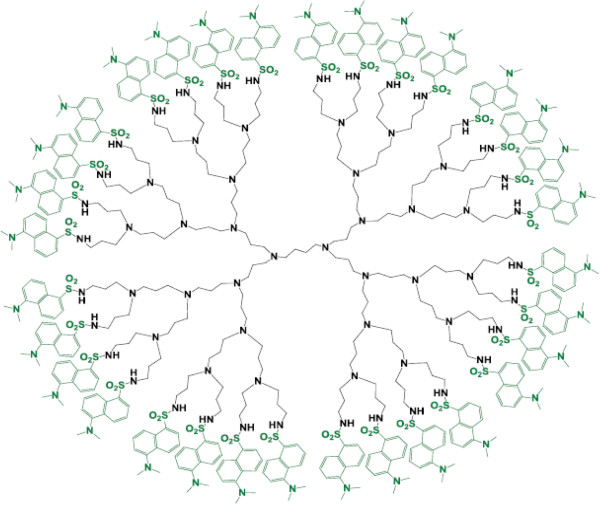
Poly (propylene amine) dendrimer, containing 32 dansyl units at its periphery.

References

    1. Srinivasa-Gopalan S, Yarema KJ. Nanotechnologies for the Life Sciences: Dendrimers in Cancer Treatment and Diagnosis, Volume 7. New York: Wiley; 2007.
    1. Klajnert B, Bryszewska M. Dendrimers: properties and applications. Acta Biochim Pol. 2001;9:199–208. - PubMed
    1. Tomalia DA, Frechet JMJ. Discovery of dendrimers and dendritic polymers: a brief historical perspective. J Polym Sci A Polym Chem. 2002;9:2719–2728.
    1. Tomalia DA. The dendritic state. Mater Today. 2005;9:34–36.
    1. Tomalia DA, Baker H, Dewald J, Hall M, Kallos M, Martin S, Roeck J, Ryder J, Smith P. A new class of polymers: starburst-dendritic macromolecules. Polym J (Tokyo) 1985;9:117.