


Review
doi: 10.1155/2014/824630.
Epub 2014 Jun 5.
An overview of live attenuated recombinant pseudorabies viruses for use as novel vaccines
Affiliations
- PMID: 24995348
- PMCID: PMC4068083
- DOI: 10.1155/2014/824630
Item in Clipboard
Review
An overview of live attenuated recombinant pseudorabies viruses for use as novel vaccines
J Immunol Res.
2014.
Abstract
Pseudorabies virus (PRV) is a double-stranded, DNA-based swine virus with a genome approximating 150 kb in size. PRV has many nonessential genes which can be replaced with genes encoding heterologous antigens but without deleterious effects on virus propagation. Recombinant PRVs expressing both native and foreign antigens are able to stimulate immune responses. In this paper, we review the current status of live attenuated recombinant PRVs and live PRV-based vector vaccines with potential for controlling viral infections in animals.
Figures
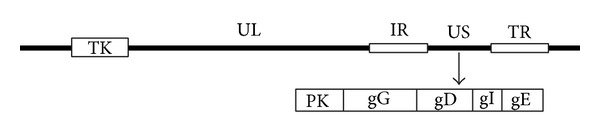
Common sites in the PRV genome for inserting exogenous genes. The genes encoding TK, PK, gG, gD, gI, and gE are the most common sites for inserting exogenous sequences. The TK gene is located within the unique long region (UL), and the PK, gG, gD, gI and gE genes are located within the unique short region (US). IR = internal repeat sequences; TR = terminal repeat sequence. The drawing is not to scale.
References
-
- Nauwynck H, Glorieux S, Favoreel H, Pensaert M. Cell biological and molecular characteristics of pseudorabies virus infections in cell cultures and in pigs with emphasis on the respiratory tract. Veterinary Research. 2007;38(2):229–241. - PubMed
-
- Mettenleiter TC. Aujeszky's disease (pseudorabies) virus: the virus and molecular pathogenesis-state of the art, June 1999. Veterinary Research. 2000;31(1):99–115. - PubMed
-
- Hooft van Iddekinge BJL, de Wind N, Wensvoort G, Kimman TG, Gielkens ALJ, Moormann RJM. Comparison of the protective efficacy of recombinant pseudorabies viruses against pseudorabies and classical swine fever in pigs; influence of different promoters on gene expression and on protection. Vaccine. 1996;14(1):6–12. - PubMed
Publication types
MeSH terms
Substances
LinkOut - more resources
Full Text Sources
Other Literature Sources
