


Infant emotion regulation: relations to bedtime emotional availability, attachment security, and temperament
- PMID: 24995668
- PMCID: PMC4262588
- DOI: 10.1016/j.infbeh.2014.06.006
Infant emotion regulation: relations to bedtime emotional availability, attachment security, and temperament
Abstract
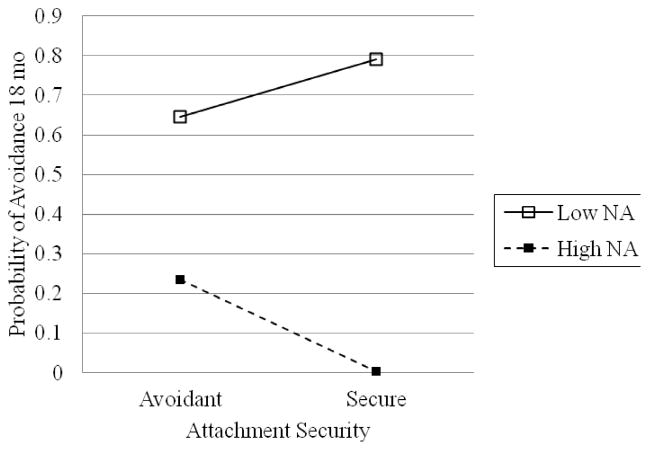
The present study examines the influences of mothers' emotional availability toward their infants during bedtime, infant attachment security, and interactions between bedtime parenting and attachment with infant temperamental negative affectivity, on infants' emotion regulation strategy use at 12 and 18 months. Infants' emotion regulation strategies were assessed during a frustration task that required infants to regulate their emotions in the absence of parental support. Whereas emotional availability was not directly related to infants' emotion regulation strategies, infant attachment security had direct relations with infants' orienting toward the environment and tension reduction behaviors. Both maternal emotional availability and security of the mother-infant attachment relationship interacted with infant temperamental negative affectivity to predict two strategies that were less adaptive in regulating frustration.
Keywords: Attachment security; Emotion regulation; Infant temperament; Maternal emotional availability.
Copyright © 2014 Elsevier Inc. All rights reserved.
Figures

References
-
- Ainsworth M, Blehar MC, Waters E, Wall S. Patterns of attachment: A psychological study of the strange situation. Hillsdale, NJ: Erlbaum; 1978.
-
- Belsky J. The developmental and evolutionary psychology of intergenerational transmission of attachment. In: Carter CS, Ahnert L, Grossmann KE, Hrdy SB, Lamb ME, Porges SW, Sachser N, editors. Attachment and Bonding: A New Synthesis. Cambridge, MA: MIT Press; 2005. pp. 169–178.
-
- Belsky J, Bakermans-Kranenburg MJ, van IJzendoorn MH. For better and for worse: Differential Susceptibility to environmental influences. Current Directions in Psychological Science. 2007;16(6):300–304. doi: 10.1111/j.1467-8721.2007.00525.x. - DOI
Publication types
MeSH terms
Grants and funding
LinkOut - more resources
Full Text Sources
Other Literature Sources
