


Developmental trajectories of disordered eating from early adolescence to young adulthood: a longitudinal study
- PMID: 24995824
- PMCID: PMC4255702
- DOI: 10.1002/eat.22329
Developmental trajectories of disordered eating from early adolescence to young adulthood: a longitudinal study
Abstract
Objective: Research examining changes in eating disorder symptoms across adolescence suggests an increase in disordered eating from early to late adolescence. However, relevant studies have largely been cross-sectional in nature and most have not examined the changes in the attitudinal symptoms of eating disorders (e.g., weight concerns). This longitudinal study aimed to address gaps in the available data by examining the developmental trajectories of disordered eating in females from preadolescence into young adulthood.
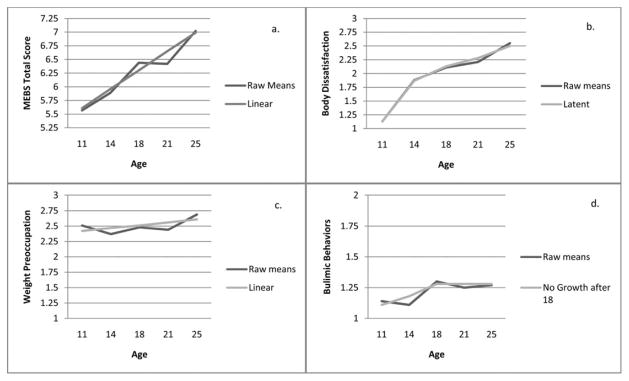
Method: Participants were 745 same-sex female twins from the Minnesota Twin Family Study. Disordered eating was assessed using the Total Score, Body Dissatisfaction subscale, Weight Preoccupation subscale, and a combined Binge Eating and Compensatory Behavior subscale from the Minnesota Eating Behavior Survey assessed at the ages of 11, 14, 18, 21, and 25. Several latent growth models were fit to the data to identify the trajectory that most accurately captures the changes in disordered eating symptoms from 11 to 25 years.
Results: The best-fitting models for overall levels of disordered eating, body dissatisfaction, and weight preoccupation showed an increase in from 11 through 25 years. In contrast, bulimic behaviors increased to age of 18 and then stabilized to age of 25.
Discussion: The findings expanded upon extant research by investigating longitudinal, symptom specific, within-person changes and showing an increase in cognitive symptoms into young adulthood and the stability of disordered eating behaviors past late adolescence.
Keywords: developmental; disordered eating; growth curve; longitudinal.
© 2014 Wiley Periodicals, Inc.
Conflict of interest statement
No conflict of interest exists for any of the authors.
Figures
References
-
- American Psychiatric Association. Diagnostic and Statistical Manual of Mental Disorders. 5. Arlington, VA: American Psychiatric Publishing; 2013.
-
- Jacobi C, Hayward C, de Zwaan M, Kraemer H, Agras WS. Coming to terms with risk factors for eating disorders: Application for risk terminology and suggestions for a general taxonomy. Psychol Bull. 2004;130:19–65. - PubMed
-
- Croll J, Neumark-Sztainer D, Story M, Ireland M. Prevalence and risk and protective factors related to disordered eating behaviors among adolescents: Relationship to gender and ethnicity. J Adolesc Health. 2002;31:166–175. - PubMed
Publication types
MeSH terms
Grants and funding
LinkOut - more resources
Full Text Sources
Other Literature Sources
Miscellaneous
