


Pyrethroid susceptibility of malaria vectors in four Districts of western Kenya
- PMID: 24996418
- PMCID: PMC4094666
- DOI: 10.1186/1756-3305-7-310
Pyrethroid susceptibility of malaria vectors in four Districts of western Kenya
Abstract
Background: Increasing pyrethroid resistance in malaria vectors has been reported in western Kenya where long lasting insecticidal nets (LLINs) and indoor residual spraying (IRS) are the mainstays of vector control. To ensure the sustainability of insecticide-based malaria vector control, monitoring programs need to be implemented. This study was designed to investigate the extent and distribution of pyrethroid resistance in 4 Districts of western Kenya (Nyando, Rachuonyo, Bondo and Teso). All four Districts have received LLINs while Nyando and Rachuonyo Districts have had IRS campaigns for 3-5 years using pyrethroids. This study is part of a programme aimed at determining the impact of insecticide resistance on malaria epidemiology.
Methods: Three day old adult mosquitoes from larval samples collected in the field, were used for bioassays using the WHO tube bioassay, and mortality recorded 24 hours post exposure. Resistance level was assigned based on the 2013 WHO guidelines where populations with <90% mortality were considered resistant. Once exposed, samples were identified to species using PCR.
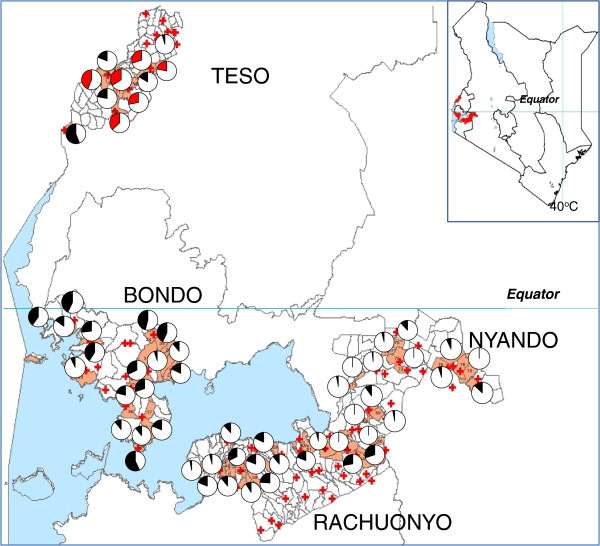
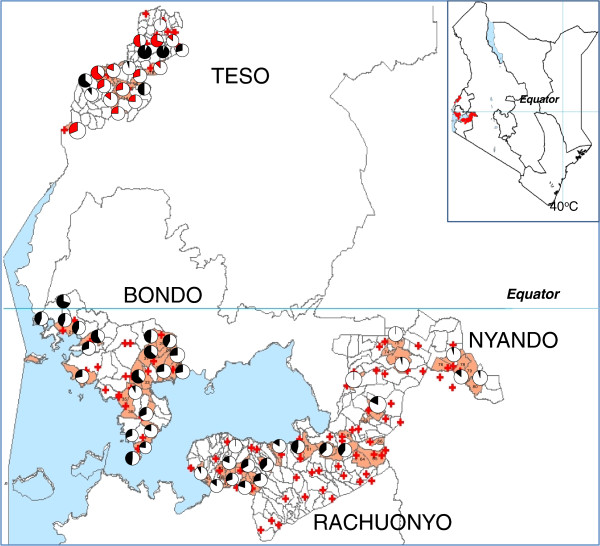
Results: An. arabiensis comprised at least 94% of all An. gambiae s.l. in Bondo, Rachuonyo and Nyando. Teso was a marked contrast case with 77% of all samples being An. gambiae s.s. Mortality to insecticides varied widely between clusters even in one District with mortality to deltamethrin ranging from 45-100%, while to permethrin the range was 30-100%. Mortality to deltamethrin in Teso District was < 90% in 4 of 6 clusters tested in An arabiensis and <90% in An. gambiae s.s in 5 of 6 clusters tested. To permethrin, mortality ranged between 5.9-95%, with <90% mortality in 9 of 13 and 8 of 13 in An. arabiensis and An. gambiae s.s. respectively. Cluster specific mortality of An. arabiensis between permethin and deltamethrin were not correlated (Z = 2.9505, P = 0.2483).
Conclusion: High levels of pyrethroid resistance were observed in western Kenya. This resistance does not seem to be associated with either species or location. Insecticide resistance can vary within small geographical areas and such heterogeneity may make it possible to evaluate the impact of resistance on malaria and mosquito parameters within similar eco-epidemiological zones.
Figures
References
-
- WHO. Global Malaria Program Insecticide-Treated Mosquito Nets: A WHO Position Statement. Geneva: WHO; 2005. http://www.who.int/malaria/publications/atoz/itnspospaperfinal.pdf.
-
- Lindblade KA, Gimnig JE, Kamau L, Hawley WA, Odhiambo F, Olang G, Kuile FOT, Vulule JM, Slutsker L. Impact of sustained use of insecticide-treated bednets on malaria Vector species distribution and culicine mosquitoes. J Med Entomol. 2006;43(2):428–432. doi: 10.1603/0022-2585(2006)043[0428:IOSUOI]2.0.CO;2. - DOI - PubMed
-
- Gimnig J, Vulule J, Lo T, Kamau L, Kolczak M, Philips-Howard P, Mathenge E, Kuile FT, Nahlen B, Hightower A. Impact of permethrin - treated bed nets on entomologic indices in an area of intense year around malaria transmission. Am J Trop Med Hyg. 2003;68:16–22. - PubMed
Publication types
MeSH terms
Substances
Grants and funding
LinkOut - more resources
Full Text Sources
Other Literature Sources
Medical
