


Radiofrequency bipolar hemostatic sealer reduces blood loss, transfusion requirements, and cost for patients undergoing multilevel spinal fusion surgery: a case control study
- PMID: 24997589
- PMCID: PMC4094224
- DOI: 10.1186/s13018-014-0050-2
Radiofrequency bipolar hemostatic sealer reduces blood loss, transfusion requirements, and cost for patients undergoing multilevel spinal fusion surgery: a case control study
Abstract
Background: A relatively new method of electrocautery, the radiofrequency bipolar hemostatic sealer (RBHS), uses saline-cooled delivery of energy, which seals blood vessels rather than burning them. We assessed the benefits of RBHS as a blood conservation strategy in adult patients undergoing multilevel spinal fusion surgery.
Methods: In a retrospective cohort study, we compared blood utilization in 36 patients undergoing multilevel spinal fusion surgery with RBHS (Aquamantys, Medtronic, Minneapolis, MN, USA) to that of a historical control group (n = 38) matched for variables related to blood loss. Transfusion-related costs were calculated by two methods.
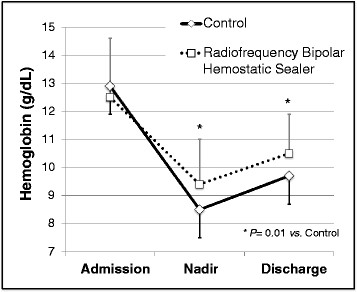
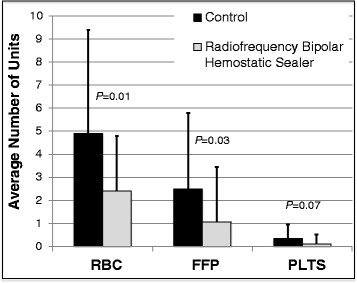
Results: Patient characteristics in the two groups were similar. Intraoperatively, blood loss was 55% less in the RBHS group than in the control group (810 ± 530 vs. 1,800 ± 1,600 mL; p = 0.002), and over the entire hospital stay, red cell utilization was 51% less (2.4 ± 3.4 vs. 4.9 ± 4.5 units/patient; p = 0.01) and plasma use was 56% less (1.1 ± 2.4 vs. 2.5 ± 3.4 units/patient; p = 0.03) in the RBHS group. Platelet use was 0.1 ± 0.5 and 0.3 ± 0.6 units/patient in the RBHS and control groups, respectively (p = 0.07). The perioperative decrease in hemoglobin was less in the RBHS group than in the control group (-2.0 ± 2.2 vs. -3.2 ± 2.1 g/dL; p = 0.04), and hemoglobin at discharge was higher in the RBHS group (10.5 ± 1.4 vs. 9.7 ± 0.9 g/dL; p = 0.01). The estimated transfusion-related cost savings were $745/case by acquisition cost and approximately 3- to 5-fold this amount by activity-based cost.
Conclusions: The use of RBHS in patients undergoing multilevel spine fusion surgery can conserve blood, promote higher hemoglobin levels, and reduce transfusion-related costs.
Figures
References
-
- Rubinstein C, Davenport DL, Dunnagan R, Saha SP, Ferraris VA, Xenos ES. Intraoperative blood transfusion of one or two units of packed red blood cells is associated with a fivefold risk of stroke in patients undergoing elective carotid endarterectomy. J Vasc Surg. 2013;57(2 Suppl):53S–57S. doi: 10.1016/j.jvs.2012.07.059. - DOI - PMC - PubMed
-
- Glance LG, Dick AW, Mukamel DB, Fleming FJ, Zollo RA, Wissler R, Salloum R, Meredith UW, Osler TM. Association between intraoperative blood transfusion and mortality and morbidity in patients undergoing noncardiac surgery. Anesthesiology. 2011;114(2):283–292. doi: 10.1097/ALN.0b013e3182054d06. - DOI - PubMed
Publication types
MeSH terms
Substances
LinkOut - more resources
Full Text Sources
Other Literature Sources
Medical
