


Micropillar arrays as a high-throughput screening platform for therapeutics in multiple sclerosis
- PMID: 24997607
- PMCID: PMC4830134
- DOI: 10.1038/nm.3618
Micropillar arrays as a high-throughput screening platform for therapeutics in multiple sclerosis
Erratum in
-
Author Correction: Micropillar arrays as a high-throughput screening platform for therapeutics in multiple sclerosis.Nat Med. 2024 Sep;30(9):2692. doi: 10.1038/s41591-024-03162-9. Nat Med. 2024. PMID: 38997609 No abstract available.
Abstract
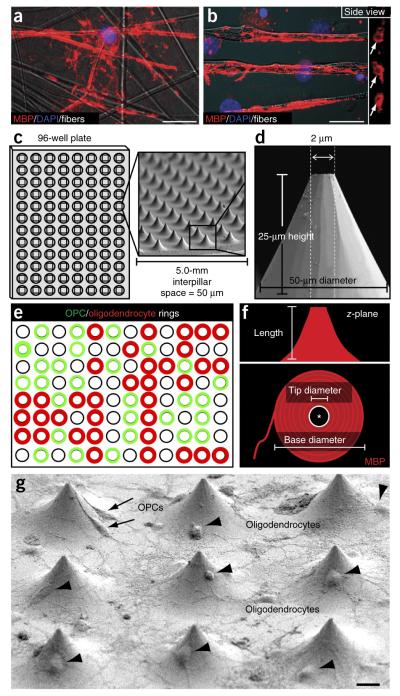
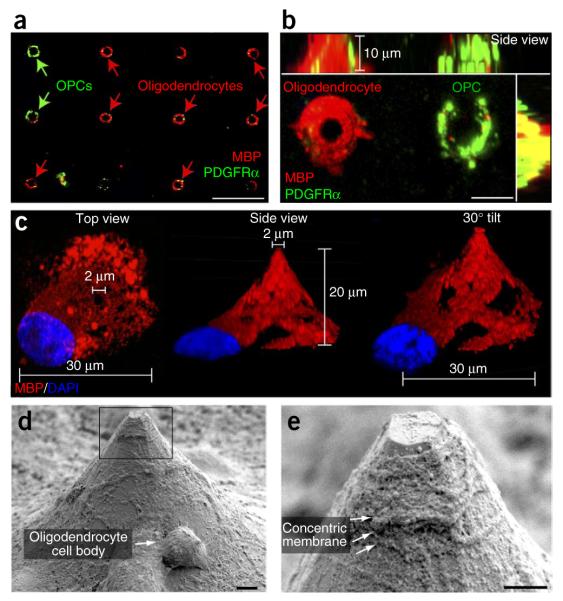
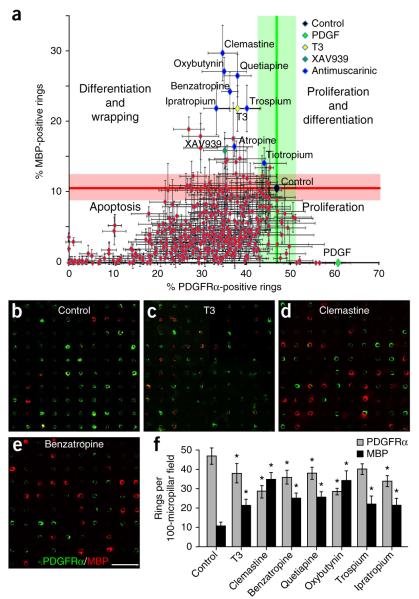
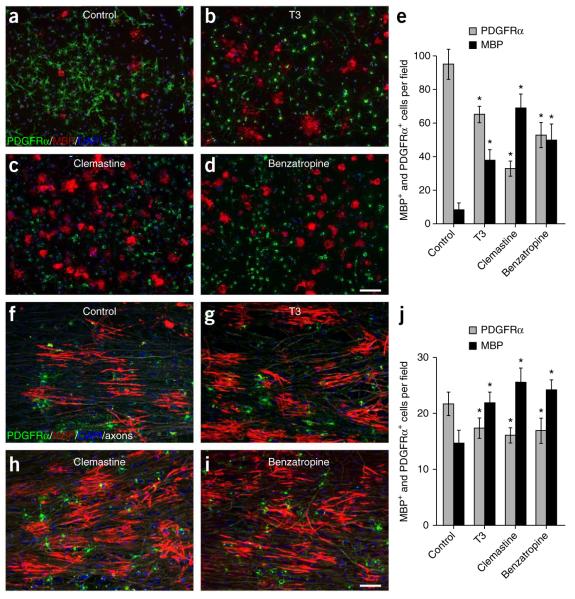
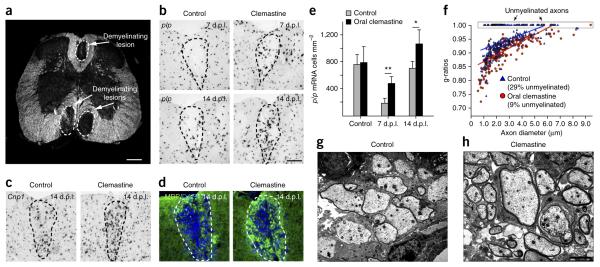
Functional screening for compounds that promote remyelination represents a major hurdle in the development of rational therapeutics for multiple sclerosis. Screening for remyelination is problematic, as myelination requires the presence of axons. Standard methods do not resolve cell-autonomous effects and are not suited for high-throughput formats. Here we describe a binary indicant for myelination using micropillar arrays (BIMA). Engineered with conical dimensions, micropillars permit resolution of the extent and length of membrane wrapping from a single two-dimensional image. Confocal imaging acquired from the base to the tip of the pillars allows for detection of concentric wrapping observed as 'rings' of myelin. The platform is formatted in 96-well plates, amenable to semiautomated random acquisition and automated detection and quantification. Upon screening 1,000 bioactive molecules, we identified a cluster of antimuscarinic compounds that enhance oligodendrocyte differentiation and remyelination. Our findings demonstrate a new high-throughput screening platform for potential regenerative therapeutics in multiple sclerosis.
Figures
Comment in
-
Neurodegenerative diseases: Pillars of remyelination.Nat Rev Drug Discov. 2014 Sep;13(9):651. doi: 10.1038/nrd4416. Epub 2014 Aug 22. Nat Rev Drug Discov. 2014. PMID: 25145590 No abstract available.
-
The best basic science paper in MS in 2013: Antimuscarinic therapies in remyelination.Mult Scler. 2014 Dec;20(14):1814-6. doi: 10.1177/1352458514558679. Epub 2014 Nov 12. Mult Scler. 2014. PMID: 25392329 No abstract available.
References
-
- Franklin RJM. Why does remyelination fail in multiple sclerosis? Nat. Rev. Neurosci. 2002;3:705–714. - PubMed
-
- Keirstead HS, Blakemore W. Identification of post-mitotic oligodendrocytes incapable of remyelination within the demyelinated adult spinal cord. J. Neuropathol. Exp. Neurol. 1997;56:1191–1201. - PubMed
-
- Keirstead HS, Levine JM, Blakemore WF. Response of the oligodendrocyte progenitor cell population (defined by NG2 labelling) to demyelination of the adult spinal cord. Glia. 1998;22:161–170. - PubMed
-
- Scolding N, et al. Oligodendrocyte progenitors are present in the normal adult human CNS and in the lesions of multiple sclerosis. Brain. 1998;121:2221–2228. - PubMed
