. 2014 Jul 8;64(1):66-79.
doi: 10.1016/j.jacc.2014.04.032.

Mutations in SCN10A are responsible for a large fraction of cases of Brugada syndrome

Affiliations

Mutations in SCN10A are responsible for a large fraction of cases of Brugada syndrome

Dan Hu et al. J Am Coll Cardiol. .

Abstract

Background: BrS is an inherited sudden cardiac death syndrome. Less than 35% of BrS probands have genetically identified pathogenic variants. Recent evidence has implicated SCN10A, a neuronal sodium channel gene encoding Nav1.8, in the electrical function of the heart.

Objectives: The purpose of this study was to test the hypothesis that SCN10A variants contribute to the development of Brugada syndrome (BrS).

Methods: Clinical analysis and direct sequencing of BrS susceptibility genes were performed for 150 probands and family members as well as >200 healthy controls. Expression and coimmunoprecipitation studies were performed to functionally characterize the putative pathogenic mutations.

Results: We identified 17 SCN10A mutations in 25 probands (20 male and 5 female); 23 of the 25 probands (92.0%) displayed overlapping phenotypes. SCN10A mutations were found in 16.7% of BrS probands, approaching our yield for SCN5A mutations (20.1%). Patients with BrS who had SCN10A mutations were more symptomatic and displayed significantly longer PR and QRS intervals compared with SCN10A-negative BrS probands. The majority of mutations localized to the transmembrane-spanning regions. Heterologous coexpression of wild-type (WT) SCN10A with WT-SCN5A in HEK cells caused a near doubling of sodium channel current compared with WT-SCN5A alone. In contrast, coexpression of SCN10A mutants (R14L and R1268Q) with WT-SCN5A caused a 79.4% and 84.4% reduction in sodium channel current, respectively. The coimmunoprecipitation studies provided evidence for the coassociation of Nav1.8 and Nav1.5 in the plasma membrane.

Conclusions: Our study identified SCN10A as a major susceptibility gene for BrS, thus greatly enhancing our ability to genotype and risk stratify probands and family members.

Keywords: Brugada syndrome; cardiac arrhythmias; cardiac conduction disease; electrophysiology; genetics; sudden cardiac death.


Figures

Figure 1
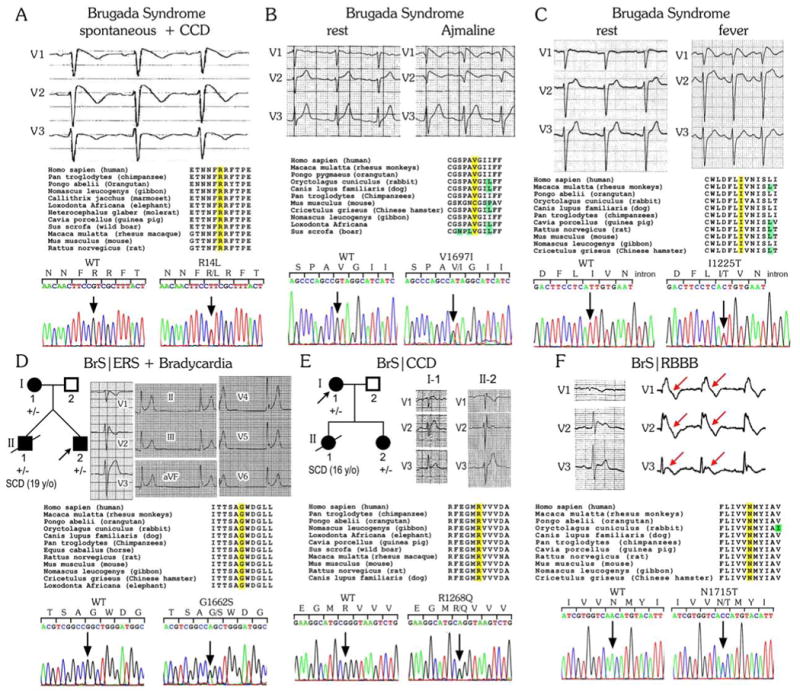
Figure 1. Representative Cases of the Different Brugada Syndrome (BrS) Phenotypes Associated with the SCN10A Mutations/Rare Variants Identified
Each panel shows the ECG phenotype, amino acid alignments of the mutated residue position in a number of mammalian species, and DNA chromatogram of wild-type (WT) and mutant SCN10A. For the pedigrees in panels D&E, +/- denotes heterozygous for the mutation; circles represent female subjects and squares represent male subjects. The arrow denotes the proband. Clinically affected and unaffected subjects are labeled as black and white, respectively. CCD: cardiac conduction disease; ERS= early repolarization syndrome; RBBB= right bundle branch block; SCD= sudden cardiac disease.
Figure 2
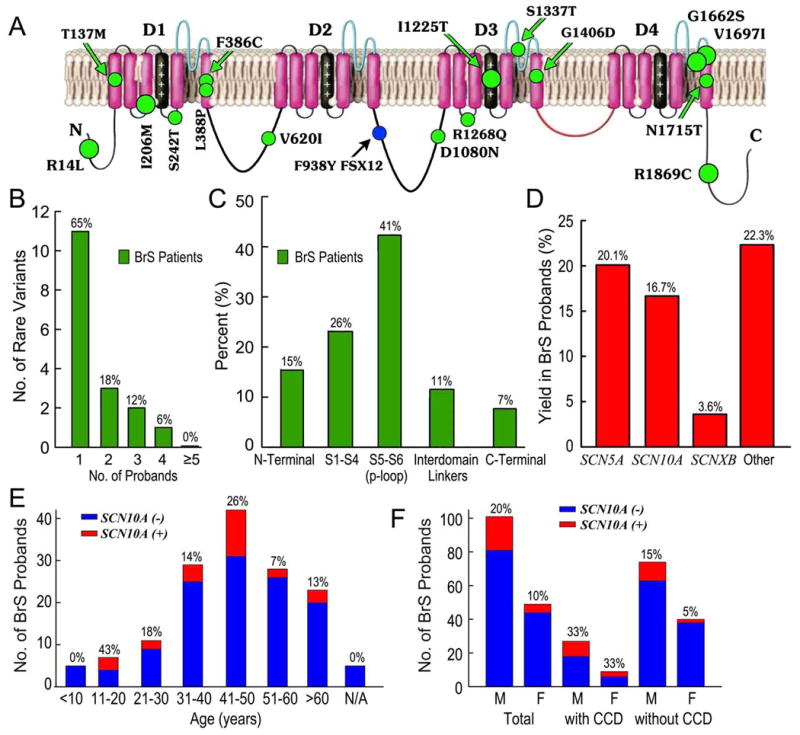
Figure 2. Clinical and Genetic Prevalence of SCN10A Mutations/Rare Variants in probands with Brugada Syndrome (BrS) Identified in the Present Study
A: Schematic showing topology of Nav1.8, the pore-forming α subunit encoded by SCN10A and location of putative BrS-causing variants. B: Frequency distribution of SCN10A mutations/rare variants in BrS cases (green). C: Percentage of mutations/rare variants in BrS cases (green) by location. D: Mutation detection yield by gene in Masonic Medical Research Laboratory BrS cases. E&F: Bar graph showing age and gender distribution of BrS cases. CCD= cardiac conduction disease.
Figure 3
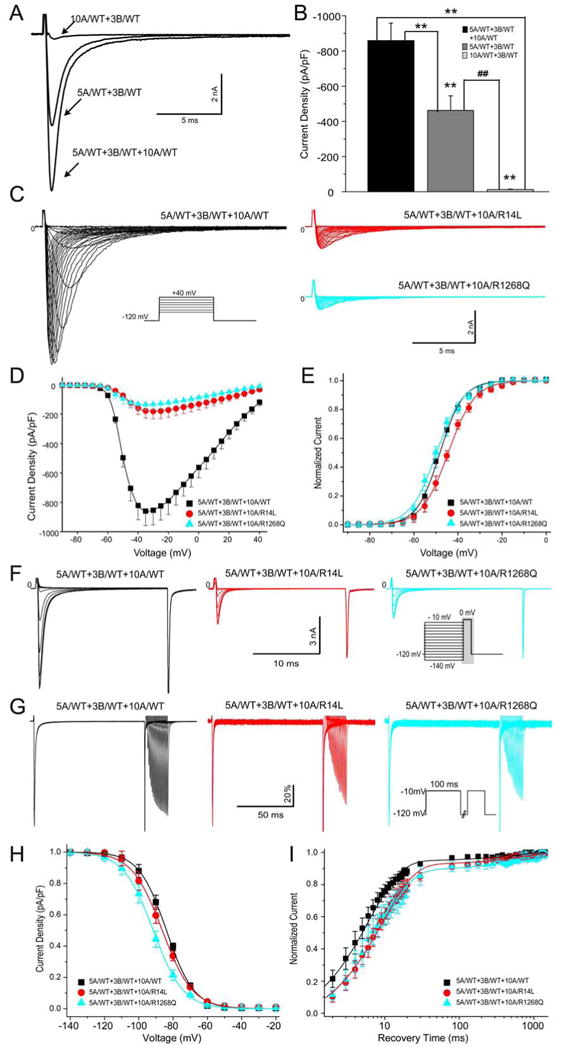
Figure 3. Electrophysiology Effect of SCN10A on Cardiac Sodium Channel Current (INa) when Co-Expressed with SCN5A and SCN3B in HEK293 Cells
A&B: Superimposed traces and bar graph depicting peak INa recorded from co-expression of SCN10A/wild type (WT)+SCN3B/WT, SCN5A/WT+SCN3B/WT and SCN5A/WT+SCN10A/WT+SCN3B/WT. **P<0.01 vs. SCN5A/WT+SCN10A/WT+SCN3B/WT, ##P<0.01 vs. SCN5A/WT+SCN3B/WT. C-E: Representative INa traces, current-voltage relationship and voltage dependence of activation for SCN10A/WT, SCN10A/R14L and SCN10A/R1268Q when co-expressed with SCN5A/WT+SCN3B/WT. F&G: Representative steady-state inactivation and recovery traces recorded from WT and mutant channels. H&I: Boltzmann distributions of voltage-dependent channel inactivation and recovery curve with a double-exponential fit for the 3 groups. All related values and the number of cells used are presented in Table S2 in the Supplemental Materials.
Figure 4
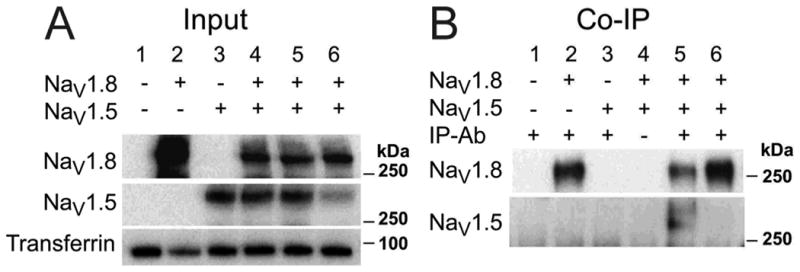
Figure 4. Representative Experiments Demonstrating Physical Interaction between Nav1.8 and Nav1.5
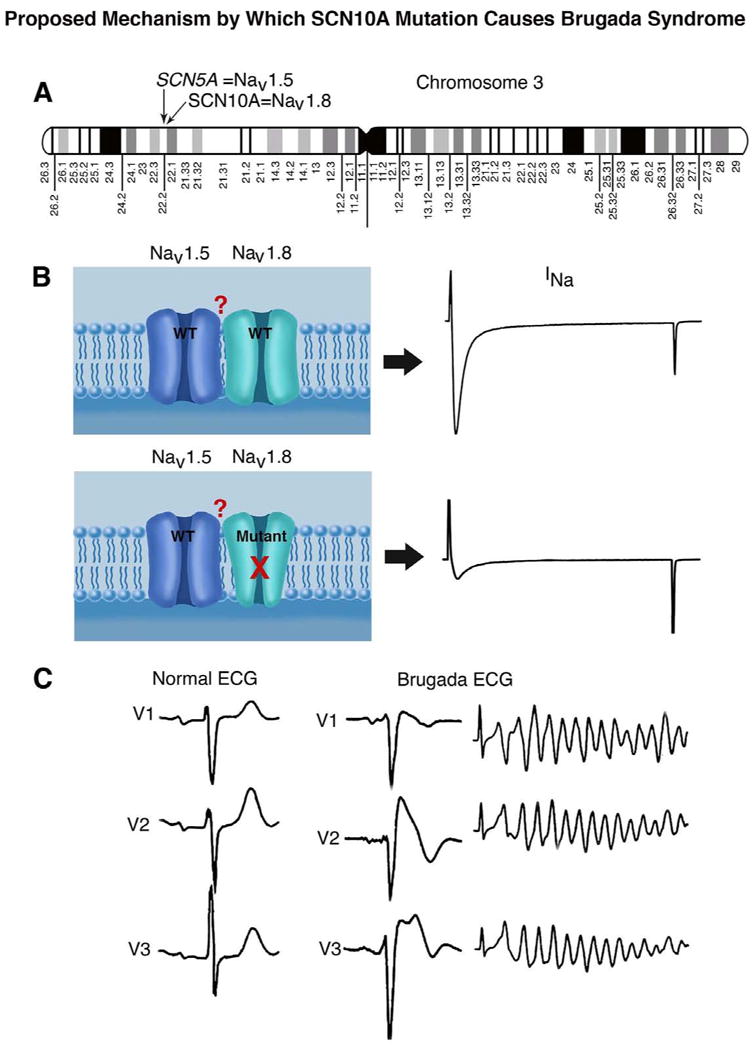
Panel A shows protein input and panel B shows protein isolated by the antibody pull-down co-immunoprecipitation (Co-IP). Lanes 1-6 correspond to the following experimental conditions: (1) non-transfected, (2) Nav1.8 expressed alone, (3) Nav1.5 expressed alone, (4 and 5) Nav1.8 and Nav1.5 co-expressed, (6) mixed lysates from lanes 3 and 4. Panel B shows the pull-down of Nav1.5 is specific to Nav1.8 cellular co-expression. Central Illustration: SCN5A and SCN10A, genes encoding cardiac and neuronal sodium channels, are found in close proximity on chromosome 3 (A). Our study suggests that mutations in SCN10A can lead to a loss of function in sodium channel current (INa) and thus contribute to the manifestation of Brugada syndrome (BrS), a sudden cardiac death syndrome. The data suggest physical association of the two channel proteins (NaV1.5 and NaV1.8) in the plasma membrane (B). Our study identifies SCN10A as a major susceptibility gene for BrS, thus greatly enhancing our capability to genotype and risk stratify probands and family members (C).
Figure 4
Figure 4. Representative Experiments Demonstrating Physical Interaction between Nav1.8 and Nav1.5
Panel A shows protein input and panel B shows protein isolated by the antibody pull-down co-immunoprecipitation (Co-IP). Lanes 1-6 correspond to the following experimental conditions: (1) non-transfected, (2) Nav1.8 expressed alone, (3) Nav1.5 expressed alone, (4 and 5) Nav1.8 and Nav1.5 co-expressed, (6) mixed lysates from lanes 3 and 4. Panel B shows the pull-down of Nav1.5 is specific to Nav1.8 cellular co-expression. Central Illustration: SCN5A and SCN10A, genes encoding cardiac and neuronal sodium channels, are found in close proximity on chromosome 3 (A). Our study suggests that mutations in SCN10A can lead to a loss of function in sodium channel current (INa) and thus contribute to the manifestation of Brugada syndrome (BrS), a sudden cardiac death syndrome. The data suggest physical association of the two channel proteins (NaV1.5 and NaV1.8) in the plasma membrane (B). Our study identifies SCN10A as a major susceptibility gene for BrS, thus greatly enhancing our capability to genotype and risk stratify probands and family members (C).

Comment in

References

    1. Brugada P, Brugada J. Right bundle branch block, persistent ST segment elevation and sudden cardiac death: a distinct clinical and electrocardiographic syndrome: a multicenter report. J Am Coll Cardiol. 1992;20:1391–6. - PubMed
    1. Antzelevitch C, Yan GX. J wave syndromes. HeartRhythm. 2010;7:549–58. - PMC - PubMed
    1. Antzelevitch C. Genetic, molecular and cellular mechanisms underlying the J wave syndromes. Circ J. 2012;76:1054–65. - PMC - PubMed
    1. Hu D, Barajas-Martinez H, Terzic A, et al. ABCC9 is a novel Brugada and early repolarization syndrome susceptibility gene. Int J Cardiol. 2014;171:431–42. - PMC - PubMed
    1. Kapplinger JD, Tester DJ, Alders M, et al. An international compendium of mutations in the SCN5A encoded cardiac sodium channel in patients referred for Brugada syndrome genetic testing. HeartRhythm. 2010;7:33–46. - PMC - PubMed

Publication types

Substances