Review
. 2014 Jun 20:5:276.
doi: 10.3389/fpls.2014.00276. eCollection 2014.

Recent advances in the study of prolamin storage protein organization and function

Affiliations
Review

Recent advances in the study of prolamin storage protein organization and function

David R Holding. Front Plant Sci. .

Abstract

Prolamin storage proteins are the main repository for nitrogen in the endosperm of cereal seeds. These stable proteins accumulate at massive levels due to the high level expression from extensively duplicated genes in endoreduplicated cells. Such abundant accumulation is achieved through efficient packaging in endoplasmic reticulum localized protein bodies in a process that is not completely understood. Prolamins are also a key determinant of hard kernel texture in the mature seed; an essential characteristic of cereal grains like maize. However, deficiencies of key essential amino acids in prolamins result in relatively poor grain protein quality. The inverse relationship between prolamin accumulation and protein quality has fueled an interest in understanding the role of prolamins and other proteins in endosperm maturation. This article reviews recent technological advances that have enabled dissection of overlapping and non-redundant roles of prolamins, particularly the maize zeins. This has come through molecular characterization of mutants first identified many decades ago, selective down-regulation of specific zein genes or entire zein gene families, and most recently through combining deletion mutagenesis with current methods in genome and transcriptome profiling. Works aimed at understanding prolamin deposition and function as well as creating novel variants with improved nutritional and digestibility characteristics, are reported.

Keywords: QPM; deletion_mutagenesis; endosperm; kafirin; prolamin; protein_body; storage_protein; zein.


Figures
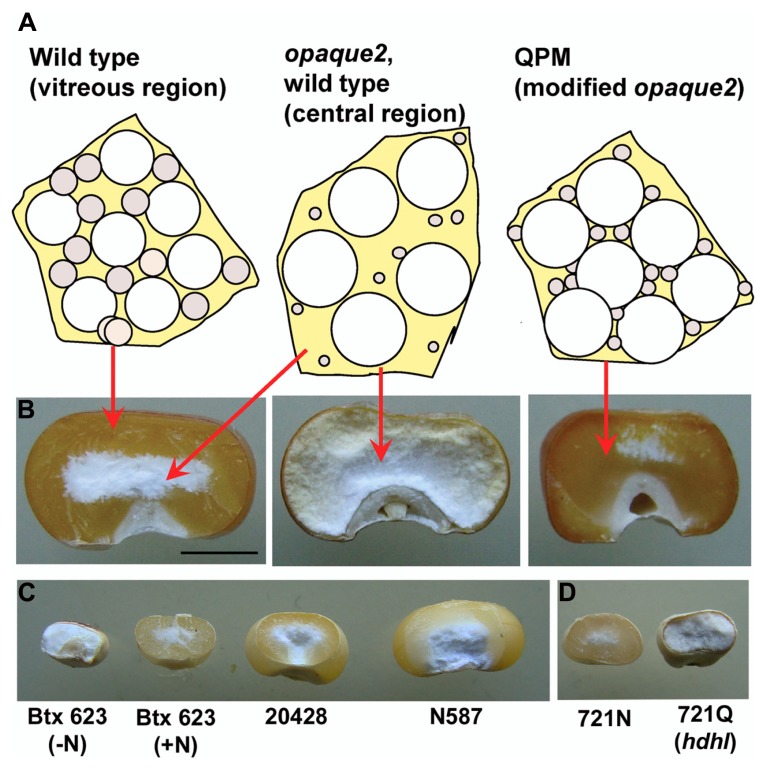
FIGURE 1
FIGURE 1
Vitreous endosperm formation in maize and sorghum kernels. (A) Individual cells of developing endosperm are represented with the relative size and abundance of starch grains (white spheres) and zein protein bodies (gray spheres) that are thought to result in vitreous or opaque endosperm in normal as well as in opaque2 and modified opaque2 (QPM) kernels. (B) Mature kernels of wild type, opaque-2 and QPM cracked in half to reveal extent of vitreous endosperm. (C) Mature sorghum kernels cracked as in B to reveal vitreous endosperm and size variability in sorghum grain. (D) High digestibility high lysine (hdhl) sorghum mutant and its wild type isoline. Scale bar in B is 3 mm and refers to kernels in panels BD.
FIGURE 2
FIGURE 2
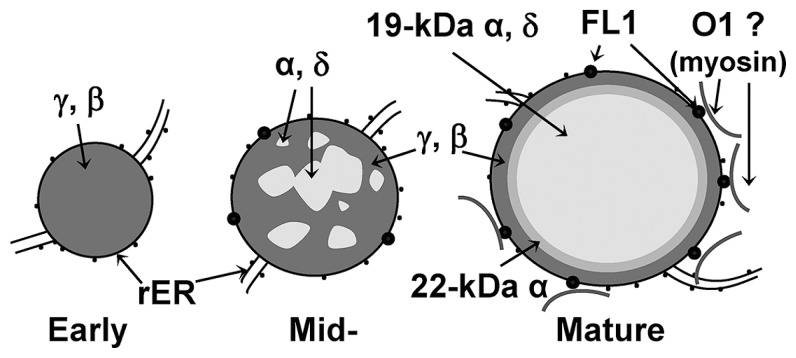
Diagram of zein distribution in early, mid- and mature protein bodies. Small black dots in membrane represent ribosomes while large black dots represent FLOURY1 protein. Curved lines outside protein bodies represent possible direct or indirect interaction with myosin.
FIGURE 3
FIGURE 3
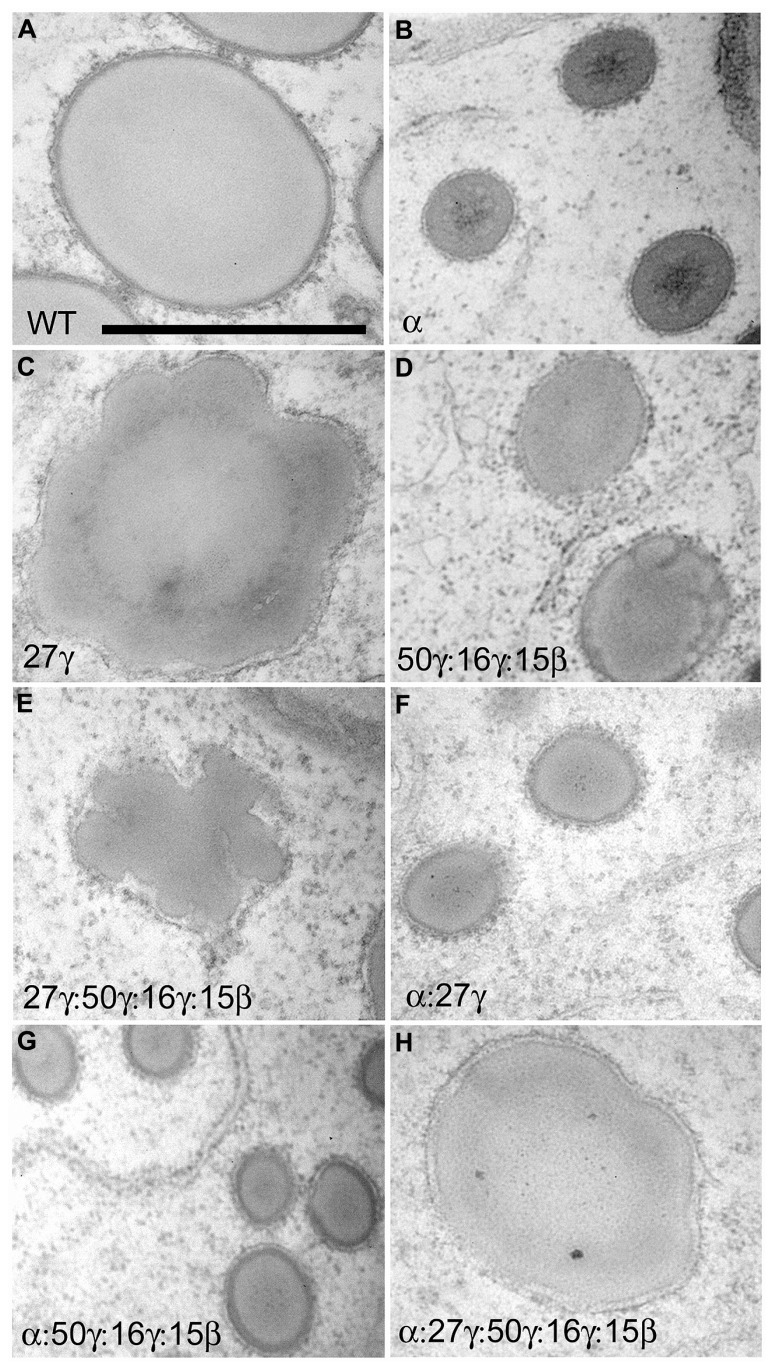
TEM analysis showing protein body size and morphology in the fourth sub-aleurone starchy layer of 18 DAP endosperm in zein RNAi lines and their crosses. Scale bar in A is 1 μm and refers to all panels. RNAi transgenes present are shown in bottom left of each panel in A–H. Figure copyright of American Society of Plant Biologists.
FIGURE 4
FIGURE 4
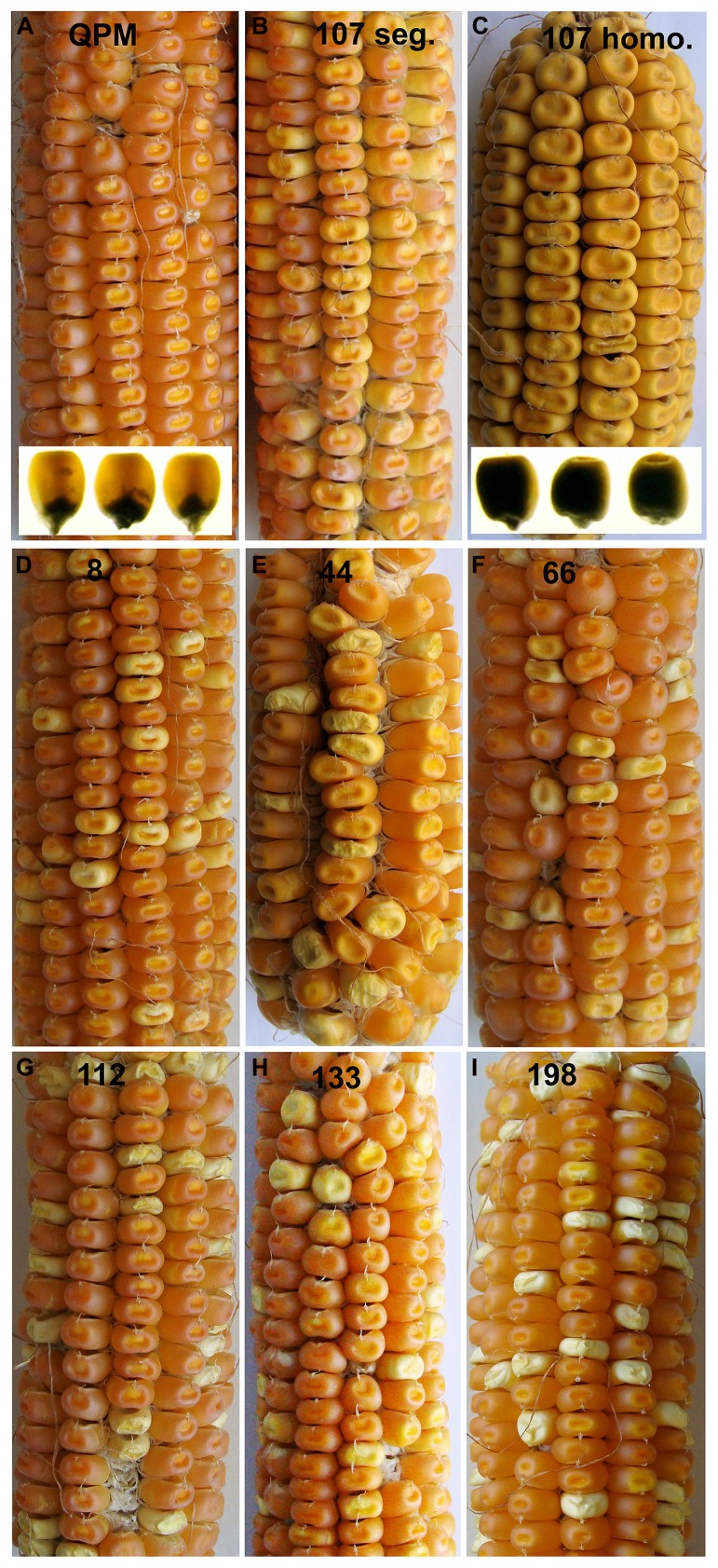
M3 ear phenotypes of selected segregating K0326Y opaque deletion mutants. K0326Y mutant line number is shown at the top center of each panel in A–I. Inserts in A,C show light box phenotypes. Modified from Yuan et al. (2014).
FIGURE 5
FIGURE 5
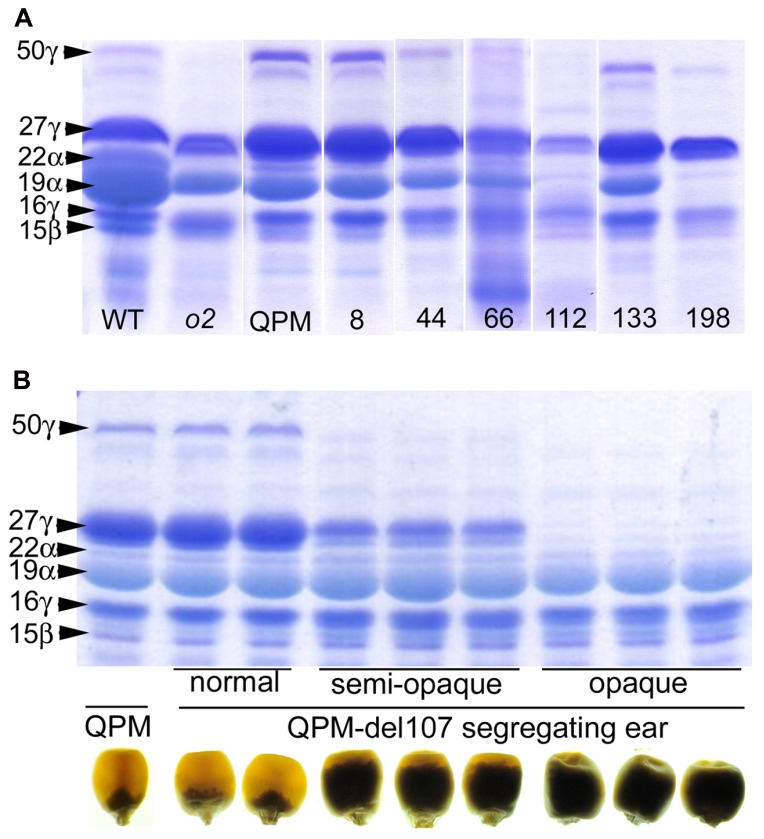
(A) SDS-PAGE zein profiles of selected K0326Y QPM opaque reversion mutants. (B) SDS-PAGE zein profiles and kernel vitreousness phenotypes of QPM, and hemizygous and homozygous line 107 gamma-zein deletion mutants. Modified from Yuan et al. (2014). Originals copyright of American Society of Plant Biologists.

References

    1. Aboubacar A., Axtell J. D., Huang C. P., Hamaker B. R. (2001). A rapid protein digestibility assay for identifying highly digestible sorghum lines. Cereal Chem. 78 160–165 10.1094/Cchem.2001.78.2.160 - DOI
    1. Coleman C. E., Clore A. M., Ranch J. P., Higgins R., Lopes M. A., Larkins B. A. (1997). Expression of a mutant alpha-zein creates the floury2 phenotype in transgenic maize. Proc. Natl. Acad. Sci. U.S.A. 94 7094–7097 10.1073/pnas.94.13.7094 - DOI - PMC - PubMed
    1. Coleman C. E., Larkins B. A. (1999). “The prolamins of maize,” in Seed Proteins edsShewry P., Casey R. (Dordrecht: Kluwer Academic Publishers; ) 109–139 10.1007/978-94-011-4431-5_6 - DOI
    1. Dannenhoffer J. M., Bostwick D. E., Or E., Larkins B. A. (1995). Opaque-15, a maize mutation with properties of a defective opaque-2 modifier. Proc. Natl. Acad. Sci. U.S.A. 92 1931–1935 10.1073/pnas.92.6.1931 - DOI - PMC - PubMed
    1. Duvick D. N. (1961). Protein granules of maize endosperm cells. Cereal Chem. 38 374–385