


Optimal defense strategies in an idealized microbial food web under trade-off between competition and defense
- PMID: 24999739
- PMCID: PMC4084851
- DOI: 10.1371/journal.pone.0101415
Optimal defense strategies in an idealized microbial food web under trade-off between competition and defense
Abstract
Trophic mechanisms that can generate biodiversity in food webs include bottom-up (growth rate regulating) and top-down (biomass regulating) factors. The top-down control has traditionally been analyzed using the concepts of "Keystone Predation" (KP) and "Killing-the-Winner" (KtW), predominately occuring in discussions of macro- and micro-biological ecology, respectively. Here we combine the classical diamond-shaped food web structure frequently discussed in KP analyses and the KtW concept by introducing a defense strategist capable of partial defense. A formalized description of a trade-off between the defense-strategist's competitive and defensive ability is included. The analysis reveals a complex topology of the steady state solution with strong relationships between food web structure and the combination of trade-off, defense strategy and the system's nutrient content. Among the results is a difference in defense strategies corresponding to maximum biomass, production, or net growth rate of invading individuals. The analysis thus summons awareness that biomass or production, parameters typically measured in field studies to infer success of particular biota, are not directly acted upon by natural selection. Under coexistence with a competition specialist, a balance of competitive and defensive ability of the defense strategist was found to be evolutionarily stable, whereas stronger defense was optimal under increased nutrient levels in the absence of the pure competition specialist. The findings of success of different defense strategies are discussed with respect to SAR11, a highly successful bacterial clade in the pelagic ocean.
Conflict of interest statement
Figures
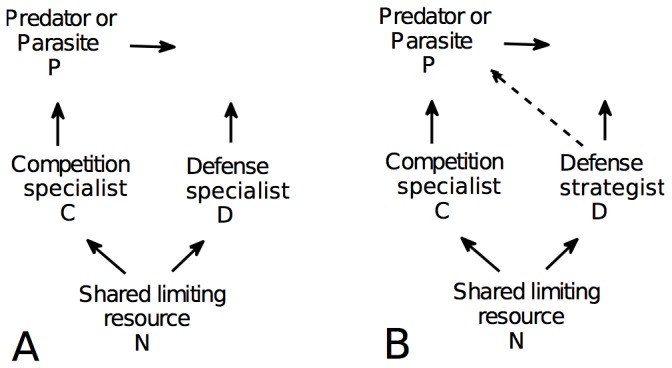
 is the sum of N, C, D and P.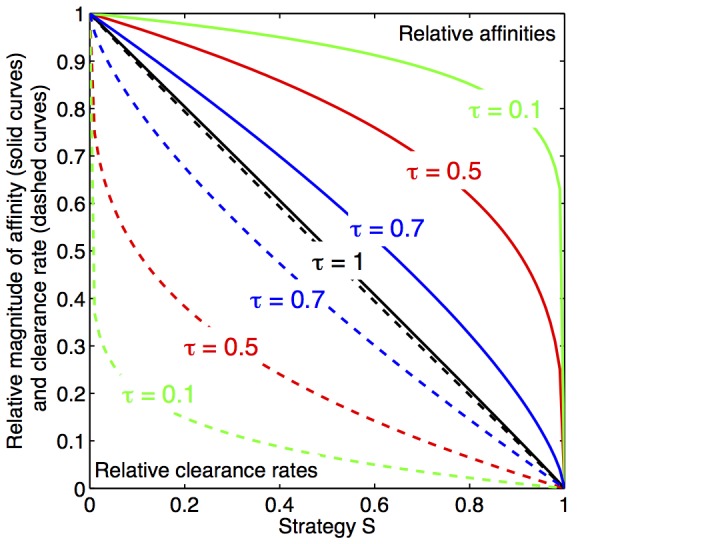
 (
( 0 pure competition,
  1 pure defense). For a trade-off parameter
  of 1 (dashed line), a linear trade-off shape is obtained where the loss in competitive ability (i.e. reduction of affinity of the defense strategist) is proportional to the gain in defense (i.e. the reduction of the predator's clearance rate) as the strategy
  increases. For a trade-off parameter
  below 1 (solid lines, shown for
  ), a trade-off is obtained where the clearance rate drops initially more steeply than the affinity for increasing
  , illustrating that a lot is gained initially in terms of reduced predation for a small reduction in competitive ability. The extension to a high trade-off parameters (
 ) is trivial (i.e. the initial gain in defense is small relative to the loss in competition), but not of interest here since solutions with the defense strategist present only exist for
  (not shown).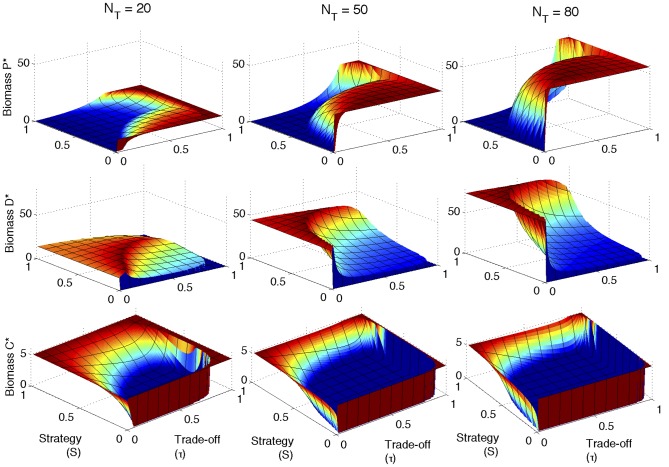
 and trade-off parameter
  for three limiting nutrient contents (
 20, left,
  50, middle, and
  80, right). Other parameters as in Table 2.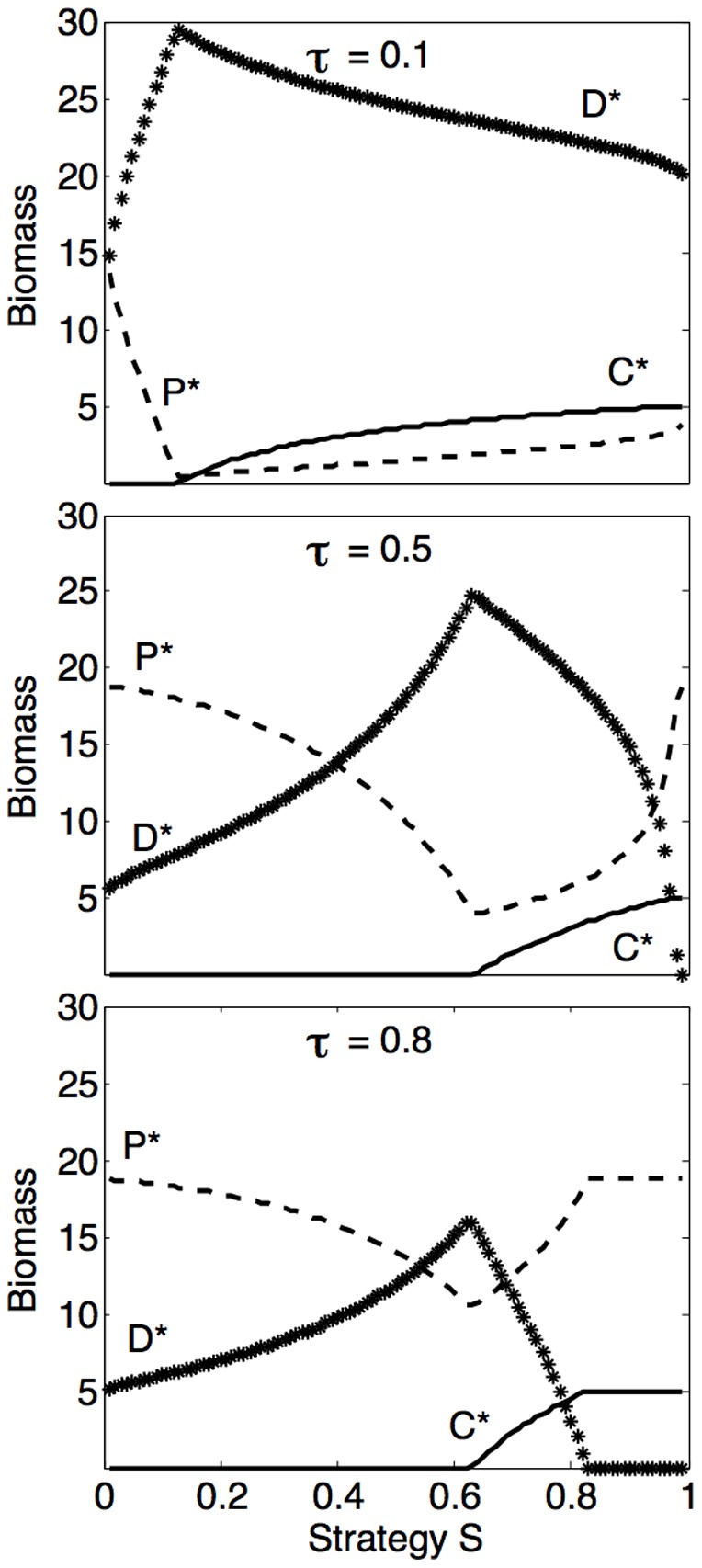
 top,
top,  middle, and
  bottom) for
  Other parameters as in Table 2.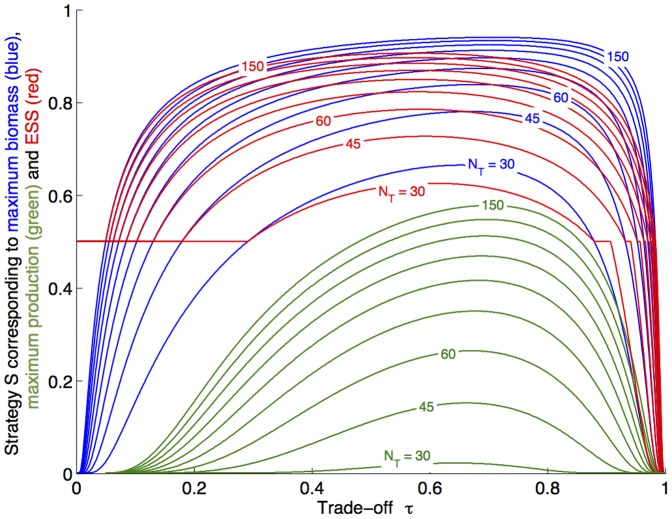
 corresponding to defense strategist's maximum biomass (blue), maximum production (defined as
  , green) and ESS (red) are shown as a function of the trade-off parameter
  for different nutrient contents. The ESS is defined by the maximum net growth rate of a invading mutant, which is found by critical point analysis of the first partial derivative of the net growth rate with respect to strategy
  (see Appendix S1). Different contours show the effect of the total nutrient content
  on the maximizing strategies. Other parameters as in Table 2.
References
-
- Fisher RA (1930) The genetical theory of natural selection. Oxford, UK: Clarendon Press.
-
- Ersel H (2004) Optimal growth under military threat. Defence and Peace Economics 15: 133–143.
-
- Pengerud B, Skjoldal EF, Thingstad TF (1987) The reciprocal interaction between degradation of glucose and ecosystem structure - Studies in mixed chemostat cultures of marine-bacteria, algae, and bacterivorous nanoagellates. Mar Ecol Prog Ser 35 : 64 pp.111–117.
-
- Bohannan BJM, Lenski RE (2000) The relative importance of competition and predation varies with productivity in a model community. Am Nat 156: 329–340. - PubMed
-
- McCauley E, Briand F (1979) Zooplankton grazing and phytoplankton species richness - field-tests of the predation hypothesis. Limnol Ocean 24: 243–252.
Publication types
MeSH terms
LinkOut - more resources
Full Text Sources
Other Literature Sources
