


Sleep disturbances and pain among individuals with prescription opioid dependence
- PMID: 24999989
- PMCID: PMC4324972
- DOI: 10.1016/j.addbeh.2014.05.025
Sleep disturbances and pain among individuals with prescription opioid dependence
Abstract
Background: Poor sleep quality has been observed in individuals with substance use disorders and is often a trigger for relapse. To date, little research has investigated sleep quality among individuals with prescription opioid (PO) dependence. The present study aimed to address this gap in the literature by examining subjective and objective sleep disturbances among PO dependent individuals.
Methods: Subjects were 68 non-treatment seeking individuals (33 PO dependent, 35 healthy controls). Subjective sleep was assessed with the Pittsburgh Sleep Quality Index (PSQI) and Insomnia Severity Index (ISI). Subjects were admitted for an overnight inpatient hospital stay during which objective sleep data was collected using an actigraphy device. Self-report pain was measured with the Brief Pain Inventory.
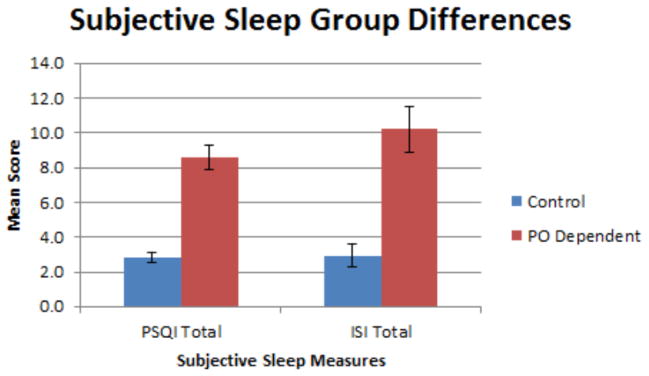
Results: Significant group differences in subjective sleep quality were revealed in the PSQI (p<0.01) and ISI (p<0.01). Poor sleep quality (i.e., PSQI total score>5) was identified in 80.6% of the PO group, as compared to 8.8% of the control group (p<.001). Significant group differences in sleep quality were identified in five of six actigraphy variables: total time asleep, sleep efficiency, latency of onset of sleep, total time awake and time mobile. Furthermore, significant associations between pain severity and sleep quality were observed.
Conclusions: Results indicate high rates of sleep impairment and poor sleep quality among PO dependent individuals. Pain severity was significantly correlated with sleep quality. Although preliminary, the findings highlight the importance of assessing and treating sleep disturbances, as well as pain, among patients with PO dependence.
Keywords: Actigraphy; Opiates; Prescription opioids; Sleep; Sleep disturbance.
Copyright © 2014 Elsevier Ltd. All rights reserved.
Figures
References
-
- Aghajanian GK. Tolerance of locus coeruleus neurones to morphine and suppression of withdrawal response by clonidine. Nature. 1978;276(5684):186–188. - PubMed
-
- Ancoli-Israel S, Cole R, Alessi C, Chambers M, Moorcroft W, Pollak CP. The role of actigraphy in the study of sleep and circadian rhythms. Sleep. 2003;26:342–392. - PubMed
-
- Assad TA, Ghanem MH, Abdel Samee AM, El-Habiby MM. Sleep profile in patients with chronic opioid abuse: A polysomnographic evaluation in an Egyptian sample. Addict Disord Their Treat. 2011;10:21–28.
Publication types
MeSH terms
Grants and funding
LinkOut - more resources
Full Text Sources
Other Literature Sources
Medical
Miscellaneous
