


Levetiracetam for neuropathic pain in adults
- PMID: 25000215
- PMCID: PMC6485608
- DOI: 10.1002/14651858.CD010943.pub2
Levetiracetam for neuropathic pain in adults
Abstract
Background: Antiepileptic drugs have been used in pain management since the 1960s; some have shown efficacy in treating different neuropathic pain conditions. The efficacy of levetiracetam for relief of neuropathic pain has not previously been reviewed.
Objectives: To assess the analgesic efficacy and adverse events of levetiracetam in chronic neuropathic pain conditions in adults.
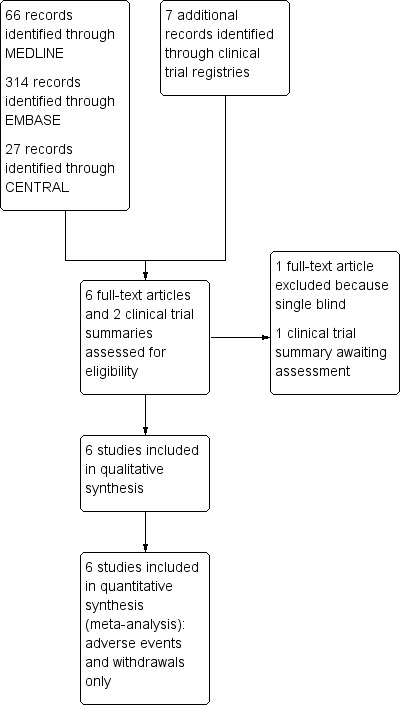
Search methods: We searched the Cochrane Central Register of Controlled Trials (CENTRAL) (2014, Issue 6) (via the Cochrane Library), MEDLINE, EMBASE, and two clinical trials databases (ClinicalTrials.gov. and the World Health Organisation Clinical Trials Registry Platform) to 3 July 2014, together with reference lists of retrieved papers and reviews.
Selection criteria: We included randomised, double-blind studies of two weeks duration or longer, comparing levetiracetam with placebo or another active treatment in adults with chronic neuropathic pain conditions. Studies had to have a minimum of 10 participants per treatments arm.
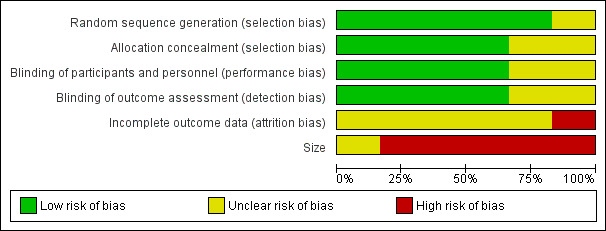
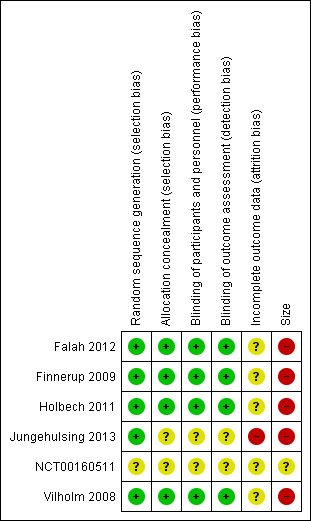
Data collection and analysis: Two review authors independently extracted efficacy and adverse event data, and examined issues of study quality. We performed analysis using three tiers of evidence. First tier evidence derived from data meeting current best standards and subject to minimal risk of bias (outcome equivalent to substantial pain intensity reduction; intention-to-treat analysis without imputation for dropouts; at least 200 participants in the comparison; 8 to 12 weeks duration; parallel design); second tier evidence from data that failed to meet one or more of these criteria and that we considered at some risk of bias but with at least 200 participants in the comparison; and third tier evidence from data involving fewer than 200 participants that was considered very likely to be biased or used outcomes of limited clinical utility, or both.
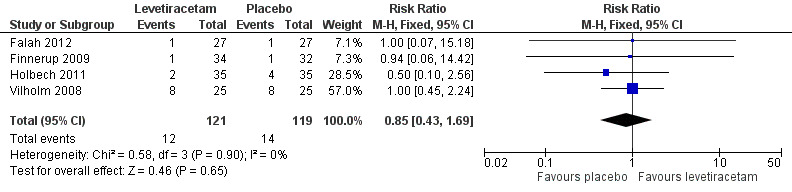
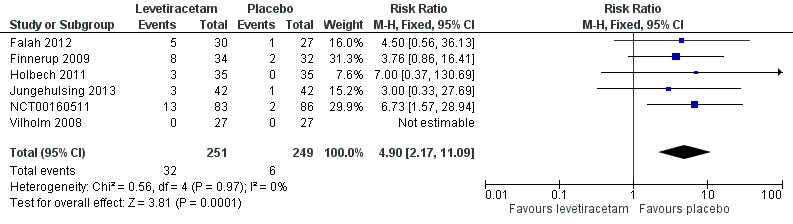
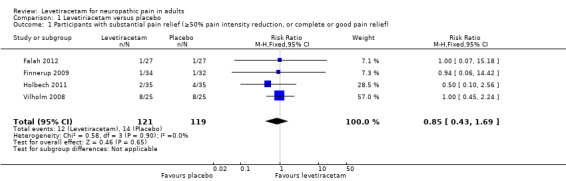
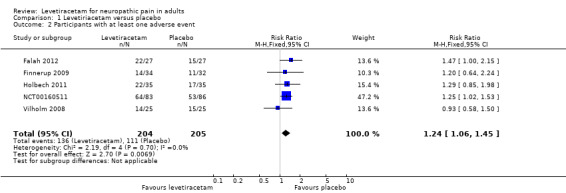
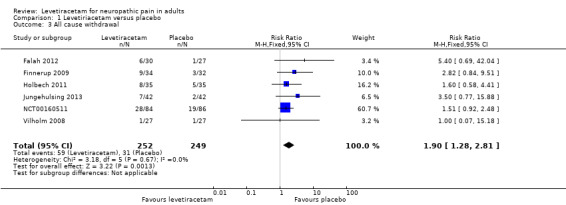
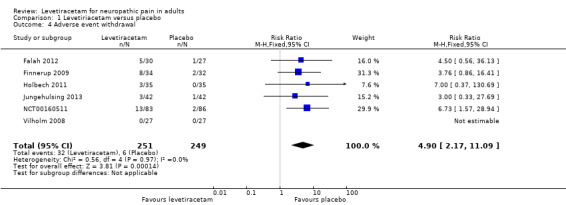
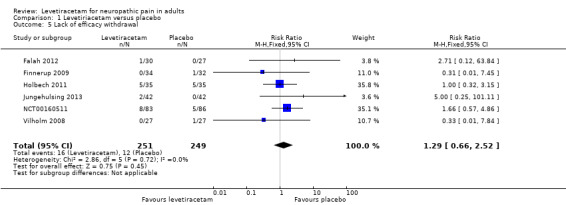
Main results: We included six studies: five small, cross-over studies with 174 participants, and one parallel group study with 170 participants. Participants were treated with levetiracetam (2000 mg to 3000 mg daily) or placebo for between four and 14 weeks. Each study included participants with a different type of neuropathic pain; central pain due to multiple sclerosis, pain following spinal cord injury, painful polyneuropathy, central post-stroke pain, postherpetic neuralgia, and post-mastectomy pain.None of the included studies provided first or second tier evidence. The evidence was very low quality, downgraded because of the small size of the treatment arms, and because studies reported results using last observation carried forward (LOCF) imputation for withdrawals or using only participants who completed the study according to the protocol, where there were greater than 10% withdrawals. There were insufficient data for a pooled efficacy analysis in particular neuropathic pain conditions, but individual studies did not show any analgesic effect of levetiracetam compared with placebo. We did pool results for any outcome considered substantial pain relief (≥ 50% pain intensity reduction or 'complete' or 'good' responses on the verbal rating scale) for four studies with dichotomous data; response rates across different types of neuropathic pain was similar with levetiracetam (10%) and placebo (12%), with no statistical difference (risk ratio 0.9; 95% confidence interval (CI) 0.4 to1.7).We pooled data across different conditions for adverse events and withdrawals. Based on very limited data, significantly more participants experienced an adverse event with levetiracetam than with placebo (number needed to treat for an additional harmful event (NNH) 8.0 (95% CI 4.6 to 32)). There were significantly more adverse event withdrawals with levetiracetam (NNH 9.7 (6.7 to 18)).
Authors' conclusions: The amount of evidence for levetiracetam in neuropathic pain conditions was very small and potentially biased because of the methods of analysis used in the studies. There was no indication that levetiracetam was effective in reducing neuropathic pain, but it was associated with an increase in participants who experienced adverse events and who withdrew due to adverse events.
Conflict of interest statement
SD and PW have received research support from charities, government, and industry sources at various times, but none relate to this review.
RAM has consulted for various pharmaceutical companies and received lecture fees from pharmaceutical companies related to analgesics and other healthcare interventions, including (in the past five years) AstraZeneca, Eli Lilly and Company, Flynn Pharma, Futura Medical, Grünenthal, GlaxoSmithKline (GSK), Horizon Pharma, Lundbeck, Menarini, MSD, Pfizer, Reckitt Benckiser, Sanofi Aventis, Urgo, Astellas, and Vifor Pharma. He has no interests to declare related to this review.
MPL has received honoraria for consultation from Baxter Pharmaceuticals, CSL Behring, and LfB, and he has received a travel support grant from Grifols. He has no interests to declare related to this review.
Figures
Update of
References
References to studies included in this review
Falah 2012 {published data only}
Finnerup 2009 {published data only}
Holbech 2011 {published data only}
Jungehulsing 2013 {published data only}
-
- Jungehulsing GJ, Israel H, Safar N, Taskin B, Nolte CH, Brunecker P, et al. Levetiracetam in patients with central neuropathic post‐stroke pain‐‐a randomized, double‐blind, placebo‐controlled trial. European Journal of Neurology 2013;20(2):331‐7. [DOI: 10.1111/j.1468-1331.2012.03857.x] - DOI - PubMed
NCT00160511 {unpublished data only}
-
- A 16 Week Study Evaluating Levetiracetam in the Treatment of Post Herpetic Neuralgia (PHN). www.clinicaltrials.gov 2013. [NCT: 00160511]
References to studies excluded from this review
Rossi 2009 {published data only}
References to studies awaiting assessment
NCT00156689 {unpublished data only}
-
- A Study to Determine if Levetiracetam Will Assist Those Suffering From Chronic Idiopathic Axonal Polyneuropathy. www.clinicaltrials.gov 2008. [NCT: 00156689]
Additional references
Apkarian 2011
AUREF 2012
-
- PaPaS author and referee guidance. http://papas.cochrane.org/papas‐documents (accessed 22 January 2013).
Baron 2010
Baron 2012
Bouhassira 2008
Derry 2012
Derry 2013
Dworkin 2008
Elbourne 2002
Gustorff 2008
Hall 2008
Higgins 2011
-
- Higgins JPT, Green S (editors). Chapter 8: Assessing risk of bias in included studies. In: Higgins JPT, Altman DG, Sterne JAC editor(s). Cochrane Handbook for Systematic Reviews of Interventions Version 5.1.0 [updated March 2011]. The Cochrane Collaboration, 2011. Available from www.cochrane‐handbook.org.
Jadad 1996
-
- Jadad AR, Moore RA, Carroll D, Jenkinson C, Reynolds DJ, Gavaghan DJ, et al. Assessing the quality of reports of randomized clinical trials: is blinding necessary?. Controlled Clinical Trials 1996;17(1):1‐12. [DOI: ] - PubMed
Jensen 2011
Kalso 2013
Katusic 1991
-
- Katusic S, Williams DB, Beard CM, Bergstralh EJ, Kurland LT. Epidemiology and clinical features of idiopathic trigeminal neuralgia and glossopharyngeal neuralgia: similarities and differences, Rochester, Minnesota,1945‐1984. Neuroepidemiology 1991;10:276‐81. - PubMed
Khaliq 2007
Khan 1996
-
- Khan KS, Daya S, Jadad A. The importance of quality of primary studies in producing unbiased systematic reviews. Archives of Internal Medicine 1996;156(6):661‐6. - PubMed
Koopman 2009
L'Abbé 1987
-
- L'Abbé KA, Detsky AS, O'Rourke K. Meta‐analysis in clinical research. Annals of Internal Medicine 1987;107:224‐33. - PubMed
Lunn 2014
Mbzivo 2012
McQuay 1998
-
- McQuay H, Moore R. An evidence‐based resource for pain relief. Oxford: Oxford University Press, 1998.
McQuay 2007
-
- McQuay HJ, Smith LA, Moore RA. Chronic Pain. In: Stevens A, Raftery J, Mant J, Simpson S editor(s). Health Care Needs Assessment. 3rd Edition. Oxford: Radcliffe Publishing, 2007. [ISBN: 978‐1‐84619‐063‐6]
Moisset 2007
Moore 1998
Moore 2008
-
- Moore RA, Barden J, Derry S, McQuay HJ. Managing potential publication bias. In: McQuay HJ, Kalso E, Moore RA editor(s). Systematic Reviews in Pain Research: Methodology Refined. Seattle: IASP Press, 2008:15‐24. [ISBN: 978–0–931092–69–5]
Moore 2009
Moore 2010a
-
- Moore RA, Eccleston C, Derry S, Wiffen P, Bell RF, Straube S, et al. "Evidence" in chronic pain ‐ establishing best practice in the reporting of systematic reviews. Pain 2010;150(3):386‐9. [DOI: ] - PubMed
Moore 2010b
Moore 2010c
-
- Moore RA, Moore OA, Derry S, Peloso PM, Gammaitoni AR, Wang H. Responder analysis for pain relief and numbers needed to treat in a meta‐analysis of etoricoxib osteoarthritis trials: bridging a gap between clinical trials and clinical practice. Annals of the Rheumatic Diseases 2010;69(2):374‐9. [DOI: ] - PMC - PubMed
Moore 2010d
Moore 2010e
-
- Moore RA, Smugar SS, Wang H, Peloso PM, Gammaitoni A. Numbers‐needed‐to‐treat analyses‐‐do timing, dropouts, and outcome matter? Pooled analysis of two randomized, placebo‐controlled chronic low back pain trials. Pain 2010;151(3):592‐7. [DOI: ] - PubMed
Moore 2011
Moore 2011b
-
- Moore RA, Straube S, Paine J, Derry S, McQuay HJ. Minimum efficacy criteria for comparisons between treatments using individual patient meta‐analysis of acute pain trials: examples of etoricoxib, paracetamol, ibuprofen, and ibuprofen/paracetamol combinations after third molar extraction. Pain 2011;152(5):982‐9. [DOI: ] - PubMed
Moore 2011c
Moore 2012a
Moore 2012b
Moore 2013a
Moore 2013b
Moore 2013c
Moore 2013d
NICE 2013
-
- Draft Guidance. National Institute for Health and Clinical Excellence (2013) Neuropathic pain – pharmacological management: the pharmacological management of neuropathic pain in adults in non‐specialist settings. National Institute for Health and Care Excellence Accessed August 2013. [www.nice.org.uk/nicemedia/live/13566/64189/64189.pdf ]
O'Brien 2010
O'Connor 2009
Rappaport 1994
RevMan 2012 [Computer program]
-
- The Nordic Cochrane Centre, The Cochrane Collaboration. Review Manager (RevMan). Version 5.2. Copenhagen: The Nordic Cochrane Centre, The Cochrane Collaboration, 2012.
Soni 2013
SPC 2013
-
- electronic Medicines Compendium: Keppra. www.medicines.org.uk/emc/medicine/16231/SPC/Keppra+250%2c500%2c750+and+1... Accessed 02.12.2013.
Straube 2008
-
- Straube S, Derry S, McQuay HJ, Moore RA. Enriched enrollment: definition and effects of enrichment and dose in trials of pregabalin and gabapentin in neuropathic pain. A systematic review. British Journal of Clinical Pharmacology 2008;66(2):266‐75. [DOI: 10.1111/j.1365-2125.2008.03200.x] - DOI - PMC - PubMed
Straube 2010
Torrance 2006
Tracey 2011
-
- Tracey I. Can neuroimaging studies identify pain endophenotypes in humans?. Nature Reviews Neurology 2011;7(3):173‐81. [doi: 10.1038/nrneurol.2011.4] - PubMed
Treede 2008
van Hecke 2014
von Hehn 2012
Vos 2012
-
- Vos T, Flaxman AD, Naghavi M, Lozano R, Michaud C, Ezzati M, et al. Years lived with disability (YLDs) for 1160 sequelae of 289 diseases and injuries 1990–2010: a systematic analysis for the Global Burden of Disease Study 2010. Lancet 2012;380(9859):2163‐96. [DOI: 10.1016/S0140-6736(12)61729-2] - DOI - PMC - PubMed
Wakita 2013
-
- Wakita M, Kotani N, Kogure K, Akaike N. Inhibition of excitatory synaptic transmission in hippocampal neurons by levetiracetam involves Zn2+‐dependentGABAA receptor‐mediated presynaptic modulation. Journal of Pharmacology and Experimental Therapeutics 2013;Nov 20:Epub ahead of print. [PUBMED: 24259680] - PubMed
Publication types
MeSH terms
Substances
Grants and funding
LinkOut - more resources
Full Text Sources
Other Literature Sources
