. 2014 Sep;58(9):5478-91.
doi: 10.1128/AAC.03339-14. Epub 2014 Jul 7.

Binding mode characterization of NBD series CD4-mimetic HIV-1 entry inhibitors by X-ray structure and resistance study

Affiliations

Binding mode characterization of NBD series CD4-mimetic HIV-1 entry inhibitors by X-ray structure and resistance study

Francesca Curreli et al. Antimicrob Agents Chemother. 2014 Sep.

Abstract

We previously identified two small-molecule CD4 mimetics--NBD-556 and NBD-557--and synthesized a series of NBD compounds that resulted in improved neutralization activity in a single-cycle HIV-1 infectivity assay. For the current investigation, we selected several of the most active compounds and assessed their antiviral activity on a panel of 53 reference HIV-1 Env pseudoviruses representing diverse clades of clinical isolates. The selected compounds inhibited tested clades with low-micromolar potencies. Mechanism studies indicated that they act as CD4 agonists, a potentially unfavorable therapeutic trait, in that they can bind to the gp120 envelope glycoprotein and initiate a similar physiological response as CD4. However, one of the compounds, NBD-09027, exhibited reduced agonist properties, in both functional and biophysical studies. To understand the binding mode of these inhibitors, we first generated HIV-1-resistant mutants, assessed their behavior with NBD compounds, and determined the X-ray structures of two inhibitors, NBD-09027 and NBD-10007, in complex with the HIV-1 gp120 core at ∼2-Å resolution. Both studies confirmed that the NBD compounds bind similarly to NBD-556 and NBD-557 by inserting their hydrophobic groups into the Phe43 cavity of gp120. The basic nitrogen of the piperidine ring is located in close proximity to D368 of gp120 but it does not form any H-bond or salt bridge, a likely explanation for their nonoptimal antagonist properties. The results reveal the structural and biological character of the NBD series of CD4 mimetics and identify ways to reduce their agonist properties and convert them to antagonists.


Figures

FIG 1
FIG 1
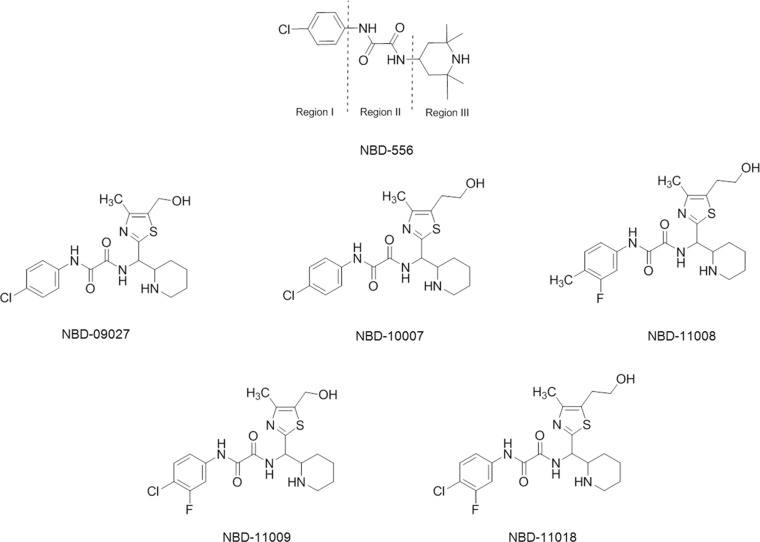
Chemical structures of NBD series compounds. The locations of regions I, II, and III are shown for NBD-556.
FIG 2
FIG 2
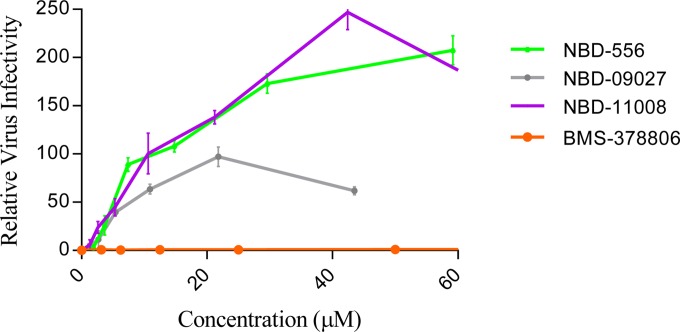
Infectivity of CD4-negative CCR5-positive cells by CD4-dependent virus. CD4-negative Cf2Th-CCR5 cells were infected with recombinant HIV-1 CD4-dependent NL4-3–ADA-Luc in the presence of increasing concentrations of NBD-556, NBD-09027, NBD-11008, and BMS-378806. Ther relative virus infectivity specifies the amount of infection detected in the presence of a compound relative to the infection detected in the absence of that compound. Three independent experiments were performed in triplicate, and the values represent the means ± standard deviations.
FIG 3
FIG 3
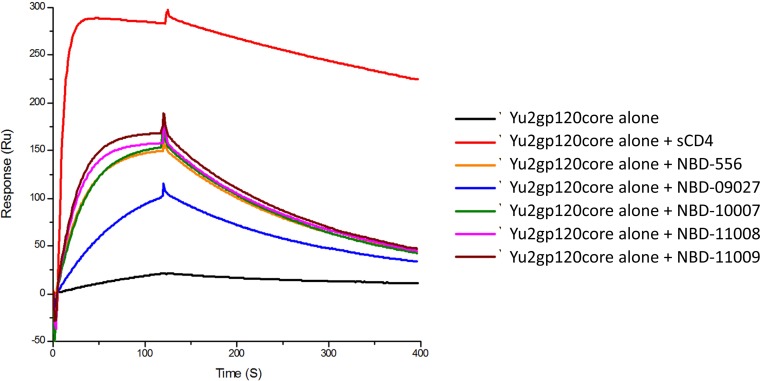
Impact of NBD series compounds on the binding between MAb 17b and YU2 core gp120 protein. The YU2 core gp120 was passed over the anti-human IgG-captured 17b in the absence or presence of saturated NBD series compounds or sCD4 (control). The injection time was 2 min and the disassociation time was 5 min. The graph is representative of results from two independent experiments.
FIG 4
FIG 4
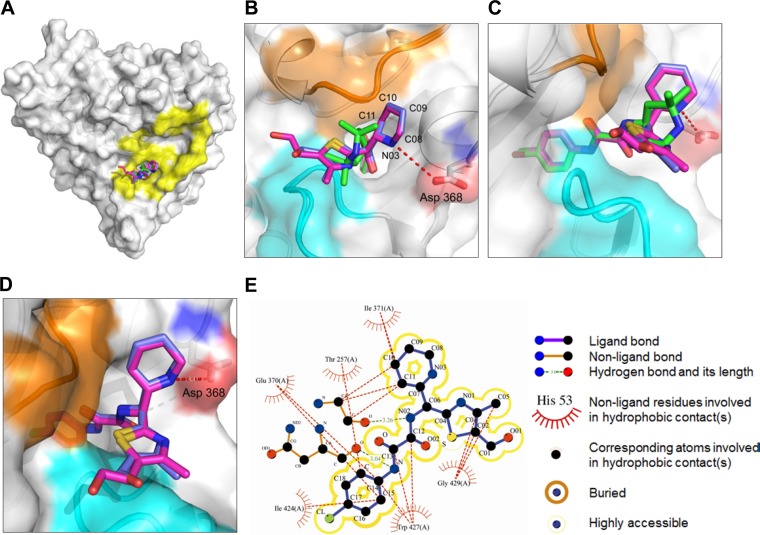
Crystal structures of HIV-1 gp120 in complexes with NBD-09027 and NBD-10007. (A) Superposition of NBD-557 (green), NBD-09027 (light blue), and NBD-10007 (purple) in the Phe43 cavity of gp120 (surface representation). CD4 binding footprints are shown in yellow. (B) Close-up view of the Phe43 cavity in panel A. The three major areas to which the small molecules are in close proximity are highlighted in cyan, orange, and red for the tip of β20–21 (gp120 residues 426 to 429), the outer domain to the inner domain exit loop (gp120 residues 472 to 474), and Asp 368 on gp120, respectively. (C) Close-up view of the Phe43 cavity with NBD-557, NBD-09027, and NBD-10007 superimposed. (D) Close-up view of NBD-09027 and NBD-10007 superimposed. The tetramethyl piperidine ring of NBD-557 and its equivalent for NBD-09027 and NBD-10007 resides outside the Phe43 cavity. (E) Schematic diagram of interactions between NBD-09027 and residues on gp120.

References

    1. Cooley LA, Lewin SR. 2003. HIV-1 cell entry and advances in viral entry inhibitor therapy. J. Clin. Virol. 26:121–132. 10.1016/S1386-6532(02)00111-7 - DOI - PubMed
    1. Jiang S, Debnath AK. 2000. Development of HIV entry inhibitors targeted to the coiled coil regions of gp41. Biochem. Biophys. Res. Commun. 269:641–646. 10.1006/bbrc.1999.1972 - DOI - PubMed
    1. Singh IP, Chauthe SK. 2011. Small molecule HIV entry inhibitors. Part II. Attachment and fusion inhibitors: 2004–2010. Expert. Opin. Ther. Pat. 21:399–416 - PubMed
    1. Duffalo ML, James CW. 2003. Enfuvirtide: a novel agent for the treatment of HIV-1 infection. Ann. Pharmacother. 37:1448–1456. 10.1345/aph.1D143 - DOI - PubMed
    1. Lieberman-Blum SS, Fung HB, Bandres JC. 2008. Maraviroc: a CCR5-receptor antagonist for the treatment of HIV-1 infection. Clin. Ther. 30:1228–1250. 10.1016/S0149-2918(08)80048-3 - DOI - PubMed

Publication types

Substances

Associated data

LinkOut - more resources