


TRP14 inhibits osteoclast differentiation via its catalytic activity
- PMID: 25002534
- PMCID: PMC4135626
- DOI: 10.1128/MCB.00293-14
TRP14 inhibits osteoclast differentiation via its catalytic activity
Abstract
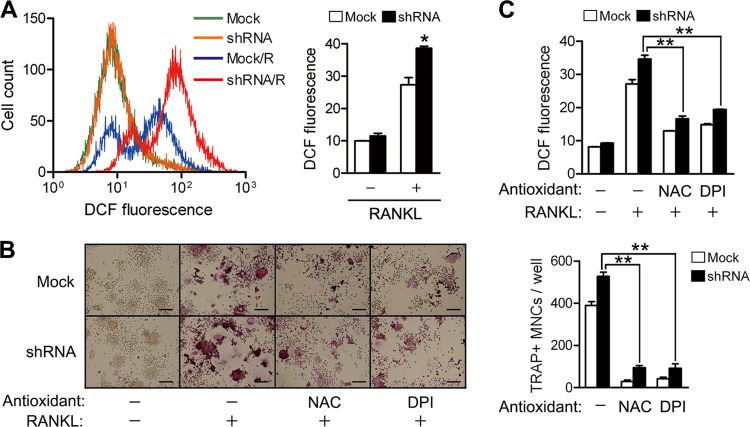
We previously reported the inhibitory role of thioredoxin-related protein of 14 kDa (TRP14), a novel disulfide reductase, in nuclear factor-κB (NF-κB) activation, but its biological function has remained to be explored. Here, we evaluated the role of TRP14 in the differentiation and function of osteoclasts (OCs), for which NF-κB and cellular redox regulation have been known to be crucial, using RAW 264.7 macrophage cells expressing wild-type TRP14 or a catalytically inactive mutant, as well as its small interfering RNA. TRP14 depletion enhanced OC differentiation, actin ring formation, and bone resorption, as well as the accumulation of reactive oxygen species (ROS). TRP14 depletion promoted the activation of NF-κB, c-Jun NH2-terminal kinase, and p38, the expression of c-Fos, and the consequent induction of nuclear factor of activated T cell, cytoplasmic 1 (NFATc1), a key determinant of osteoclastogenesis. However, pretreatment with N-acetylcysteine or diphenylene iodonium significantly reduced the OC differentiation, as well as the ROS accumulation and NF-κB activation, that were enhanced by TRP14 depletion. Furthermore, receptor activator of NF-κB ligand (RANKL)-induced ROS accumulation, NF-κB activation, and OC differentiation were inhibited by the ectopic expression of wild-type TRP14 but not by its catalytically inactive mutant. These results suggest that TRP14 regulates OC differentiation and bone resorption through its catalytic activity and that enhancing TRP14 may present a new strategy for preventing bone resorption diseases.
Copyright © 2014, American Society for Microbiology. All Rights Reserved.
Figures




References
-
- Wong BR, Rho J, Arron J, Robinson E, Orlinick J, Chao M, Kalachikov S, Cayani E, Bartlett FS, III, Frankel WN, Lee SY, Choi Y. 1997. TRANCE is a novel ligand of the tumor necrosis factor receptor family that activates c-Jun N-terminal kinase in T cells. J. Biol. Chem. 272:25190–25194. 10.1074/jbc.272.40.25190 - DOI - PubMed
-
- Yasuda H, Shima N, Nakagawa N, Yamaguchi K, Kinosaki M, Mochizuki S, Tomoyasu A, Yano K, Goto M, Murakami A, Tsuda E, Morinaga T, Higashio K, Udagawa N, Takahashi N, Suda T. 1998. Osteoclast differentiation factor is a ligand for osteoprotegerin/osteoclastogenesis-inhibitory factor and is identical to TRANCE/RANKL. Proc. Natl. Acad. Sci. U. S. A. 95:3597–3602. 10.1073/pnas.95.7.3597 - DOI - PMC - PubMed
Publication types
MeSH terms
Substances
LinkOut - more resources
Full Text Sources
Other Literature Sources
Molecular Biology Databases
Miscellaneous
