


Functional antagonism between high temperature requirement protein A (HtrA) family members regulates trophoblast invasion
- PMID: 25002585
- PMCID: PMC4132796
- DOI: 10.1074/jbc.M114.576744
Functional antagonism between high temperature requirement protein A (HtrA) family members regulates trophoblast invasion
Abstract
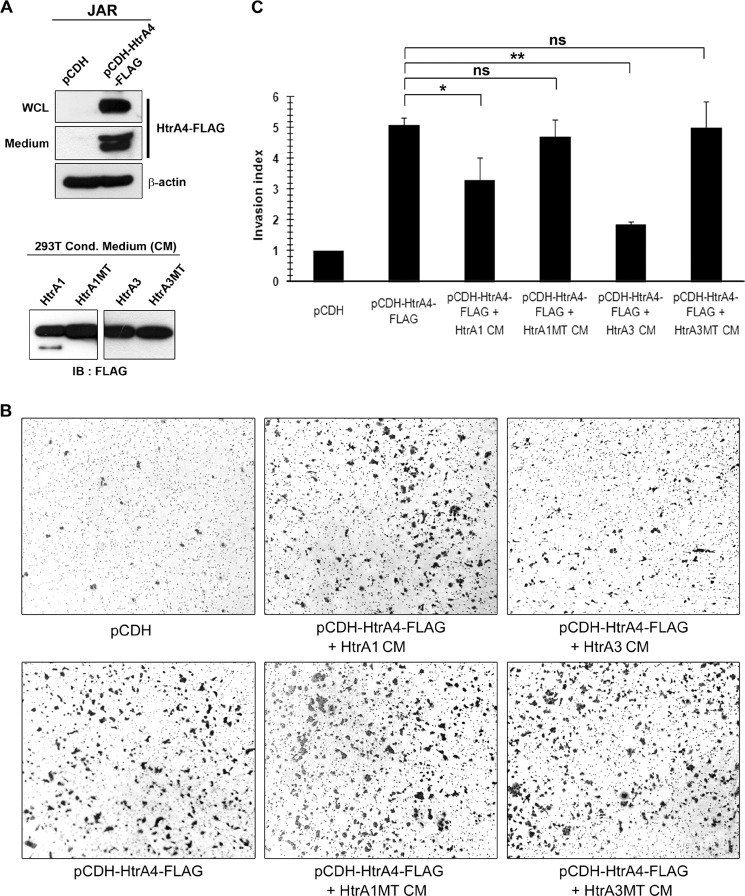
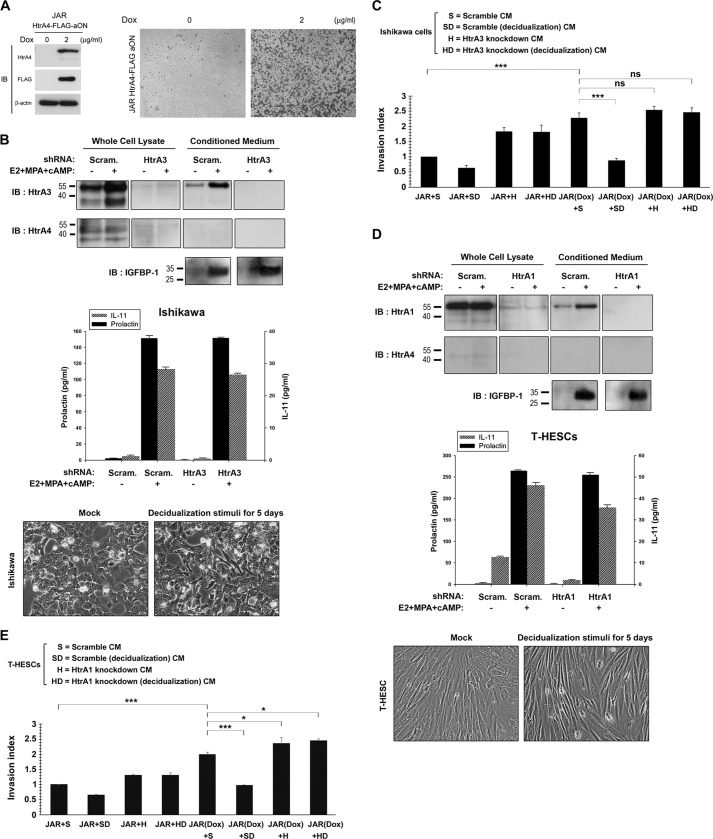
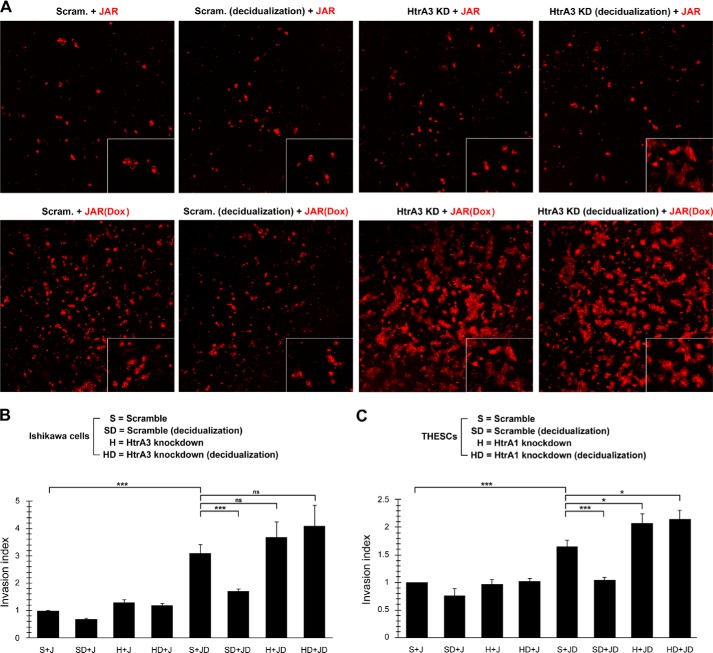
Human trophoblast invasion of decidualized endometrium is essential for placentation and is tightly regulated and involves trophoblast-decidual cell interaction. High temperature requirement A4 (HtrA4) is a secreted serine protease highly expressed in the invasive extravillous trophoblasts that invade decidua. In contrast, both HtrA1 and HtrA3 have been shown to inhibit trophoblast invasion. Here we provide evidence that decidua-secreted HtrA1 and HtrA3 antagonize HtrA4-mediated trophoblast invasion. We demonstrated that HtrA1 and HtrA3 interact with and degrade HtrA4 and thereby inhibit trophoblast-like JAR cell invasion. Specifically, HtrA1 and HtrA3 expression is up-regulated under decidualization conditions in endometrial stromal and epithelial cells, T-HESCs and Ishikawa cells, respectively. Conditioned media from these two cell lines after decidualization treatment suppress HtrA4-expressing JAR cell invasion in an HtrA1- or HtrA3-dependent manner. Co-culture of the HtrA4-expressing JAR cells with decidualization stimuli-treated T-HESC or Ishikawa monolayer also impairs JAR cell invasion, which can be reversed by HtrA1 or HtrA3 knockdown, supporting that HtrA1 and HtrA3 are crucial for trophoblast-decidual cell interaction in the control of trophoblast invasion. Our study reveals a novel regulatory mechanism of trophoblast invasion through physical and functional interaction between HtrA family members.
Keywords: Cell Invasion; Gene Expression; Placenta; Pregnancy; Protease; Trophoblast.
© 2014 by The American Society for Biochemistry and Molecular Biology, Inc.
Figures
References
-
- Benirschke K., Kaufmann P. (2001) Nonvillous parts and trophoblast invasion. In Pathology of the Human Placenta, 4th Ed., pp. 171–272, Springer-Verlag, New York
-
- Irwin J. C., Suen L. F., Faessen G. H., Popovici R. M., Giudice L. C. (2001) Insulin-like growth factor (IGF)-II inhibition of endometrial stromal cell tissue inhibitor of metalloproteinase-3 and IGF-binding protein-1 suggests paracrine interactions at the decidua:trophoblast interface during human implantation. J. Clin. Endocrinol. Metab. 86, 2060–2064 - PubMed
-
- Shimonovitz S., Hurwitz A., Dushnik M., Anteby E., Geva-Eldar T., Yagel S. (1994) Developmental regulation of the expression of 72 and 92 kDa type IV collagenases in human trophoblasts: a possible mechanism for control of trophoblast invasion. Am. J. Obstet. Gynecol. 171, 832–838 - PubMed
-
- Damsky C. H., Librach C., Lim K. H., Fitzgerald M. L., McMaster M. T., Janatpour M., Zhou Y., Logan S. K., Fisher S. J. (1994) Integrin switching regulates normal trophoblast invasion. Development 120, 3657–3666 - PubMed
Publication types
MeSH terms
Substances
LinkOut - more resources
Full Text Sources
Other Literature Sources
Molecular Biology Databases
