


Immunomodulatory effects of bone marrow-derived mesenchymal stem cells on pro-inflammatory cytokine-stimulated human corneal epithelial cells
- PMID: 25003339
- PMCID: PMC4086952
- DOI: 10.1371/journal.pone.0101841
Immunomodulatory effects of bone marrow-derived mesenchymal stem cells on pro-inflammatory cytokine-stimulated human corneal epithelial cells
Abstract
Purpose: To investigate the modulatory effect of rat bone marrow mesenchymal stem cells (MSC) on human corneal epithelial cells (HCE-T) stimulated with pro-inflammatory cytokines interferon gamma (IFN-γ) and tumor necrosis factor alpha (TNF-α) in an in vitro co-cultured model.
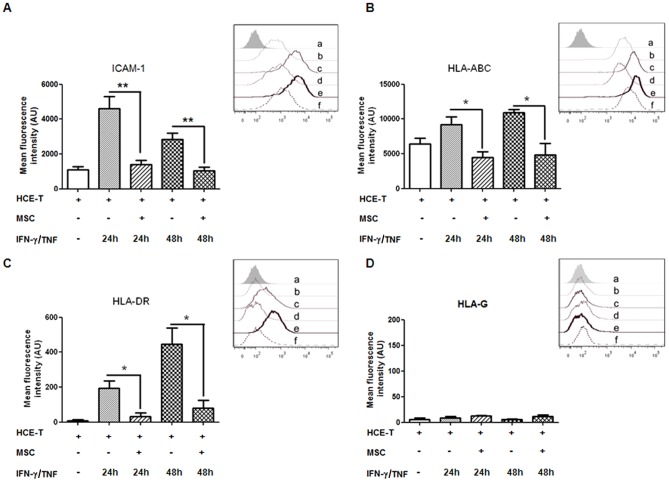
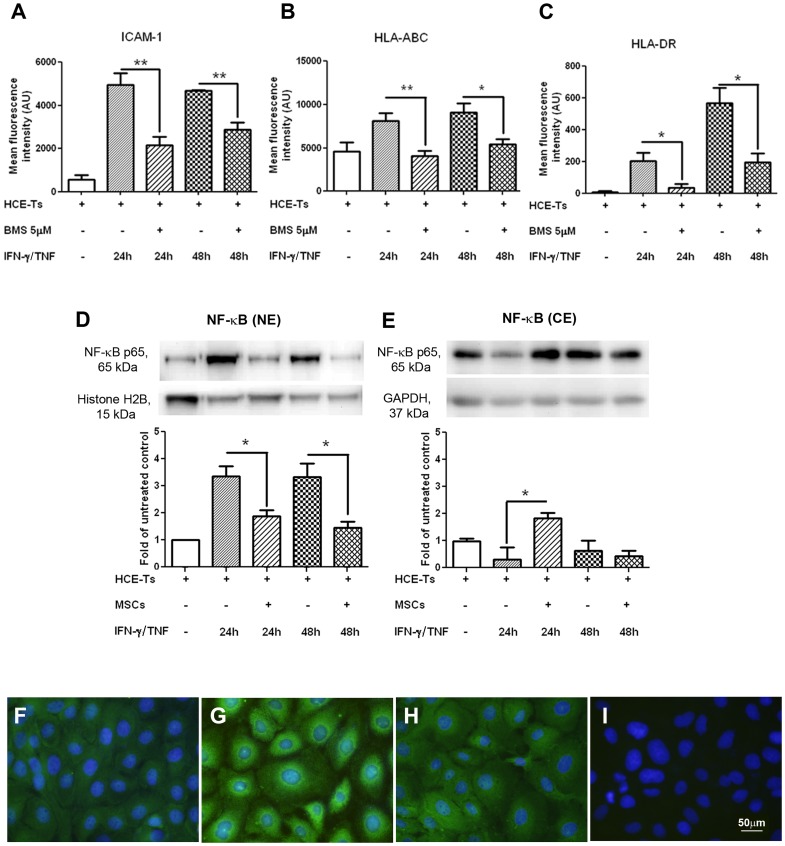
Methods: HCE-T alone and co-cultured with MSC were stimulated with IFN-γ/TNF for 24 and 48 hours or left untreated. The expression of intracellular adhesion molecule (ICAM)-1, human leukocyte antigen ABC, DR and G (HLA-ABC, HLA-DR, HLA-G) were investigated by flow cytometry. Subcellular localization of nuclear factor-kappa B (NF-κB) and expression of indoleamine 2,3-dioxygenase (IDO) were assessed by immunofluorescence staining and western blot. The concentration of transforming growth factor beta 1 (TGF-β1) in the conditioned media from different cultures was evaluated by enzyme-linked immunosorbent assay. NF-κB and TGF-β1 signaling pathway blocking experiments were performed to analyze associations between the expression of cell surface molecules and the NF-κB transcription pathway, and the expression of IDO and TGF-β1 signaling pathway.
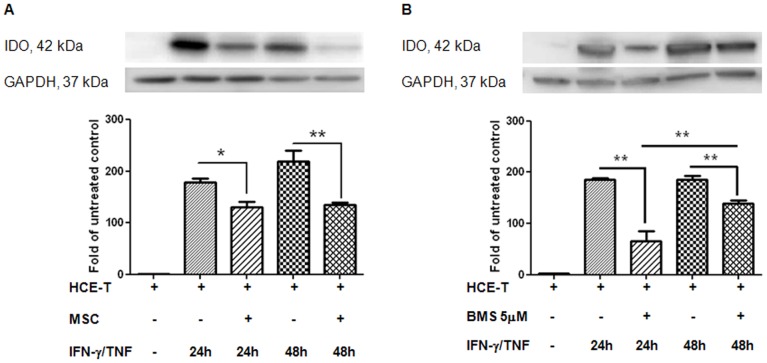
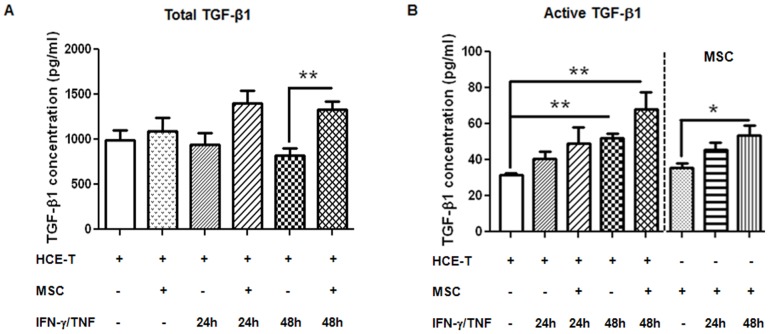
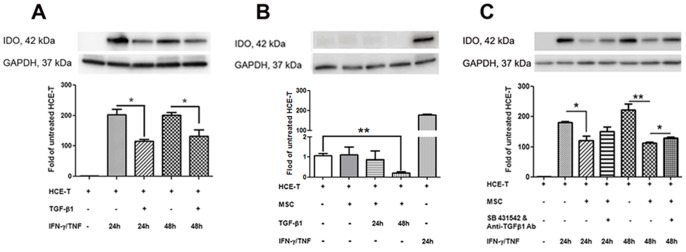
Results: IFN-γ/TNF treatment significantly up-regulated expression of ICAM-1, HLA-ABC, and induced de novo expression of HLA-DR and IDO on HCE-T cultured alone, while HLA-G expression remained unaffected. Up-regulation was significantly inhibited by co-culture with MSC. Increased TGF-β1 secretion was detected in 48 h IFN-γ/TNF-stimulated MSC monocultures and HCE-T/MSC co-cultures. MSC attenuated the activation of cytokine-induced NF-κB and IDO induction. Blockade of NF-κB transcription pathway by BMS-345541 significantly reduced the up-regulation of ICAM-1, HLA-ABC, HLA-DR and IDO expression, while blockade of TGF-β1 signaling pathways reversed the modulatory effect of MSC on IDO expression.
Conclusions: MSC reduced the expression of adhesion and immunoregulatory molecules on pro-inflammatory cytokine-stimulated HCE-T via the NF-κB transcription pathway. MSC attenuated expression of IDO through both NF-κB transcription and TGF-β1 signaling pathways. Co-culture of HCEC with MSC therefore provides a useful in vitro model to study the anti-inflammatory properties of MSC on corneal epithelium.
Conflict of interest statement
Figures
References
-
- Oh JY, Kim MK, Shin MS, Lee HJ, Lee JH, et al. (2009) The anti-inflammatory effect of subconjunctival bevacizumab on chemically burned rat corneas. Curr Eye Res 34: 85–91. - PubMed
-
- Uwaydat S, Jha P, Tytarenko R, Brown H, Wiggins M, et al. (2011) The use of topical honey in the treatment of corneal abrasions and endotoxin-induced keratitis in an animal model. Curr Eye Res 36: 787–796. - PubMed
Publication types
MeSH terms
Substances
LinkOut - more resources
Full Text Sources
Other Literature Sources
Research Materials
Miscellaneous
