. 2015 Jan;9(1):207-16.
doi: 10.1038/ismej.2014.106. Epub 2014 Jul 8.

Improved annotation of antibiotic resistance determinants reveals microbial resistomes cluster by ecology

Affiliations

Improved annotation of antibiotic resistance determinants reveals microbial resistomes cluster by ecology

Molly K Gibson et al. ISME J. 2015 Jan.

Abstract

Antibiotic resistance is a dire clinical problem with important ecological dimensions. While antibiotic resistance in human pathogens continues to rise at alarming rates, the impact of environmental resistance on human health is still unclear. To investigate the relationship between human-associated and environmental resistomes, we analyzed functional metagenomic selections for resistance against 18 clinically relevant antibiotics from soil and human gut microbiota as well as a set of multidrug-resistant cultured soil isolates. These analyses were enabled by Resfams, a new curated database of protein families and associated highly precise and accurate profile hidden Markov models, confirmed for antibiotic resistance function and organized by ontology. We demonstrate that the antibiotic resistance functions that give rise to the resistance profiles observed in environmental and human-associated microbial communities significantly differ between ecologies. Antibiotic resistance functions that most discriminate between ecologies provide resistance to β-lactams and tetracyclines, two of the most widely used classes of antibiotics in the clinic and agriculture. We also analyzed the antibiotic resistance gene composition of over 6000 sequenced microbial genomes, revealing significant enrichment of resistance functions by both ecology and phylogeny. Together, our results indicate that environmental and human-associated microbial communities harbor distinct resistance genes, suggesting that antibiotic resistance functions are largely constrained by ecology.


Figures
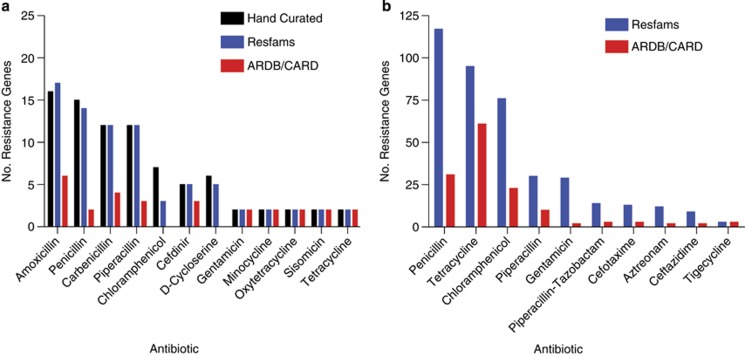
Figure 1
Figure 1
Annotation of functional metagenomic selections using Resfams. Unique full-length open reading frames (ORFs; >90 amino acids (a.a.)) annotated as AR proteins from functional metagenomic selections using Resfams HMM database (blue) compared with hand curation (black) and BLAST to AR databases (red) from (a) MDR cultured soil bacteria and (b) human gut microbiota. The Resfams HMM database identified no false positive annotations as measured by the hand-curated gold standard for cultured soil bacteria. For the amoxicillin selection, MetaGeneMark predicted one ORF in the hand-curated set as two independent ORFs and both were correctly identified by Resfams.
Figure 2
Figure 2
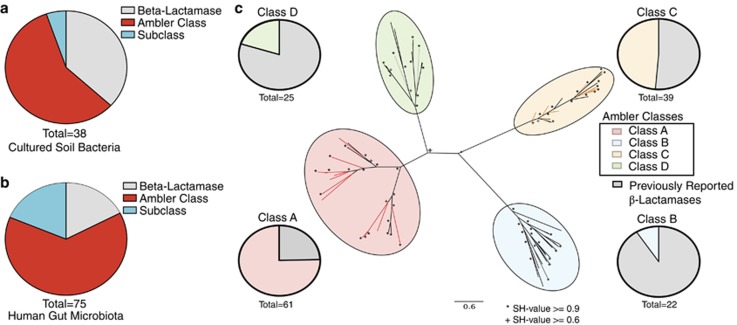
Resfams improves the resolution of annotation of antibiotic resistance proteins. The majority of β-lactamases identified from (a) MDR cultured soil bacteria and (b) human gut microbiota in functional metagenomic selections that are highly sequence divergent from any protein in the ARDB or CARD databases (<80% amino acid (a.a.) identity over 85% of target sequence) are annotated according to Ambler class (red) or subclass (cyan) level by Resfams. (c) All highly divergent β-lactamases from (a) and (b) that are annotated at the Ambler class and subclass level (colored branches) by Resfams accurately cluster on a phylogenetic tree with previously verified β-lactamases from all four Ambler classes (black branches). Pie charts in (c) depict the fraction of Resfams identified β-lactamases and previously verified β-lactamases represented on the phylogenetic tree in each Ambler class clade.
Figure 3
Figure 3
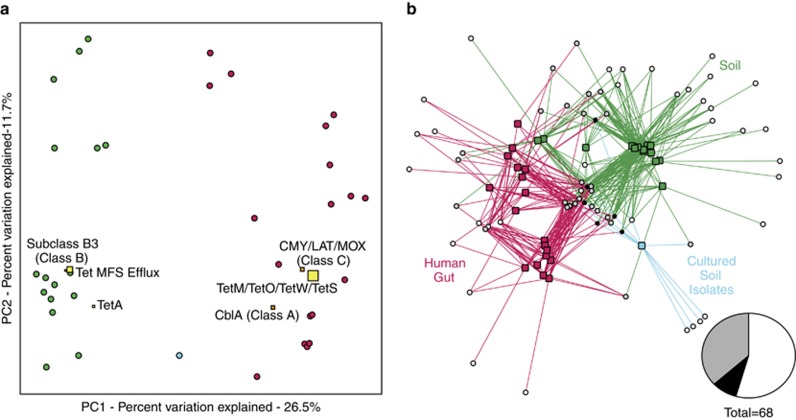
Resistomes differ by ecology. (a) Principal coordinate analysis (PCoA) plot depicting Bray-Curtis distances between resistomes of the soil (green), human gut (magenta) and MDR soil isolates (cyan), calculated using unique AR protein counts. Resistomes of different ecologies cluster separately (P<0.001, ANOSIM). Function biplot coordinates (squares) represent the weighted average of the top six most discriminating AR functions between ecologies across all samples. The size of the biplot squares represent the aggregate abundance of the unique AR family members. Separation of resistomes is heavily influenced by β-lactamase (orange squares) and tetracycline resistance functions (yellow squares). (b) Bipartite network diagram of normalized AR protein counts across all resistomes. Edges connect sample nodes (squares) to AR function (circles). Edges and sample nodes are colored by sample ecology (green, soil; magenta, human gut; cyan, MDR soil isolates) and AR functions are colored by extent of sharing across ecologies (white, unique to ecology; gray, shared between two ecologies; black, shared across all three ecologies). Inset pie chart represents the percentage of AR Resfams families that belong to each group.
Figure 4
Figure 4
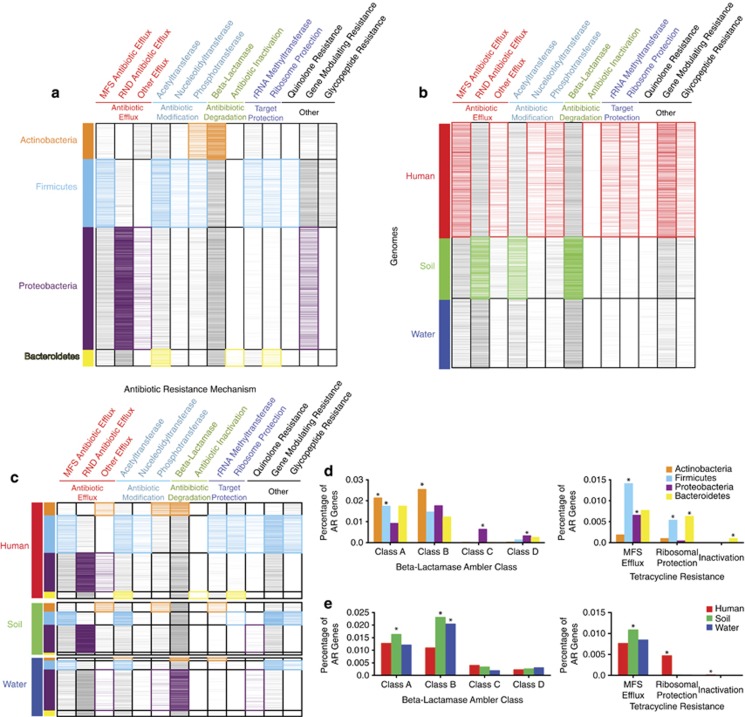
Resistomes annotated by Resfams across phylogeny and habitats of 6179 sequenced bacterial isolate genomes. Binary heatmaps of genomes organized by (a) phylogeny, (b) habitat and (c) phylogeny within habitat. Sections of the heatmaps are colored if a particular AR mechanism is significantly enriched within a particular phyla or habitat (P<0.01, Fisher's exact). Enrichment of β-lactamase Ambler class and tetracycline resistance functions is depicted across (d) phyla and (e) habitat (*P<0.01, Fisher's exact).
Figure 5
Figure 5
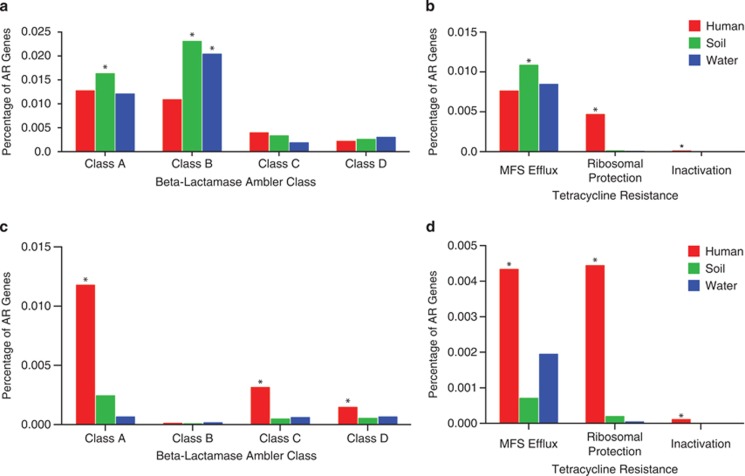
Annotation of antibiotic resistance across habitats using Resfams compared with pairwise sequence alignment. Predicted enrichment of β-lactamase Ambler classes and tetracycline resistance mechanisms (*P<0.01, Fisher's exact) in sequenced genomes across habitats using (a, b) Resfams family profile HMMs compared with (c, d) BLAST to the ARDB and CARD databases.

References

    1. Allen HK, Moe LA, Rodbumrer J, Gaarder A, Handelsman J. Functional metagenomics reveals diverse β-lactamases in a remote Alaskan soil. ISME J. 2008;3:243–251. - PubMed
    1. Ambler RP. The structure of beta-lactamases. Philos Trans R Soc Lond B Biol Sci. 1980;289:321–331. - PubMed
    1. Bateman A, Birney E, Durbin R, Eddy SR, Howe KL, Sonnhammer EL. The Pfam protein families database. Nucleic Acids Res. 2000;28:263–266. - PMC - PubMed
    1. Benvenis R, Davies J. Aminoglycoside antibiotic-inactivating enzymes in actinomycetes similar to those present in clinical isolates of antibiotic-resistant bacteria. Proc Natl Acad Sci USA. 1973;70:2276–2280. - PMC - PubMed
    1. Caporaso JG, Kuczynski J, Stombaugh J, Bittinger K, Bushman FD, Costello EK, et al. QIIME allows analysis of high-throughput community sequencing data. Nat Methods. 2010;7:335–336. - PMC - PubMed

Publication types

Substances