Primary headaches interfere with the efficacy of temporomandibular disorders management
- PMID: 25004051
- PMCID: PMC4428456
- DOI: 10.1590/1678-775720130557
Primary headaches interfere with the efficacy of temporomandibular disorders management
Abstract
Objectives: This cross-sectional study aimed to evaluate the influence of Primary Headache (PH) on efficacy of a Temporomandibular Disorders (TMD) conservative therapy and its association with the presence of self-reported parafunctional habits.
Sample and methods: Sample was composed of 400 medical records, divided into four groups: I) Muscular TMD (n = 64); II) Muscular TMD+PH (n = 48); III) Muscular TMD+Articular TMD (n = 173); IV) Muscular TMD+Articular TMD+PH (n = 115). All groups had undergone a TMD therapy for three months with a stabilization appliance and counseling for habits and behavioral changes, with no specific headache management. Current pain intensity and existence or not of self-reported bruxism were assessed. Repeated measures ANOVA and Chi-Square test followed by Odds were used for statistical analysis, with a significance level of 5%.
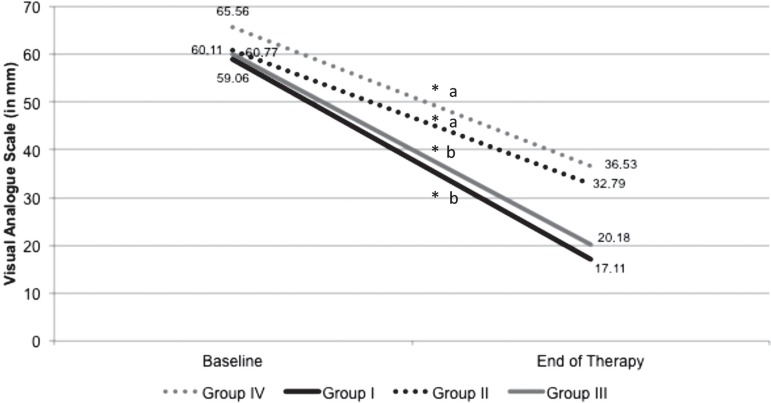
Results: results of this study showed that: (1) A conservative therapy with stabilization appliance and counseling for habits and behavioral changes was effective in the TMD pain relief; (2) Groups with an additional diagnosis of PH had worsened the pain improvement significantly; and (3) no association between the presence of self-reported bruxism and PH was found.
Conclusions: this study could elucidate the important effect that headache may have on the TMD management.
Conflict of interest statement
The authors declare that they have no conflicts of interest.
Figures
References
-
- Ahlberg K, Ahlberg J, Könönen M, Alakuijala A, Partinen M, Savolainen A. Perceived orofacial pain and its associations with reported bruxism and insomnia symptoms in media personnel with or without irregular shift work. Acta Odontol Scand. 2005;63(4):213–217. - PubMed
-
- Alencar F, Jr, Becker A. Evaluation of different occlusal splints and counselling in the management of myofascial pain dysfunction. J Oral Rehabil. 2009;36(2):79–85. - PubMed
-
- Arima T, Svensson P, Arendt-Nielsen L. Experimental grinding in healthy subjects: a model for postexercise jaw muscle soreness? J Orofac Pain. 1999;13(2):104–114. - PubMed
-
- Bader G, Lavigne G. Sleep bruxism; an overview of an oromandibular sleep movement disorder. REVIEW ARTICLE. Sleep Med Rev. 2000;4(1):27–43. - PubMed
-
- Ballegaard V, Thede-Schmidt-Hansen P, Svensson P, Jensen R. Are headache and temporomandibular disorders related? A blinded study. Cephalalgia. 2008;28(8):832–841. - PubMed
MeSH terms
LinkOut - more resources
Full Text Sources
Other Literature Sources
Medical