. 2014 Jul 8;3(7):e174.
doi: 10.1038/mtna.2014.23.

A short antisense oligonucleotide ameliorates symptoms of severe mouse models of spinal muscular atrophy

Affiliations

A short antisense oligonucleotide ameliorates symptoms of severe mouse models of spinal muscular atrophy

Jeffrey M Keil et al. Mol Ther Nucleic Acids. .

Abstract

Recent reports underscore the unparalleled potential of antisense-oligonucleotide (ASO)-based approaches to ameliorate various pathological conditions. However, in vivo studies validating the effectiveness of a short ASO (<10-mer) in the context of a human disease have not been performed. One disease with proven amenability to ASO-based therapy is spinal muscular atrophy (SMA). SMA is a neuromuscular disease caused by loss-of-function mutations in the survival motor neuron 1 (SMN1) gene. Correction of aberrant splicing of the remaining paralog, SMN2, can rescue mouse models of SMA. Here, we report the therapeutic efficacy of an 8-mer ASO (3UP8i) in two severe models of SMA. While 3UP8i modestly improved survival and function in the more severe Taiwanese SMA model, it dramatically increased survival, improved neuromuscular junction pathology, and tempered cardiac deficits in a new, less severe model of SMA. Our results expand the repertoire of ASO-based compounds for SMA therapy, and for the first time, demonstrate the in vivo efficacy of a short ASO in the context of a human disease.


Figures
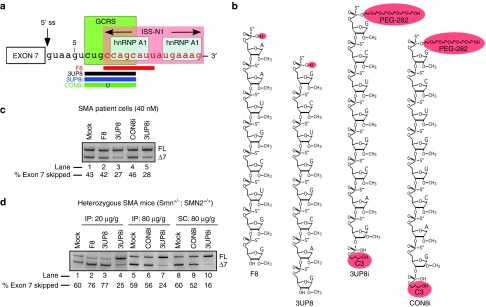
Figure 1
Figure 1
Effect of GC-rich sequence (GCRS)-targeting ASOs on splicing of SMN2 in vitro and in vivo. (a) Diagrammatic representation of annealing positions of ASOs targeting GCRS within SMN2 intron 7. Negative regulators of exon 7 splicing, GCRS, ISS-N1 and hnRNP A1 binding sites are highlighted with boxes. Annealing positions of ASOs (3UP8, 3UP8i, CON8i, and F8) are shown as horizontal bars. Numbering of nucleotides starts from the first position of intron 7. (b) Sequences of ASOs used in this study. All ASOs employed for mouse studies had PEG-282 and propyl modifications at the 5′ and 3′ ends, respectively. (c) SMN2 exon 7 inclusion in SMA patient fibroblasts after transfection with various ASOs. (d) SMN2 exon 7 inclusion in the liver of heterozygous mice (Smn+/−; SMN2+/+) after treatment with various ASOs. Each ASO was administered by intraperitoneal (IP) or subcutaneous (SC) route at the indicated dose. Exon 7-included and exon 7-skipped products are indicated as FL and Δ7, respectively.
Figure 2
Figure 2
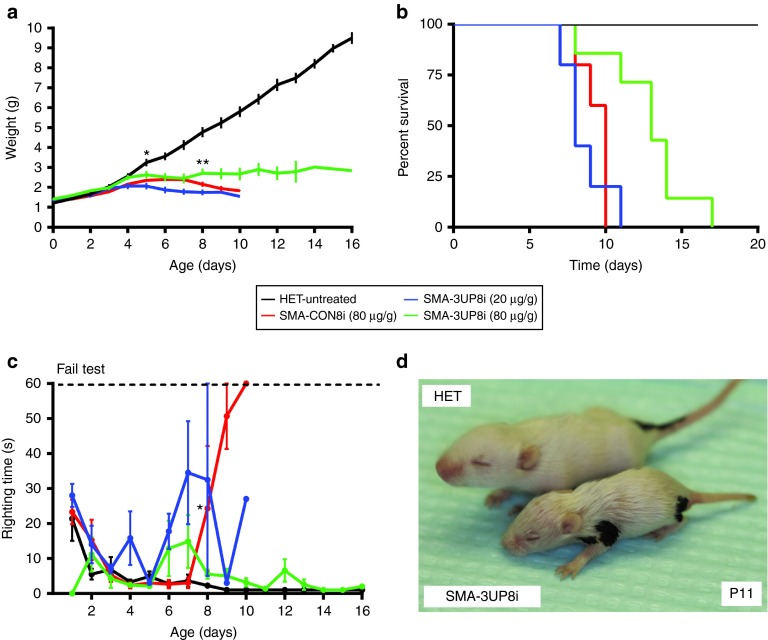
3UP8i modestly improves weight, survival, and righting reflex in severe SMA mice. 5058-Hemi FVB/N SMA mice (SMN2tg/o;Smntm1Hung/tm1Hung) were administered three doses at P0, P5, P10 of 3UP8i or mismatch control (CON8i) by IP injection (HET, n = 5; SMA-3UP8i (20 µg/g body weight), n = 5; SMA-3UP8i (80 µg/g body weight), n = 7; SMA-CON8i, n = 5). (a) SMA mice treated with 3UP8i show improved weight over CON8i-treated SMA mice. Values show as mean ± SEM. *P = 0.04825, **P = 0.0231, Student's t-test. (b) Kaplan–Meier survival curve. The median survival of pairwise comparison between 3UP8i (80 µg/g body weight) and CON8i-treated SMA mice was significantly different, by log-rank test, P = 0.00260. Median survival, HET = undefined (n = 5); 3UP8i (80 µg/g body weight) = 13 d (n = 7); 3UP8i (20 µg/g) = 8 d (n = 5); CON8i = 10 d (n = 5). (c) Righting reflex. Righting time ≥60 seconds considered a failed test. Data presented as a mean ± SEM. *P = 0.02761, Student's t-test. (d) Representative image of a P11 SMA mouse treated with 3UP8i at 80 µg/g body weight shown alongside a littermate control (HET).
Figure 3
Figure 3
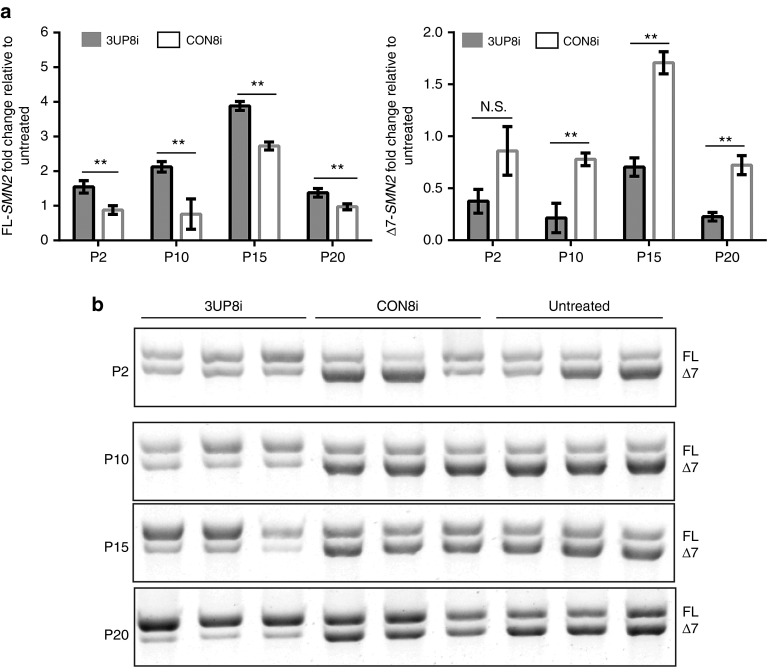
3UP8i splicing efficacy is age-dependent. 5058-4copy mice (SMN2tg/o; SMN2tg/o) were administered 3UP8i (80 µg/g body weight, once daily) of or mismatch control (CON8i) starting at days P0, P8, P13, and P18. Liver was harvested at P2, P10, P15, and P20 was analyzed via qRT-PCR for full-length (FL) SMN2 (Left Panel) and ▵7-SMN2 (Right Panel). (a) SMN2 exon-7 inclusion. SMN2 levels were normalized to Gapdh. Data presented as mean fold change (log2−▵▵Ct) of 3UP8i relative to untreated ± S.D, n = 3 at each time point. Student's t-test, **P < 0.01, N.S., not significant. (b) FL- and ▵7-SMN2 end point RT-PCR of samples analyzed in (a). Exon 7-included and exon 7-skipped products are indicated as FL and Δ7, respectively.
Figure 4
Figure 4
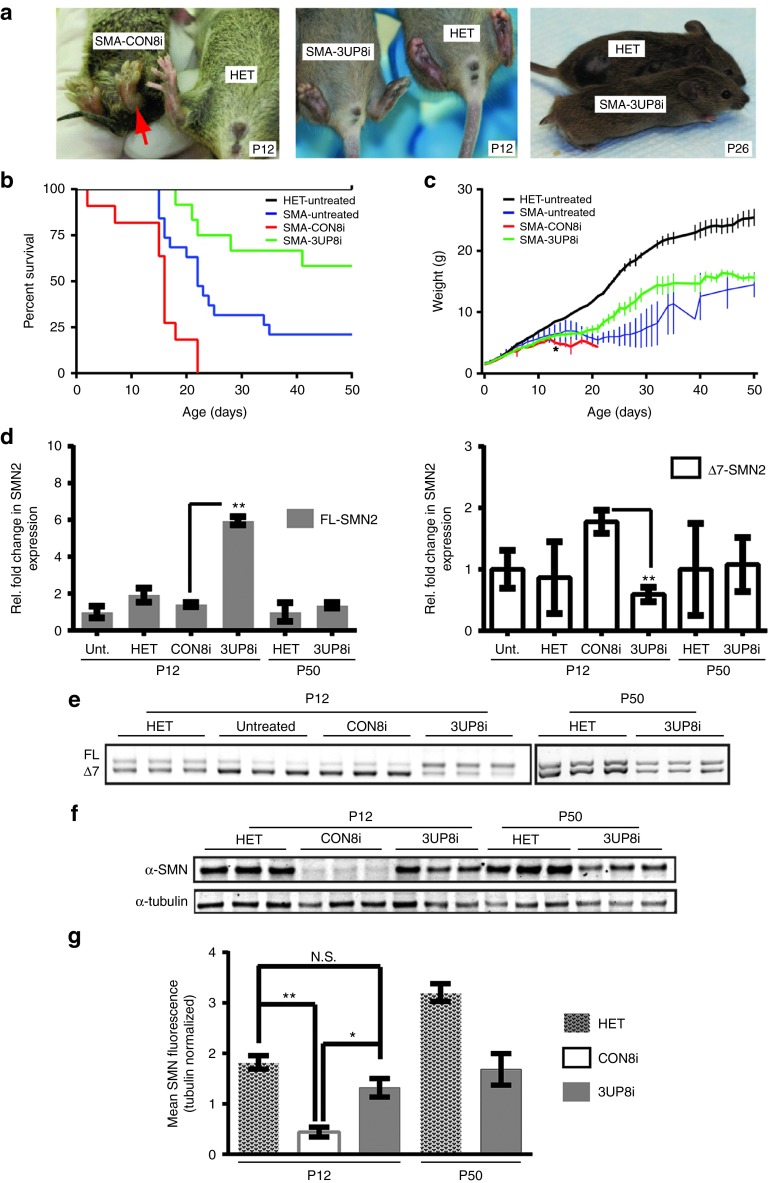
3UP8i improves pathology and survival in 5058-Hemi hybrid SMA mice. Hemi-hybrid SMA mice (SMN2tg/o;Smntm1Hung/tm1.1Jme) were administered three doses (80 µg/g body weight at P0, P5, P10) of 3UP8i or mismatch control (CON8i) by IP injection. (a) Representative images of SMA mice treated with 3UP8i (P12, middle panel; P26, right panel) or CON8i (left panel). Red arrow highlights severe hind limb edema in the CON8i-treated SMA mice. Note necrosed tail (right panel). (b) Kaplan–Meier survival curve. The median survival of pairwise comparison between 3UP8i- and CON8i-treated SMA mice was significantly different, by log-rank test, P < 0.0001. Median survival, HET = undefined (n > 20); SMA-3UP8i = undefined at P50 (n = 12); SMA- CON8i = 16 days (n = 11); SMA-untreated (Unt.) = 22 days (n = 19). (c) Weight of 5058 Hemi-hybrid SMA mice treated with 3UP8i increases compared to CON8i-treated mice (HET, n > 20; SMA-3UP8i, n = 12; SMA-CON8i, n = 11, SMA-Unt., n = 19). Data presented as mean ± SEM. *P = 0.028456, Student's t-test. (d) SMN2 exon-7 inclusion. Liver was harvested at P12 or P50, and analyzed via qRT-PCR for full-length FL-SMN2 (left Panel) and ▵7-SMN2 (right panel). SMN2 levels were normalized to Gapdh. Data presented as fold change (log2−▵▵Ct) ± S.D. (n = 4) relative to either untreated (P12) or HET (P50). Student's t-test, **P = 0.00000003 (FL); P = 0.00004661 (▵7). (e) FL- and ▵7-SMN2 end point RT-PCR of samples analyzed in (d). (f) Liver was harvested at P12 or P50, and subjected to immunoblot with α-SMN and α-tubulin antibodies. (g) SMN levels were normalized to tubulin. Data presented as mean ± S.D. (n = 3). Student's t-test, *P = 0.0018, **P = 0.0001; N.S., not significant. Unt., untreated.
Figure 5
Figure 5
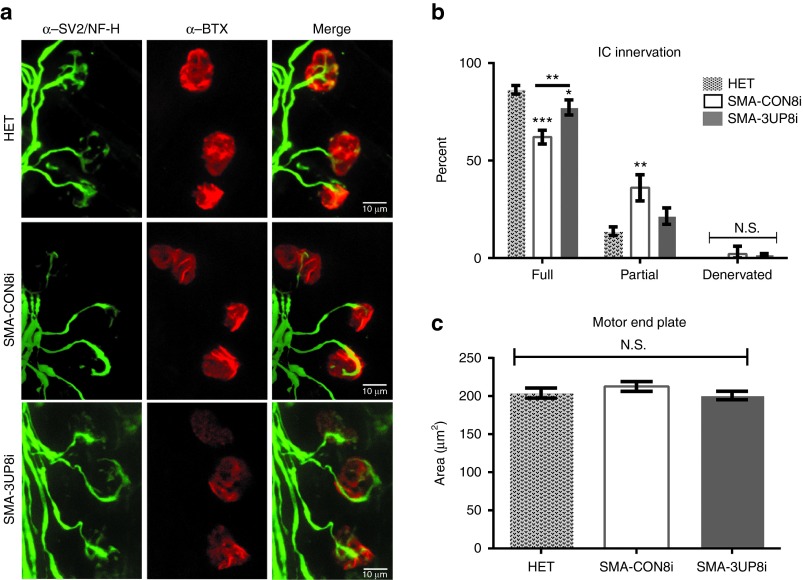
3UP8i improves NMJ pathology. 5058-Hemi hybrid SMA mice (SMN2tg/o;Smntm1Hung/tm1.1Jme) were administered three doses (80 µg/g body weight at P0, P5, P10) of 3UP8i or mismatch control (CON8i) by IP injection (n = 4, n > 50 NMJs/pup). (a) Whole mount NMJ analysis of P12 intercostal (IC) muscles stained with neurofilament H (NF-H)/synaptic vesicle 2 (SV2) (green), and α-Bungarotoxin (BTX) (red). Scale bar = 10 µm. (b) Quantification of IC innervation status. Data presented as mean ± SEM. Two-way analysis of variance repeated measures, with Bonferroni posthoc comparisons (*P = 0.0128, **P = 0.0002, ***P = 0.0001). Asterisks above error bars indicate significance relative to untreated control (HET); asterisks above line indicate significance between 3UP8i and CON8i-treated SMA mice. (c) Quantification of IC motor end plate area. Data are presented as mean ± SEM; N.S., not significant.

References

    1. Schrank B, Götz R, Gunnersen JM, Ure JM, Toyka KV, Smith AG, et al. Inactivation of the survival motor neuron gene, a candidate gene for human spinal muscular atrophy, leads to massive cell death in early mouse embryos. Proc Natl Acad Sci USA. 1997;94:9920–9925. - PMC - PubMed
    1. Lefebvre S, Bürglen L, Reboullet S, Clermont O, Burlet P, Viollet L, et al. Identification and characterization of a spinal muscular atrophy-determining gene. Cell. 1995;80:155–165. - PubMed
    1. Roberts DF, Chavez J, Court SD. The genetic component in child mortality. Arch Dis Child. 1970;45:33–38. - PMC - PubMed
    1. Crawford TO, Pardo CA. The neurobiology of childhood spinal muscular atrophy. Neurobiol Dis. 1996;3:97–110. - PubMed
    1. Dubowitz V. Chaos in the classification of SMA: a possible resolution. Neuromuscul Disord. 1995;5:3–5. - PubMed