Review
. 2014 Dec;28(12):2276-82.
doi: 10.1038/leu.2014.211. Epub 2014 Jul 9.

Pre-leukemic evolution of hematopoietic stem cells: the importance of early mutations in leukemogenesis

Affiliations
Review

Pre-leukemic evolution of hematopoietic stem cells: the importance of early mutations in leukemogenesis

M R Corces-Zimmerman et al. Leukemia. 2014 Dec.

Abstract

Cancer has been shown to result from the sequential acquisition of genetic alterations in a single lineage of cells. In leukemia, increasing evidence has supported the idea that this accumulation of mutations occurs in self-renewing hematopoietic stem cells (HSCs). These HSCs containing some, but not all, leukemia-specific mutations have been termed as pre-leukemic. Multiple recent studies have sought to understand these pre-leukemic HSCs and determine to what extent they contribute to leukemogenesis. These studies have elucidated patterns in mutation acquisition in leukemia, demonstrated resistance of pre-leukemic cells to standard induction chemotherapy and identified these pre-leukemic cells as a putative reservoir for the generation of relapsed disease. When combined with decades of research on clonal evolution in leukemia, mouse models of leukemogenesis, and recent massively parallel sequencing-based studies of primary patient leukemia, studies of pre-leukemic HSCs begin to piece together the evolutionary puzzle of leukemogenesis. These results have broad implications for leukemia treatment, targeted therapies, minimal residual disease monitoring and early detection screening.


Figures
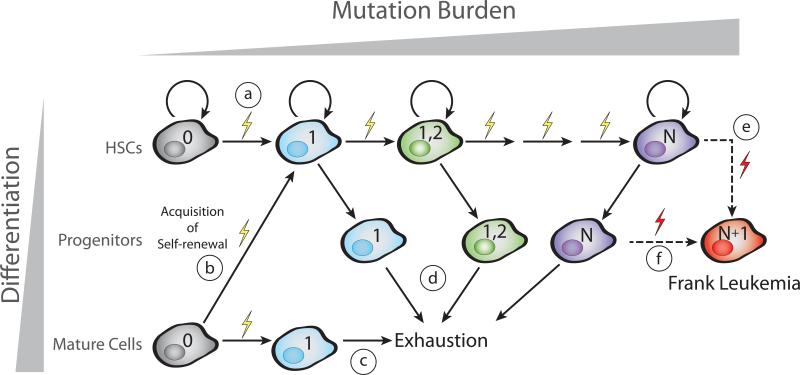
Figure 1
Figure 1. Model for pre-leukemic evolution of leukemia
Sequential acquisition of mutations during clonal evolution is illustrated by changes in color. Multiple scenarios for leukemic evolution exist. The simplest model posits that the first mutation would occur in a normal HSC (A) that retains the ability to self-renew. Alternatively, the first mutation could occur in a more differentiated cell and could confer self-renewal to this previously non-self-renewing cell (B). If, however, the first mutation were to occur in a differentiated cell but not confer self-renewal, this mutation would likely be lost due to exhaustion of this lineage (C). Subsequent mutations accumulate in this self-renewing HSC lineage. At each stage of evolution, these self-renewing cells retain the ability to produce differentiated progeny of both the myeloid and lymphoid lineages (D). Eventually, one or a few additional mutations lead to the generation of a fully leukemic cell. This mutational event could occur in a bonafide HSC (E) or in a progenitor cell (F). The resultant leukemia cell loses the capability to differentiate into multiple cellular lineages.
Figure 2
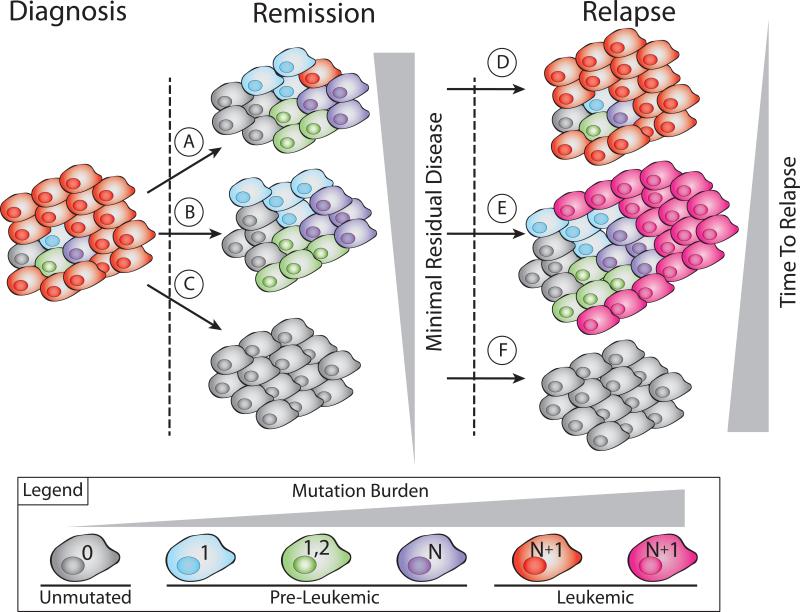
Figure 2. Mechanisms of relapse resulting from varying levels of leukemia cell eradication
Multiple distinct clinical scenarios exist after initial treatment of leukemia. If there is incomplete eradication of leukemia cells (A), the patient would be considered to have some minimal residual disease, and these residual leukemia cells would be able to proliferate and cause relapsed disease with short latency that is genetically similar to the disease at diagnosis. Alternatively, complete eradication of leukemia cells but incomplete targeting of pre-leukemic cells (B) could result in low or undetectable minimal residual disease. However, it remains possible for these pre-leukemic cells to acquire further genetic alterations leading to a genetically divergent relapsed disease with a longer latency (E). The optimal therapeutic situation would be one in which all leukemic and pre-leukemic cells are eradicated (C). Such a scenario would result in the most durable remissions, and potentially, long-term cure of AML (F).

References

    1. Yachida S, Jones S, Bozic I, Antal T, Leary R, Fu B, et al. Distant metastasis occurs late during the genetic evolution of pancreatic cancer. Nature. 2010;467:1114–1117. - PMC - PubMed
    1. Jones S, Chen W-D, Parmigiani G, Diehl F, Beerenwinkel N, Antal T, et al. Comparative lesion sequencing provides insights into tumor evolution. Proc. Natl. Acad. Sci. U. S. A. 2008;105:4283–8. - PMC - PubMed
    1. Araten DJ, Golde DW, Zhang RH, Thaler HT, Gargiulo L, Notaro R, et al. A quantitative measurement of the human somatic mutation rate. Cancer Res. 2005;65:8111–7. - PubMed
    1. Alexandrov LB, Nik-Zainal S, Wedge DC, Aparicio S. a. J. R., Behjati S, Biankin AV, et al. Signatures of mutational processes in human cancer. Nature. 2013 doi:10.1038/nature12477.
    1. Fialkow PJ, Singer JW, Raskind WH,W,AJ, Jacobson RJ, Bernstein ID, et al. Clonal Development, Stem-cell Differentiation, and Clinical Remissions in Acute Non-lymphocytic Leukemia. N. Engl. J. Med. 1987;317:468–473. - PubMed

Publication types