Randomized Controlled Trial
. 2014 Jul 9:13:260.
doi: 10.1186/1475-2875-13-260.

Effectiveness of post-campaign, door-to-door, hang-up, and communication interventions to increase long-lasting, insecticidal bed net utilization in Togo (2011-2012): a cluster randomized, control trial

Affiliations
Randomized Controlled Trial

Effectiveness of post-campaign, door-to-door, hang-up, and communication interventions to increase long-lasting, insecticidal bed net utilization in Togo (2011-2012): a cluster randomized, control trial

Rachelle E Desrochers et al. Malar J. .

Abstract

Background: It is well established that insecticide-treated bed nets (ITNs), in particular long-lasting, insecticidal nets (LLINs), can be used as one of the primary interventions for effective malaria control. A consistent gap between net ownership and use has been observed, indicating that factors exist that prevent an owned mosquito net from being used. One approach used in the context of LLIN campaigns is a post-distribution, door-to-door visit of households with educational messages and to physically assist with hang-up of nets.

Methods: A cluster randomized trial was conducted in the Plateaux Region of Togo to evaluate the effectiveness of different approaches to post-LLIN campaign home visits (number of visits and timing) by volunteers to enhance LLIN hang-up and utilization.

Results: It was found that, in general, households that received intervention visits, particularly the most recent intervention visit, had levels of use that were typically 5 to 10% higher than the control households, while access did not differ among control and intervention households. Eight months post-campaign, ITN use by all individuals, children under five years and women of reproductive age was 11.3 to 14.4 percentage points greater in the study arm that received all three intervention visits than in the control communities. In households that received one or two additional door-to-door visits, the majority of respondents indicated that the volunteer provided new information during the visit regarding the use and importance of ITNs despite having received previous multiple visits.

Conclusions: The impact of the interventions appears to have been primarily through the delivery and reinforcement of key behaviour-change communication (BCC) messages regarding the importance of using an ITN and its care. Regardless of whether the respondents in fact received new information or had forgotten earlier information, this suggests that regular visits from community agents are useful in reinforcing key BCC messages.


Figures
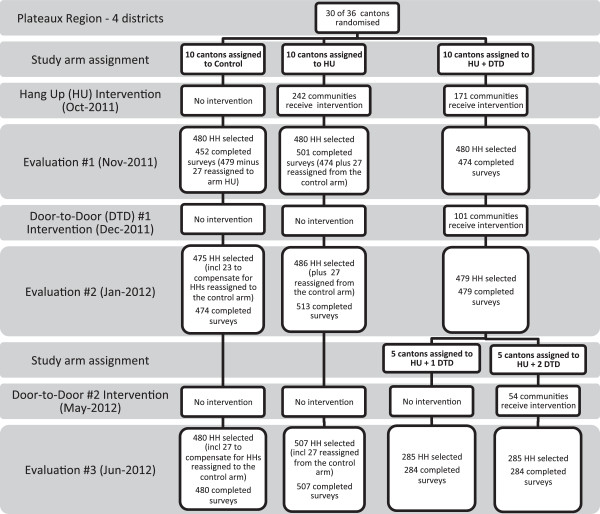
Figure 1
Figure 1
Overview of the study design depicting the flow of clusters and households through each phase of the study.
Figure 2
Figure 2
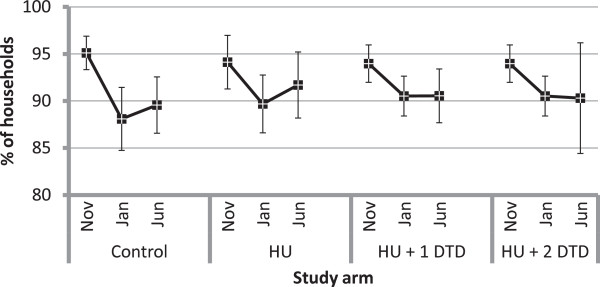
Per cent of households that retained all campaign insecticide-treated nets received by study arm for each evaluation. Within each study arm, the markers represent the estimates from the first (November 2011), second (January 2012) and third (June 2012) evaluations, respectively. Note that the results for the first and second evaluations are shared between the HU + 1 DTD and HU + 2 DTD arms and differ only for the third evaluation.
Figure 3
Figure 3
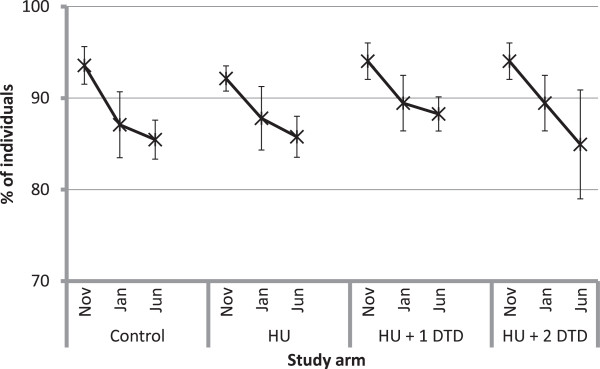
The per cent of individuals with access to an insecticide-treated net (if one ITN covers two people) by study arm. Within each study arm, the markers represent the estimates from the first (November 2011), second (January 2012) and third (June 2012) evaluations, respectively. Note that the results for the first and second evaluations are shared between the HU + 1 DTD and HU + 2 DTD arms and differ only for the third evaluation.
Figure 4
Figure 4
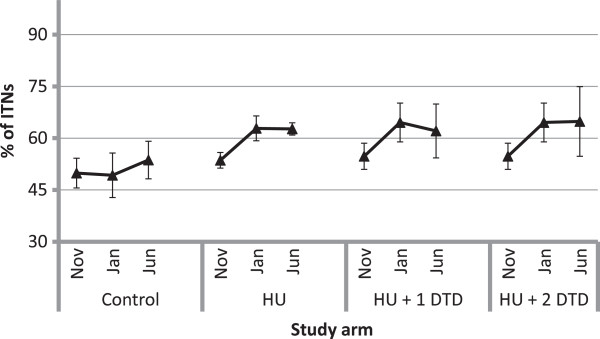
Proportion of existing insecticide-treated nets in the households used the previous night. Within each study arm, the markers represent the estimates from the first (November 2011), second (January 2012) and third (June 2012) evaluations, respectively. Note that the results for the first and second evaluations are shared between the HU + 1 DTD and HU + 2 DTD arms and differ only for the third evaluation.
Figure 5
Figure 5
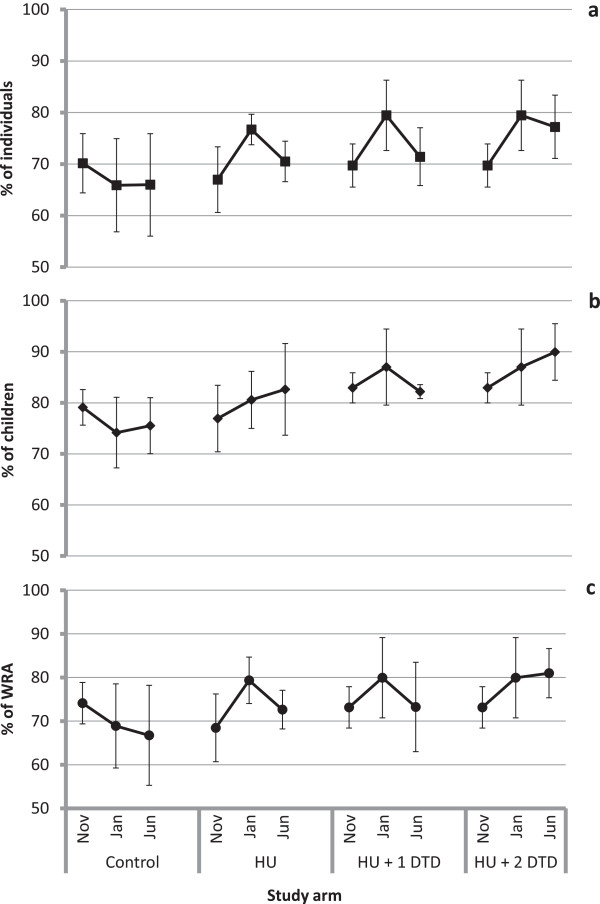
The per cent of individuals reported to have slept under an insecticide-treated net the previous night for each of the study arms. Panel a represents the per cent of all individuals, b is the per cent of children under five years and c is the per cent of women of reproductive age (18–49 years). Within each study arm, the markers represent the estimates from the first (November 2011), second (January 2012) and third (June 2012) evaluations, respectively. Note that the results for the first and second evaluations are shared between the HU + 1 DTD and HU + 2 DTD arms and differ only for the third evaluation.
Figure 6
Figure 6
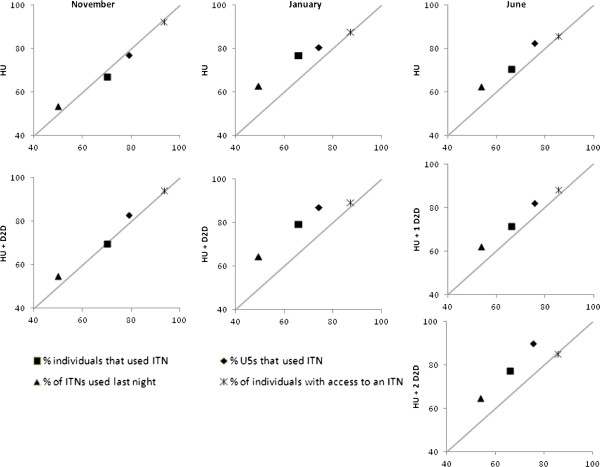
Scatterplot of access (star) and use (solid) indicators in HU and HU + DTD intervention arms on y-axis versus control arm (on the X-axis). Communities in the HU arm received only the hang-up visit immediately following the mass distribution campaign in October 2011. The communities of the HU + DTD arm received a follow-up door-to-door visit in December 2011 and the communities in the HU + 2 DTD arm (one half of HU + DTD) received a second follow-up door-to = door visit in May 2012.

References

    1. Lengeler C. Insecticide-treated bednets and curtains for preventing malaria. Cochrane Database Syst Rev. 2000;2:CD000363. - PubMed
    1. WHO. Long-Lasting Insecticidal Nets For Malaria Prevention: A Manual For Malaria Programme Managers. Geneva, Switzerland: WHO Press; 2007.
    1. WHO. World Malaria Report 2011. Geneva, Switzerland: WHO Press; 2011.
    1. Korenromp EL, Miller J, Cibulskis RE, Kabir Cham M, Alnwick D, Dye C. Monitoring mosquito net coverage for malaria control in Africa: possession vs. use by children under 5 years. Trop Med Int Health. 2003;8:693–703. doi: 10.1046/j.1365-3156.2003.01084.x. - DOI - PubMed
    1. Koenker H, Killian A. Recalculating the net use gap: a multi-country comparison of ITN use versus ITN access. PLoS One. 2014;9:e97496. doi: 10.1371/journal.pone.0097496. - DOI - PMC - PubMed

Publication types

MeSH terms

LinkOut - more resources