


Anemia in a cohort of HIV-infected Hispanics: prevalence, associated factors and impact on one-year mortality
- PMID: 25005803
- PMCID: PMC4099091
- DOI: 10.1186/1756-0500-7-439
Anemia in a cohort of HIV-infected Hispanics: prevalence, associated factors and impact on one-year mortality
Abstract
Background: Anemia occurs frequently in HIV-infected patients and has been associated with an increased risk of death in this population. For Hispanic subjects, information describing this blood disorder during HIV is scarce. Therefore, the present study examined data from a cohort of HIV-positive Hispanics to determine the prevalence of anemia, identify its associated factors, and evaluate its relationship with one-year mortality.
Methods: This study included 1,486 patients who enrolled between January, 2000 and December, 2010 in an HIV-cohort in Bayamón, Puerto Rico. Data were collected through personal interviews and medical record abstractions. To determine the factors independently associated with anemia, a multivariable logistic regression model was used. Kaplan-Meier and Cox proportional hazards models were also performed to estimate survival time and to predict death risk.
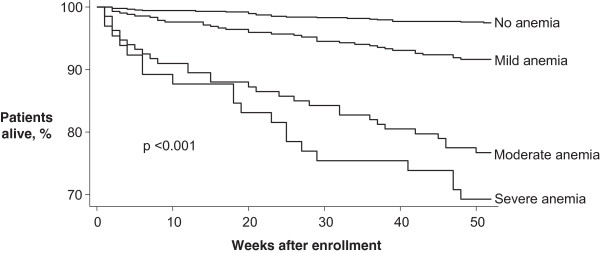
Results: The prevalence of anemia at enrollment was 41.5%. Factors independently associated with increased odds of anemia were: unemployment (OR = 2.02; 95% CI 1.45-2.79), CD4 count <200 cells/μL (OR = 2.66; 95% CI 1.94-3.66), HIV viral load ≥100,000 copies/mL (OR = 1.94; 95% CI 1.36-2.78), white blood cell count <4,000 cells/μL (OR = 2.42; 95% CI 1.78-3.28) and having clinical AIDS (OR = 2.39; 95% CI 1.39-4.09). Overweight (OR = 0.43; 95% CI 0.32-0.59) and obese (OR = 0.44; 95% CI 0.29-0.67) BMI's were independently associated with reduced odds of anemia. Survival differed significantly by anemia status (log-rank test: p < 0.001). One-year mortality estimates were: 30.8%, 23.3%, 8.4% and 2.5%, for patients with severe, moderate, mild and no anemia, respectively. Having anemia at baseline was independently associated with an increased one-year mortality risk (severe anemia: HR = 9.06; 95% CI: 4.16-19.72; moderate anemia: HR = 6.51; 95% CI: 3.25-13.06; mild anemia: HR = 2.53; 95% CI: 1.35-4.74).
Conclusions: A high prevalence of anemia at enrollment was observed in this cohort of HIV-infected Hispanics. Unemployment and several adverse prognostic features of HIV infection were independently associated with this blood disorder. Anemia resulted to be the strongest predictor of one-year mortality, evidencing a dose-response effect. Further investigations are needed to evaluate whether recovering from anemia is associated with longer survival, and to identify the types of anemia affecting this particular group of HIV patients.
Figures
References
-
- Spivak JL, Bender BS, Quinn TC. Hematologic abnormalities in the acquired immune deficiency syndrome. Am J Med. 1984;77:224–228. - PubMed
-
- Zon LI, Arkin C, Groopman JE. Haematologic manifestations of the human immune deficiency virus (HIV) Br J Haematol. 1987;66:251–256. - PubMed
-
- Claster S. Biology of anemia, differential diagnosis, and treatment options in human immunodeficiency virus infection. J Infect Dis. 2002;185(Suppl 2):105–109. - PubMed
-
- Mocroft A, Kirk O, Barton SE, Dietrich M, Proenca R, Colebunders R, Pradier C, dArminio MA, Ledergerber B, Lundgren JD. Anaemia is an independent predictive marker for clinical prognosis in HIV-infected patients from across Europe. EuroSIDA study group. AIDS. 1999;13:943–950. - PubMed
-
- van der Werf MJ, van Benthem BH, van Ameijden EJ. Prevalence, incidence and risk factors of anaemia in HIV-positive and HIV-negative drug users. Addiction. 2000;95:383–392. - PubMed
Publication types
MeSH terms
Grants and funding
LinkOut - more resources
Full Text Sources
Other Literature Sources
Medical
Research Materials
