


Outcomes after treatment of 17,378 patients with locally advanced (T3N0-2) non-small-cell lung cancer
- PMID: 25005840
- PMCID: PMC4366575
- DOI: 10.1093/ejcts/ezu270
Outcomes after treatment of 17,378 patients with locally advanced (T3N0-2) non-small-cell lung cancer
Abstract
Objectives: Treatment patterns and outcomes in a population-based database were examined to identify patients likely to benefit from surgical resection of locally advanced (T3N0-2) non-small-cell lung cancer (NSCLC).
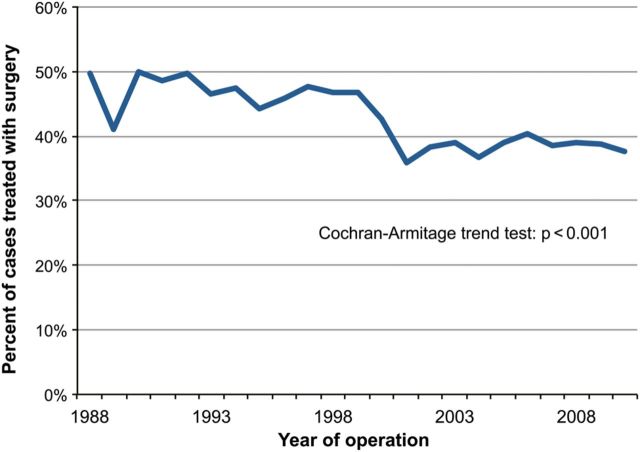
Methods: Factors predicting the use of surgery for patients with T3N0-2M0 NSCLC in the Surveillance, Epidemiology and End Results (SEER) database from 1988 to 2010 were assessed using a multivariable logistic regression model. Survival was analysed using the Kaplan-Meier approach and Cox proportional hazard models. Propensity matching was used to compare outcomes after surgery and outcomes in patients who refused surgery and underwent radiation therapy (RT).
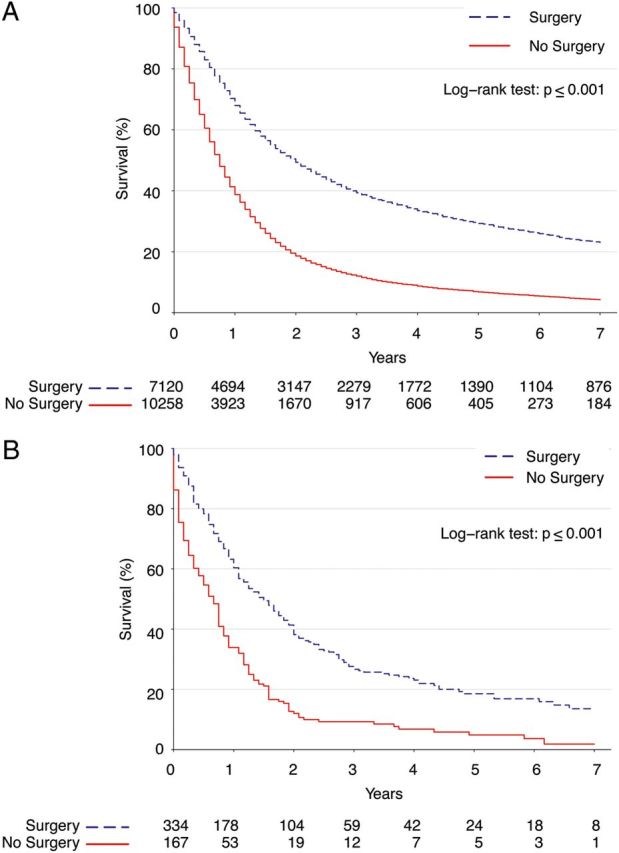
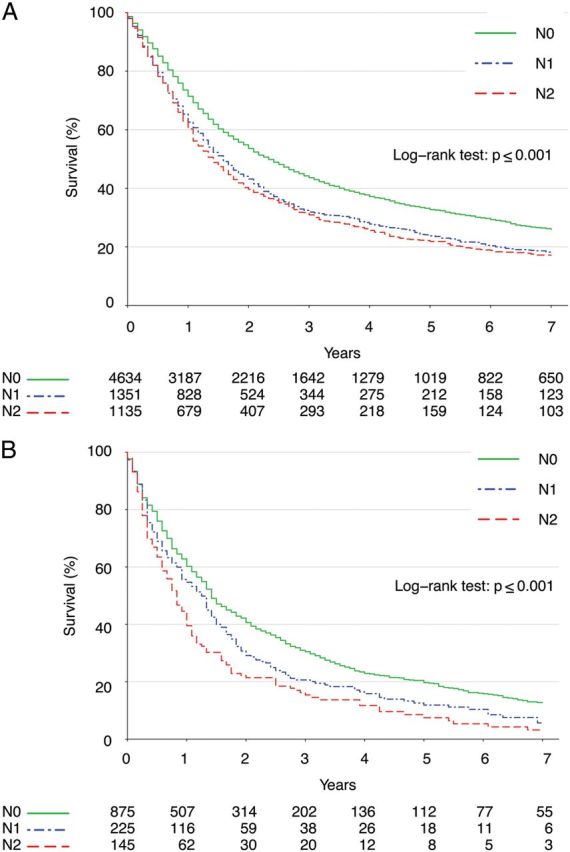
Results: Of 17 378 patients identified for study inclusion [8597 (50%) T3N0, 2304 (13%) T3N1 and 6477 (37%) T3N2], surgery was used in 7120 (41%). Only female sex and being married predicted the use of surgery, while older age, black race and N2 nodal disease predicted non-surgical management. Surgical patients overall had better long-term survival than non-surgical patients [odds ratio (OR) 0.42, 95% confidence interval (CI): 0.41-0.45, P < 0.001]. After propensity adjustment, patients who refused surgery and instead were treated with RT had significantly worse long-term survival than matched surgery patients (OR 0.65, 95% CI: 0.48-0.89, P = 0.0074). Sublobar resection and pneumonectomy predicted worse survival in patients who had surgery. Nodal disease also predicted worse survival after surgery, but surgery maintained an association with better overall survival compared with non-operative therapy among patients with both N1 (OR 0.53, P < 0.001) and N2 disease (OR 0.50, P < 0.001) in separate analyses stratified by nodal status. Older age also predicted worse survival after surgery, but patients older than 75 who were treated with surgery had significantly better long-term survival than non-operative patients (OR 0.49, 95% CI: 0.45-0.53, P < 0.001).
Conclusions: Surgery is used in a minority of patients with locally advanced NSCLC, but is associated with better survival than non-surgical treatment, even for patients older than 75 and patients with nodal disease. Given the very poor outcomes observed with non-operative management, surgical resection should be carefully considered in all patients with locally advanced NSCLC and should not necessarily be denied because of patient age or nodal disease.
Keywords: Chest wall; Lobectomy; Lung cancer surgery; Outcomes; Pneumonectomy.
© The Author 2014. Published by Oxford University Press on behalf of the European Association for Cardio-Thoracic Surgery. All rights reserved.
Figures
References
-
- Siegel R, Naishadham D, Jemal A. Cancer statistics, 2013. CA Cancer J Clin. 2013;63:11–30. - PubMed
-
- Howlader N, Noone AM, Krapcho M, Garshell J, Neyman N, Altekruse SF, et al. SEER Cancer Statistics Review, 1975–2010. Bethesda, MD: National Cancer Institute; 2013. http://seer.cancer.gov/csr/1975_2010/ based on November 2012 SEER data submission, posted to the SEER web site, April.
-
- Ettinger DS, Akerley W, Borghaei H, Chang AC, Cheney RT, Chirieac LR, et al. Non-small cell lung cancer, version 2.2013. J Natl Compr Canc Netw. 2013;11:645–53. - PubMed
-
- Kozower BD, Larner JM, Detterbeck FC, Jones DR. Special treatment issues in non-small cell lung cancer: diagnosis and management of lung cancer, 3rd ed: American College of Chest Physicians evidence-based clinical practice guidelines. Chest. 2013;143:e369S–99S. - PubMed
-
- Pisters KM, Evans WK, Azzoli CG, Kris MG, Smith CA, Desch CE, et al. Cancer Care Ontario and American Society of Clinical Oncology adjuvant chemotherapy and adjuvant radiation therapy for stages I-IIIA resectable non small-cell lung cancer guideline. J Clin Oncol. 2007;25:5506–18. - PubMed
Publication types
MeSH terms
Grants and funding
LinkOut - more resources
Full Text Sources
Other Literature Sources
Medical
