


Revealing the structure of the world airline network
- PMID: 25005934
- PMCID: PMC4087919
- DOI: 10.1038/srep05638
Revealing the structure of the world airline network
Abstract
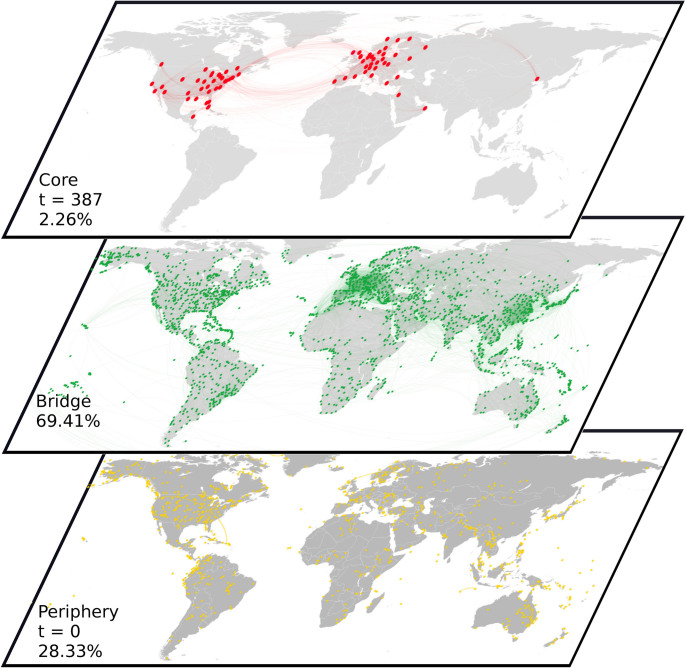
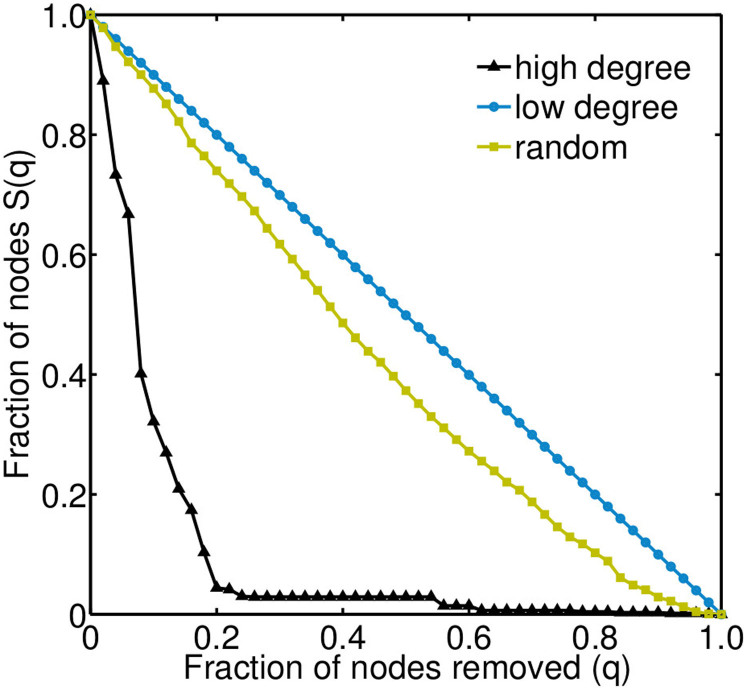
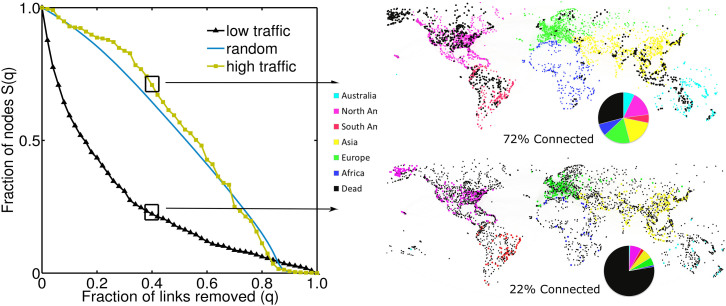
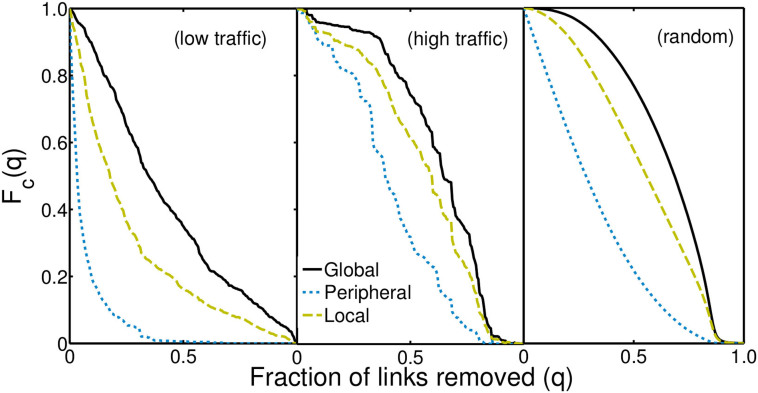
Resilience of most critical infrastructures against failure of elements that appear insignificant is usually taken for granted. The World Airline Network (WAN) is an infrastructure that reduces the geographical gap between societies, both small and large, and brings forth economic gains. With the extensive use of a publicly maintained data set that contains information about airports and alternative connections between these airports, we empirically reveal that the WAN is a redundant and resilient network for long distance air travel, but otherwise breaks down completely due to removal of short and apparently insignificant connections. These short range connections with moderate number of passengers and alternate flights are the connections that keep remote parts of the world accessible. It is surprising, insofar as there exists a highly resilient and strongly connected core consisting of a small fraction of airports (around 2.3%) together with an extremely fragile star-like periphery. Yet, in spite of their relevance, more than 90% of the world airports are still interconnected upon removal of this core. With standard and unconventional removal measures we compare both empirical and topological perceptions for the fragmentation of the world. We identify how the WAN is organized into different classes of clusters based on the physical proximity of airports and analyze the consequence of this fragmentation.
Figures
References
-
- The Sydney Morning Herald., http://goo.gl/gvy9Kg, (2010) (Date of access:04/04/2014).
-
- ICAO., http://goo.gl/LCgb5f, (2012) (Date of access:04/04/2014).
-
- Albert R., Jeong H. & Barabási A.-L. Error and attack tolerance of complex networks. Nature 406, 378–382 (2000). - PubMed
-
- Barabási A.-L., Albert R. & Jeong H. Scale-free characteristics of random networks: the topology of the world-wide web. Phys. A 281, 69–77 (2000).
-
- Boccaletti S., Latora V., Moreno Y., Chavez M. & Hwang D.-U. Complex networks: structure and dynamics. Phys. Rep. 424, 175–308 (2006).
Publication types
LinkOut - more resources
Full Text Sources
Other Literature Sources
Miscellaneous
