. 2014;11(6):702-14.
doi: 10.4161/rna.29196. Epub 2014 Jul 9.

Contributions of transcription and mRNA decay to gene expression dynamics of fission yeast in response to oxidative stress

Affiliations

Contributions of transcription and mRNA decay to gene expression dynamics of fission yeast in response to oxidative stress

Samuel Marguerat et al. RNA Biol. 2014.

Abstract

The cooperation of transcriptional and post-transcriptional levels of control to shape gene regulation is only partially understood. Here we show that a combination of two simple and non-invasive genomic techniques, coupled with kinetic mathematical modeling, afford insight into the intricate dynamics of RNA regulation in response to oxidative stress in the fission yeast Schizosaccharomyces pombe. This study reveals a dominant role of transcriptional regulation in response to stress, but also points to the first minutes after stress induction as a critical time when the coordinated control of mRNA turnover can support the control of transcription for rapid gene regulation. In addition, we uncover specialized gene expression strategies associated with distinct functional gene groups, such as simultaneous transcriptional repression and mRNA destabilization for genes encoding ribosomal proteins, delayed mRNA destabilization with varying contribution of transcription for ribosome biogenesis genes, dominant roles of mRNA stabilization for genes functioning in protein degradation, and adjustment of both transcription and mRNA turnover during the adaptation to stress. We also show that genes regulated independently of the bZIP transcription factor Atf1p are predominantly controlled by mRNA turnover, and identify putative cis-regulatory sequences that are associated with different gene expression strategies during the stress response. This study highlights the intricate and multi-faceted interplay between transcription and RNA turnover during the dynamic regulatory response to stress.

Keywords: Atf1; RNA Polymerase II; fission yeast; gene regulation; mRNA turnover; mathematical modelling; oxidative stress; post-transcriptional control; ribosome biogenesis.


Figures

None
Figure 1. Dynamic changes in gene expression largely reflect changes in Pol II occupancy during oxidative stress. Genes with large regulation in Pol II occupancy and transcript expression data (MFCEXP and MFCPOL > 2-fold, see main text) were hierarchically clustered (Pearson correlation) using GeneSpring GX7 software (Agilent). Clustering results were plotted as a heat-map, where upregulated genes are shown in yellow and downregulated genes in blue as indicated at the bottom (gray: no data). Example sub-clusters showing signs of dominant post-transcriptional regulation are marked by asterisks.
None
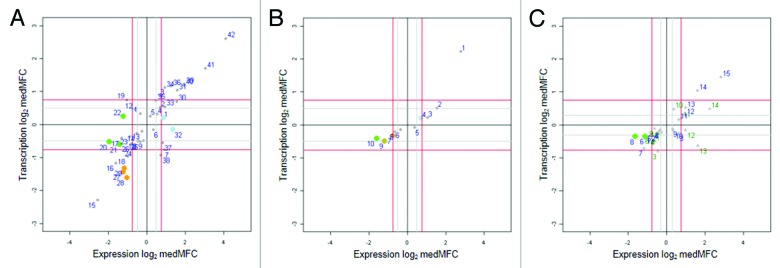
Figure 2. Multiple regulatory patterns involve modulation of transcription and/or mRNA turnover. Genes with good fits to one of three mathematical models are classified by Bayesian hierarchical clustering. The resulting clusters are plotted as a function of their median maximum-fold change values for expression (medMFCEXP) and for Pol II occupancy (medMFCPOL). Orange dots represent clusters enriched for ribosomal proteins. Blue dots represent clusters regulated mainly at the mRNA stability level. Green dots are clusters enriched for genes of the Ribi regulon. (A) Clusters derived from genes assigned to the ‘constant’ model (1c-42c). (B) Clusters derived from genes assigned to the ‘constant’ model with exponential approach to a new steady-state (1e-10e). (C) Clusters derived from genes assigned to the ‘switch’ model (stabilized, 1ss-14ss, triangles; destabilized, 1ds-15ds, circles).
None
Figure 3. Specific gene categories use distinct expression strategies. Median transcription (T) and expression (E) profiles of selected gene groups with common expression strategies are plotted. Names of gene clusters are indicated in legend at lower left. These findings were validated by independent low-resolution time course experiments (Fig. S10). (A) Median expression profiles of genes encoding ribosomal proteins distributed in three clusters from the ‘constant’ model. (B) Median expression profiles of three clusters showing regulation mostly at the mRNA degradation level. Clusters 1c and 32c contain genes related to protein degradation, while cluster 13ss in enriched for tf2 elements. (C) Median expression profiles of four subcategories of genes from the Ribi regulon: ‘total’, all genes in list; ‘constant’, genes assigned to ‘constant’ model showing transcriptional regulation; ‘switch’, genes assigned to ‘switch’ model; ‘post’, genes from ‘constant’ model showing little or no regulation at transcriptional level.
None
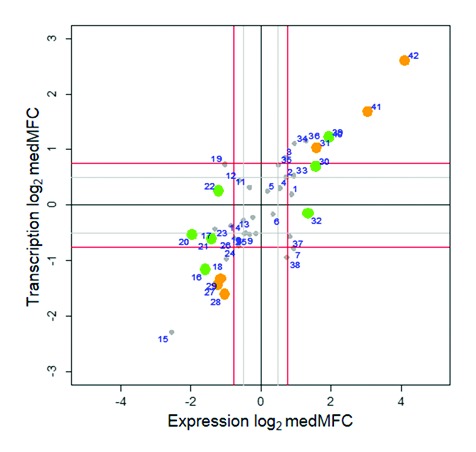
Figure 4. Atf1p-dependent and -independent genes show distinct expression strategies. Clusters from ‘constant’ model were plotted as a function of their medMFCEXP and medMFCPOL (see legend Figure 2). Clusters were classified as ‘Atf1p-dependent’ (orange dots), ‘Atf1p-independent’ (green dots), or left unassigned (gray dots).
None
Figure 5. Sequence motifs associated with distinct regulatory strategies.(A) Clusters from the ‘constant’ model were plotted as a function of their medMFCEXP and medMFCPOL (see legend Figure 2). The FIRE and TEISER algorithms were run using 300 nucleotide regions up- and down-stream of genes from the ‘constant’ clusters. Identified motifs (FIRE) and secondary-structure loops (TEISER) are shown together with the clusters they are enriched in. The significance p values of motif or loop enrichment in the clusters are shown in parentheses. Additional information is provided in Tables S6 and S7.(B) As in (A) but with clusters from the ‘switch’ model, both for stabilized (1ss-14ss, triangles) and destabilized (1ds-15ds, circles) clusters.

References

    1. Keene JD. Minireview: global regulation and dynamics of ribonucleic Acid. Endocrinology. 2010;151:1391–7. doi: 10.1210/en.2009-1250. - DOI - PMC - PubMed
    1. Lackner DH, Beilharz TH, Marguerat S, Mata J, Watt S, Schubert F, Preiss T, Bähler J. A network of multiple regulatory layers shapes gene expression in fission yeast. Mol Cell. 2007;26:145–55. doi: 10.1016/j.molcel.2007.03.002. - DOI - PMC - PubMed
    1. Thomsen S, Anders S, Janga SC, Huber W, Alonso CR. Genome-wide analysis of mRNA decay patterns during early Drosophila development. Genome Biol. 2010;11:R93. doi: 10.1186/gb-2010-11-9-r93. - DOI - PMC - PubMed
    1. Lackner DH, Schmidt MW, Wu S, Wolf DA, Bähler J. Regulation of transcriptome, translation, and proteome in response to environmental stress in fission yeast. Genome Biol. 2012;13:R25. doi: 10.1186/gb-2012-13-4-r25. - DOI - PMC - PubMed
    1. Mata J, Marguerat S, Bähler J. Post-transcriptional control of gene expression: a genome-wide perspective. Trends Biochem Sci. 2005;30:506–14. doi: 10.1016/j.tibs.2005.07.005. - DOI - PubMed

Publication types

MeSH terms

LinkOut - more resources