


Incentives and disincentives for the treatment of depression and anxiety: a scoping review
- PMID: 25007422
- PMCID: PMC4086319
- DOI: 10.1177/070674371405900706
Incentives and disincentives for the treatment of depression and anxiety: a scoping review
Abstract
Objective: There is widespread support for primary care to help address growing mental health care demands. Incentives and disincentives are widely used in the design of health care systems to help steer toward desired goals. The absence of a conceptual model to help understand the range of factors that influence the provision of primary mental health care inspired a scoping review of the literature. Understanding the incentives that promote and the disincentives that deter treatment for depression and anxiety in the primary care context will help to achieve goals of greater access to mental health care.
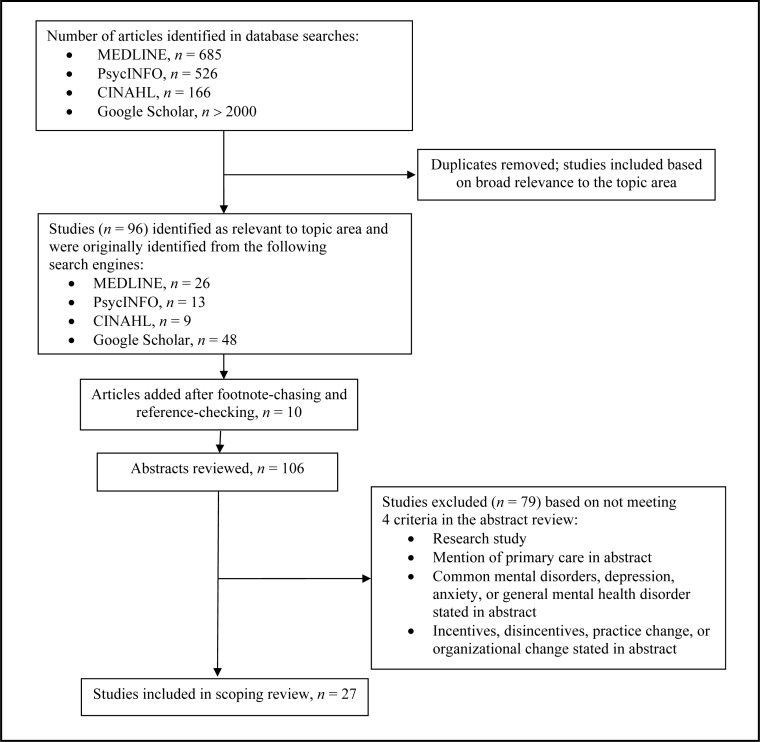
Method: A review of the literature was conducted to answer the question, how are incentives and disincentives conceptualized in studies investigating the treatment of common mental disorders in primary care? A comprehensive search of MEDLINE, PsycINFO, CINAHL, and Google Scholar was undertaken using Arksey and O'Malley's 5-stage methodological framework for scoping reviews.
Results: We identified 27 studies. A range of incentives and disincentives influence the success of primary mental health care initiatives to treat depression and anxiety. Six types of incentives and disincentives can encourage or discourage treatment of depression and anxiety in primary care: attitudes and beliefs, training and core competencies, leadership, organizational, financial, and systemic.
Conclusions: Understanding that there are 6 different types of incentives that influence treatment for anxiety and depression in primary care may help service planners who are trying to promote improved mental health care.
Objectif :: L’idée que les soins de première ligne aident à répondre aux demandes croissantes de soins de santé mentale obtient un large soutien. Les incitatifs et les désincitatifs sont largement utilisées dans la conception des systèmes de santé pour aider à prendre la direction des buts escomptés. L’absence d’un modèle conceptuel destiné à comprendre la variété de facteurs qui influencent la prestation de soins de santé mentale de première ligne a inspiré une revue étendue de la littérature. Comprendre les incitatifs qui favorisent le traitement de la dépression et de l’anxiété dans le contexte des soins de première ligne ainsi que les désincitatifs qui les découragent contribuera à atteindre les objectifs d’accès accru aux soins de santé mentale.
Méthode :: Une revue de la littérature a été menée pour répondre à la question : comment les incitatifs et les désincitatifs sont-ils conceptualisées dans les études portant sur le traitement des troubles mentaux communs dans les soins de première ligne? Une recherche détaillée de MEDLINE, PsycINFO, CINAHL et Google Scholar a été entreprise à l’aide du cadre méthodologique en 5 stades d’Arksey et O’Malley pour les revues étendue.
Résultats :: Nous avons repéré 27 études. Une variété d’incitatifs et de désincitatifs influencent la réussite des initiatives de soins de santé mentale de première ligne pour traiter la dépression et l’anxiété. Six types d’incitatif et de désincitatifs peuvent encourager ou décourager le traitement de la dépression et de l’anxiété dans les soins de première ligne : attitudes et croyances, formation et compétences essentielles, leadership, organisationnelles, financières, et systémiques.
Conclusions :: Savoir qu’il existe 6 différents types d’incitatifs qui influencent le traitement de l’anxiété et de la dépression dans les soins de première ligne peut aider les planificateurs de services qui tentent de promouvoir de meilleurs soins de santé mentale.
Figures
Comment in
-
Support, patience, and expectancy: therapeutic options alongside intensified treatments for depression?Can J Psychiatry. 2014 Jul;59(7):347-8. doi: 10.1177/070674371405900701. Can J Psychiatry. 2014. PMID: 25007418 Free PMC article. No abstract available.
References
-
- Craven M, Bland R. Depression in primary care: current and future challenges. Can J Psychiatry. 2013;58(8):442–448. - PubMed
-
- Prince M, Patel V, Saxena S, et al. No health without mental health. Lancet. 2007;370:859–877. - PubMed
-
- Marcus M, Yasamy MT, van Ommeren M, et al. Depression: a global public health concern [Internet] Geneva (CH): World Health Organization; 2012. Available from: http://www.who.int/mental_health/management/depression/who_paper_depress....
-
- Kiecolt-Glaser J, Glaser R. Depression and immune function: central pathways to morbidity and mortality. J Psychosom Res. 2002;53:873–876. - PubMed
-
- Kates N, Mazowita G, Lemire F, et al. The evolution of collaborative mental health care in Canada: a shared vision for the future. Can J Psychiatry. 2011;56(5 Insert 1):1–10.
Publication types
MeSH terms
LinkOut - more resources
Full Text Sources
Other Literature Sources
Medical
