. 2014 Aug 19;86(16):8206-12.
doi: 10.1021/ac501537w. Epub 2014 Jul 10.

Temperature-ramped (129)Xe spin-exchange optical pumping

Affiliations

Temperature-ramped (129)Xe spin-exchange optical pumping

Panayiotis Nikolaou et al. Anal Chem. .

Abstract

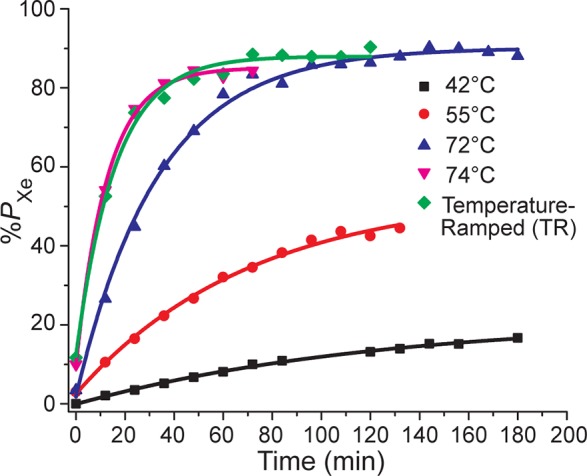
We describe temperature-ramped spin-exchange optical pumping (TR-SEOP) in an automated high-throughput batch-mode (129)Xe hyperpolarizer utilizing three key temperature regimes: (i) "hot"-where the (129)Xe hyperpolarization rate is maximal, (ii) "warm"-where the (129)Xe hyperpolarization approaches unity, and (iii) "cool"-where hyperpolarized (129)Xe gas is transferred into a Tedlar bag with low Rb content (<5 ng per ∼1 L dose) suitable for human imaging applications. Unlike with the conventional approach of batch-mode SEOP, here all three temperature regimes may be operated under continuous high-power (170 W) laser irradiation, and hyperpolarized (129)Xe gas is delivered without the need for a cryocollection step. The variable-temperature approach increased the SEOP rate by more than 2-fold compared to the constant-temperature polarization rate (e.g., giving effective values for the exponential buildup constant γSEOP of 62.5 ± 3.7 × 10(-3) min(-1) vs 29.9 ± 1.2 × 10(-3) min(-1)) while achieving nearly the same maximum %PXe value (88.0 ± 0.8% vs 90.1% ± 0.8%, for a 500 Torr (67 kPa) Xe cell loading-corresponding to nuclear magnetic resonance/magnetic resonance imaging (NMR/MRI) enhancements of ∼3.1 × 10(5) and ∼2.32 × 10(8) at the relevant fields for clinical imaging and HP (129)Xe production of 3 T and 4 mT, respectively); moreover, the intercycle "dead" time was also significantly decreased. The higher-throughput TR-SEOP approach can be implemented without sacrificing the level of (129)Xe hyperpolarization or the experimental stability for automation-making this approach beneficial for improving the overall (129)Xe production rate in clinical settings.


Figures
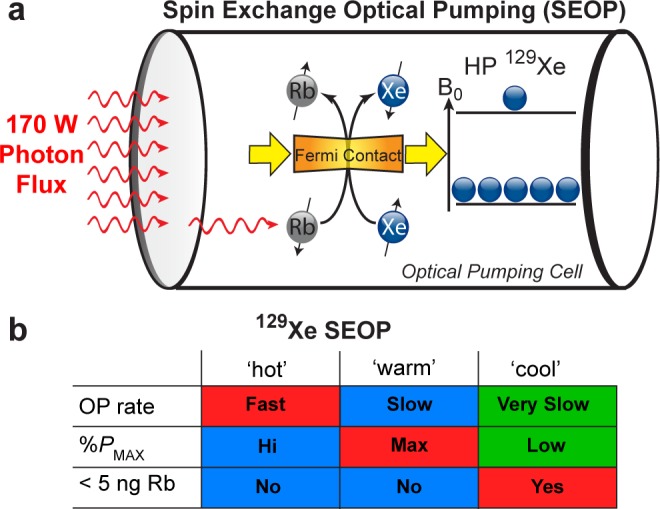
Figure 1
Figure 1
(a) Schematic of batch-mode 129Xe spin-exchange optical pumping (SEOP) using a high-power laser diode array (LDA) and 0.5 L optical pumping (OP) cell. (b) A brief qualitative summary of 129Xe SEOP parameter regions studied here Xe density and incident laser power. Note that <5 ng of residual Rb quantity in the Tedlar bag (after HP gas expansion) has been utilized in FDA-approved clinical trial protocols.
Figure 2
Figure 2
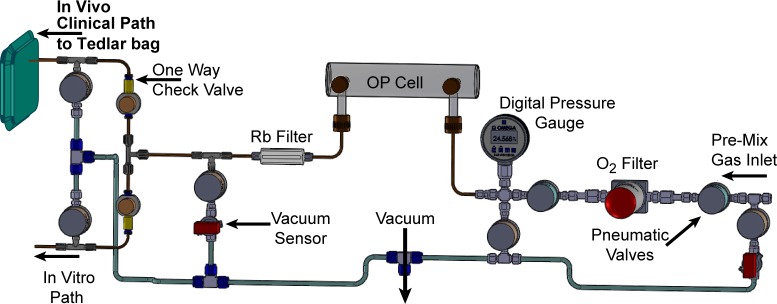
Positive-pressure gas loading manifold (nominal pressure is 2.7 atm for a 0.5 L OP-cell), which consists of Teflon pneumatic valves and tubing, one-way check valves, in-line O2 and Rb getters/filters, vacuum and pressure sensors, and two exit paths: “in vivo” (i.e., for clinical use) and “in vitro” (i.e., for experiments not involving living organisms). Implementation of the Rb filter does not appear to measurably impact 129Xe hyperpolarization (ref (20)).
Figure 3
Figure 3
129Xe optical pumping (hyperpolarization) buildup curves for an OP-cell filled with 500 Torr 129Xe/1500 Torr N2 gas mixture under variable temperatures of 42, 55, 72, 74 °C, and TR-SEOP (74 → 72 °C).
Figure 4
Figure 4
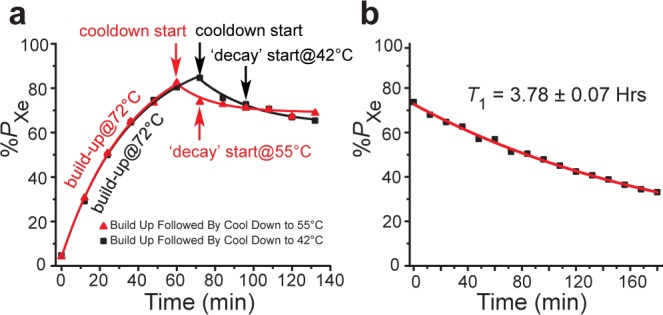
(a) Exponential fit buildup (72 °C) and decay curves of the OP cell cool down to 42 and 55 °C, respectively, of 500 Torr 129Xe. (b) T1 decay of hyperpolarized 129Xe (500 Torr partial pressure) at room temperature with the laser turned off.
Figure 5
Figure 5
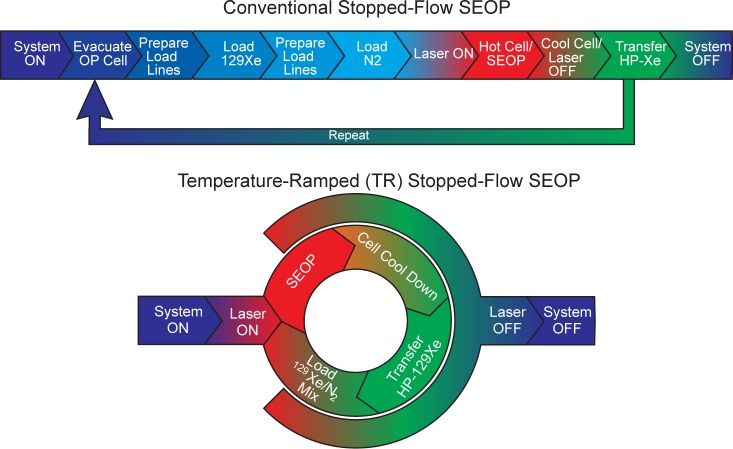
Operational diagrams of clinical-scale batch-mode SEOP polarizers: conventional (top) and enabled by the new temperature-ramped (TR) SEOP method presented here (bottom).

References

    1. Kurhanewicz J.; Vigneron D. B.; Brindle K.; Chekmenev E. Y.; Comment A.; Cunningham C. H.; DeBerardinis R. J.; Green G. G.; Leach M. O.; Rajan S. S.; Rizi R. R.; Ross B. D.; Warren W. S.; Malloy C. R. Neoplasia 2011, 13, 81–97. - PMC - PubMed
    1. Goodson B. M. J. Magn. Reson. 2002, 155, 157–216. - PubMed
    1. Ruset I. C.; Tsai L. L.; Mair R. W.; Patz S.; Hrovat M. I.; Rosen M. S.; Muradian I.; Ng J.; Topulos G. P.; Butler J. P.; Walsworth R. L.; Hersman F. W. Concepts Magn. Reson., Part B 2006, 29B, 210–221. - PMC - PubMed
    1. Tsai L. L.; Mair R. W.; Rosen M. S.; Patz S.; Walsworth R. L. J. Magn. Reson. 2008, 193, 274–285. - PMC - PubMed
    1. Branca R. T.; Cleveland Z. I.; Fubara B.; Kumar C. S. S. R.; Maronpot R. R.; Leuschner C.; Warren W. S.; Driehuys B. Proc. Natl. Acad. Sci. U.S.A. 2010, 10783693–3697. - PMC - PubMed

Publication types

MeSH terms