. 2014 Sep;88(18):10875-82.
doi: 10.1128/JVI.01447-14. Epub 2014 Jul 9.

Detailed study of the interaction between human herpesvirus 6B glycoprotein complex and its cellular receptor, human CD134

Affiliations

Detailed study of the interaction between human herpesvirus 6B glycoprotein complex and its cellular receptor, human CD134

Huamin Tang et al. J Virol. 2014 Sep.

Abstract

Recently, we identified a novel receptor, CD134, which interacts with the human herpesvirus 6B (HHV-6B) glycoprotein (g)H/gL/gQ1/gQ2 complex and plays a key role in the entry of HHV-6B into target cells. However, details of the interaction between the HHV-6B gH/gL/gQ1/gQ2 complex and CD134 were unknown. In this study, we identified a cysteine-rich domain (CRD), CDR2, of CD134 that is critical for binding to the HHV-6B glycoprotein complex and HHV-6B infection. Furthermore, we found that the expression of HHV-6B gQ1 and gQ2 subunits was sufficient for CD134 binding, which is different from the binding of human herpesvirus 6A (HHV-6A) to its receptor, CD46. Finally, we identified a region in gQ1 critical for HHV-6B gQ1 function. These results contribute much to our understanding of the interaction between this ligand and receptor.

Importance: We identified the domain in HHV-6B entry receptor CD134 and the components in the HHV-6B gH/gL/gQ1/gQ2 complex required for ligand-receptor binding during HHV-6B infection. Furthermore, we identified domains in gQ1 proteins of HHV-6A and -6B and a key amino acid residue in HHV-6B gQ1 required for its function. These data should be the basis for further investigation of ligand-receptor interaction in the study of HHV-6A and -6B.


Figures

FIG 1
FIG 1
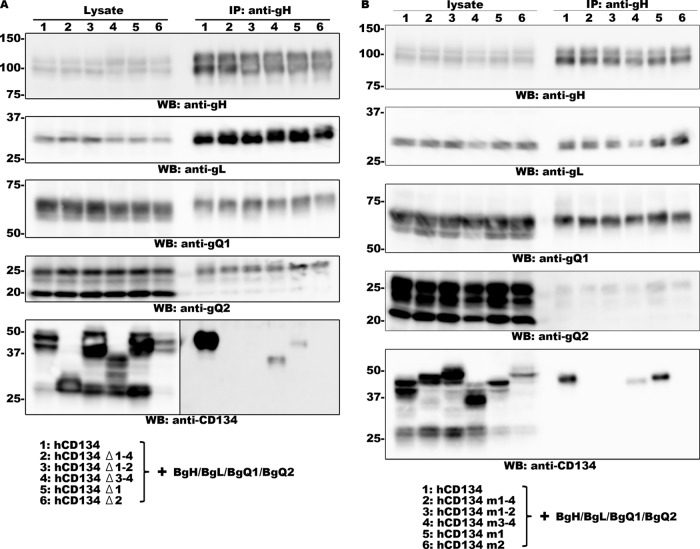
CRD2 of CD134 is required for binding to HHV-6B gH/gL/gQ1/gQ2. 293T cells were transfected with HHV-6B gH, gL, gQ1, and gQ2, (BgH, BgL, BgQ1, and BgQ2, respectively) and the CD134 deletion mutant (A) or chimeric mutant (B). Cells were harvested 2 days after transfection and prepared for immunoprecipitation (using anti-gH antibody) and Western blot (WB) analysis. The samples applied to each lane are listed at the bottom.
FIG 2
FIG 2
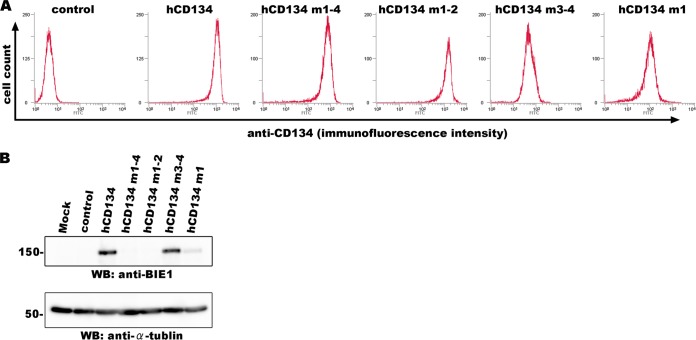
CRD2 of CD134 is required for HHV-6B infection. (A) Expression of human CD134 or its chimeric mutants in stable expression cell lines (JJhan cells) was confirmed by flow cytometry using an antibody for CD134. (B) JJhan cells, human-CD134-expressing JJhan cells, and chimeric-CD134-expressing JJhan cells were infected with HHV-6B. The cells were harvested at 24 h postinfection and prepared for Western blot (WB) analysis.
FIG 3
FIG 3
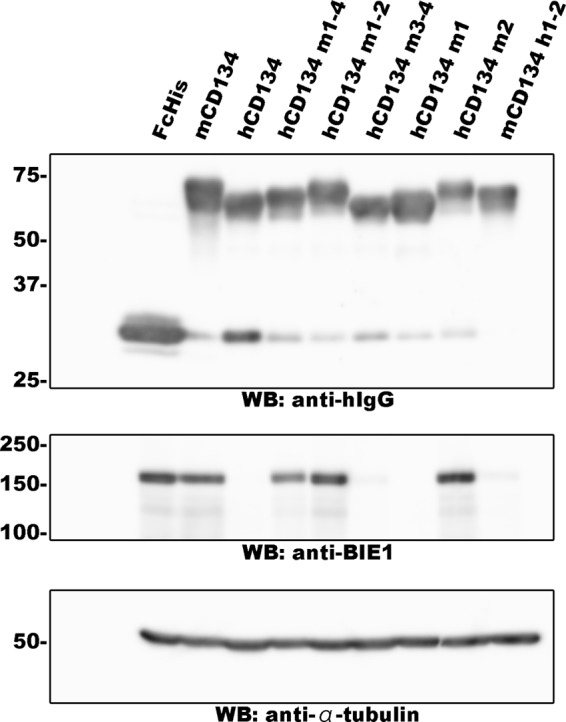
Soluble CD134 blocks HHV-6B infection. Soluble CD134 proteins were purified from the culture medium of 293T cells transfected with plasmids for the expression of these proteins, and expression was confirmed by Western blot (WB) analysis (top). These proteins were incubated with HHV-6B, which was then used to infect MT4 cells. The cells were harvested at 24 h postinfection and prepared for Western blot analysis (middle and bottom).
FIG 4
FIG 4
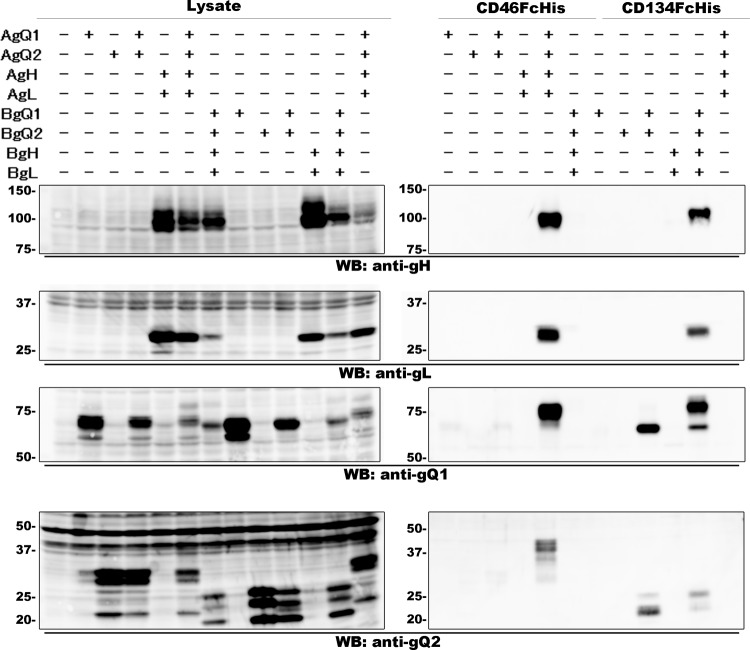
gQ1 and gQ2 of HHV-6B bind to CD134. The expression of each protein (indicated at the top of each lane) in the lysates of 293T cells transfected with an expression plasmid(s) was confirmed by Western blot (WB) analysis (left). Soluble forms of CD46 and CD134 (CD46FcHis and CD134FcHis, respectively) bound to Ni-NTA and were incubated with the cell lysates. The proteins bound to Ni-NTA were eluted and prepared for Western blot analysis (right).
FIG 5
FIG 5
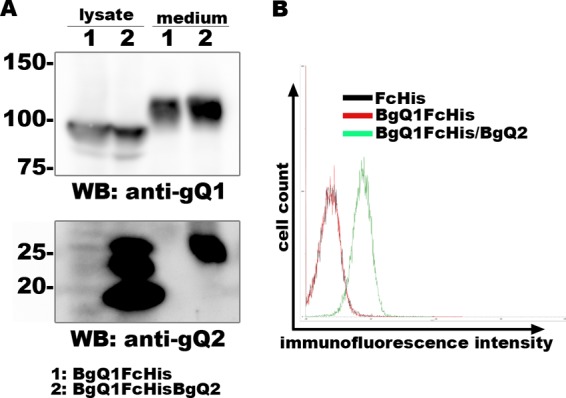
The secreted HHV-6B gQ1/gQ2 complex binds to CD134. 293T cells were transfected with a plasmid(s) for the expression of BgQ1 (tagged with Fc and His) alone or together with BgQ2. Secreted BgQ1 was purified using Ni-NTA. The expression and secretion (lysate and medium, respectively) of BgQ1 and BgQ2 were confirmed by Western blot (WB) analysis (A). The purified proteins were incubated with CD134-expressing JJhan cells. Binding of the purified proteins to the cells was analyzed by flow cytometry using Alexa Fluor 488 goat anti-human IgG antibody (B).
FIG 6
FIG 6
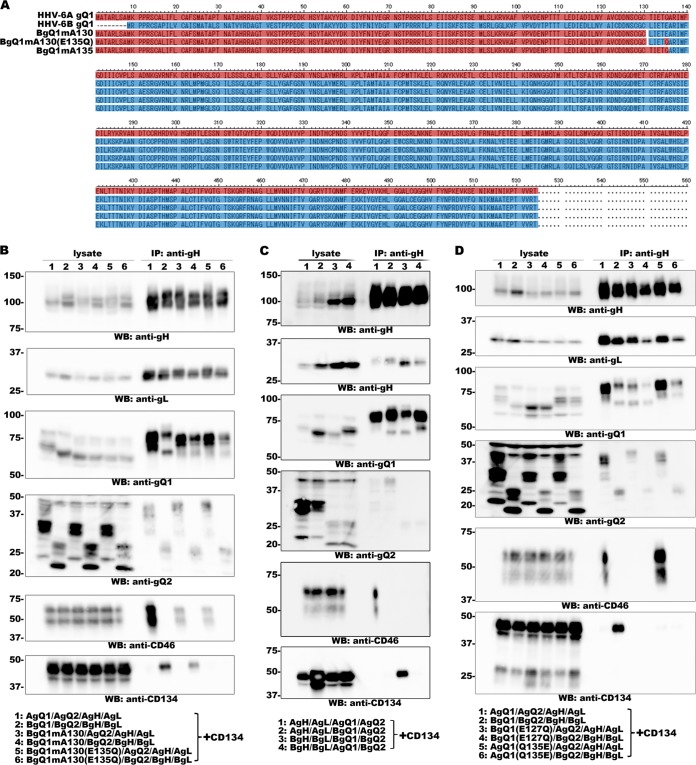
Analysis of the interaction between the complexes containing gQ1 mutants and CD134. (A) Amino acid sequence alignment of gQ1 proteins. The HHV-6A gQ1 sequence is in red, and the HHV-6B gQ1 sequence is in blue. (B, C, and D) 293T cells transfected with plasmids for expression of the proteins (lane numbers are defined at the bottom of the figure) were lysed for immunoprecipitation assay using anti-gH antibody. Expression of each protein (lysate) and the proteins precipitated from the lysates (anti-gH immunoprecipitation [IP]) were confirmed by Western blot (WB) analysis.

Similar articles

Cited by

References

    1. Aubin JT, Collandre H, Candotti D, Ingrand D, Rouzioux C, Burgard M, Richard S, Huraux JM, Agut H. 1991. Several groups among human herpesvirus 6 strains can be distinguished by Southern blotting and polymerase chain reaction. J. Clin. Microbiol. 29:367–372 - PMC - PubMed
    1. Campadelli-Fiume G, Guerrini S, Liu X, Foa-Tomasi L. 1993. Monoclonal antibodies to glycoprotein B differentiate human herpesvirus 6 into two clusters, variants A and B. J. Gen. Virol. 74:2257–2262. 10.1099/0022-1317-74-10-2257 - DOI - PubMed
    1. Salahuddin SZ, Ablashi DV, Markham PD, Josephs SF, Sturzenegger S, Kaplan M, Halligan G, Biberfeld P, Wong-Staal F, Kramarsky B, et al. 1986. Isolation of a new virus, HBLV, in patients with lymphoproliferative disorders. Science 234:596–601. 10.1126/science.2876520 - DOI - PubMed
    1. Wyatt LS, Balachandran N, Frenkel N. 1990. Variations in the replication and antigenic properties of human herpesvirus 6 strains. J. Infect. Dis. 162:852–857. 10.1093/infdis/162.4.852 - DOI - PubMed
    1. Ablashi D, Agut H, Alvarez-Lafuente R, Clark DA, Dewhurst S, Diluca D, Flamand L, Frenkel N, Gallo R, Gompels UA, Hollsberg P, Jacobson S, Luppi M, Lusso P, Malnati M, Medveczky P, Mori Y, Pellett PE, Pritchett JC, Yamanishi K, Yoshikawa T. 2014. Classification of HHV-6A and HHV-6B as distinct viruses. Arch. Virol. 159:863–870. 10.1007/s00705-013-1902-5 - DOI - PMC - PubMed

Publication types

MeSH terms