. 2014 Aug 22;281(1789):20140709.
doi: 10.1098/rspb.2014.0709.

Social contacts and the locations in which they occur as risk factors for influenza infection

Affiliations

Social contacts and the locations in which they occur as risk factors for influenza infection

Kin O Kwok et al. Proc Biol Sci. .

Abstract

The interaction of human social behaviour and transmission is an intriguing aspect of the life cycle of respiratory viral infections. Although age-specific mixing patterns are often assumed to be the key drivers of the age-specific heterogeneity in transmission, the association between social contacts and biologically confirmed infection has not previously been tested at the individual level. We administered a questionnaire to participants in a longitudinal cohort survey of influenza in which infection was defined by longitudinal paired serology. Using a variety of statistical approaches, we found overwhelming support for the inclusion of individual age in addition to contact variables when explaining odds of infection: the best model not including age explained only 15.7% of the deviance, whereas the best model with age explained 23.6%. However, within age groups, we did observe an association between contacts, locations and infection: median numbers of contacts (or locations) reported by those infected were higher than those from the uninfected group in every age group other than the youngest. Further, we found some support for the retention of location and contact variables in addition to age in our regression models, with excess odds of infection of approximately 10% per additional 10 contacts or one location. These results suggest that, although the relationship between age and incidence of respiratory infection at the level of the individual is not driven by self-reported social contacts, risk within an age group may be.

Keywords: contact patterns; influenza; pandemic.


Figures
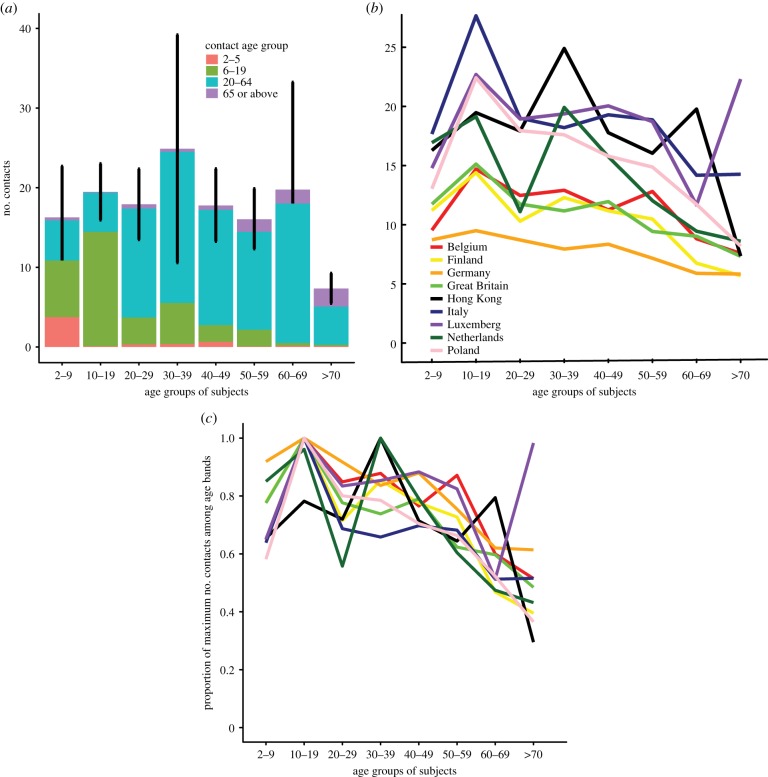
Figure 1.
Figure 1.
Age-specific contact patterns. (a) Distribution of self-reported contacts by age group for the present study. Values are the average per participant of the midpoint between reported maximum and minimum. Vertical black lines indicate binomial confidence bounds for the number of contacts across all four contact age classes for each participant age group. (b) Comparison of total number of contacts per age group for eight European countries, as reported in the PolyMod study [8]. PolyMod reported both participants and contacts in 5 year age groups starting with 0–4 years. Therefore, other than for the lowest age class, we used linear interpolation to generate consistent age boundaries from our less detailed data. For the lowest age class of participants, we report a range of 2–4 years, because our youngest participant was 2 years old. We assumed that PolyMod recruited few 0 and 1 year olds, so we did not interpolate for the lowest participant age class. We did not ask participants to report their contacts in 5 year age groups. (c) Also compares total contacts between the present study and the PolyMod study. However, in (c), although the relative amplitude for each age group for individual populations has been preserved, the amplitude has been rescaled, so that the maximum value for each country for any age group is 1.
Figure 2.
Figure 2.
Comparison between locations and contacts. (a) Box and whisker plot [14] for total number of reported locations (midpoint of maximum and minimum) for participant age groups. (b) Box and whisker plot for total number of reported contacts (midpoint of maximum and minimum) for participant age groups. Note that participants with number of reported contacts >100 are not plotted in this chart. (c) This figure is the reproduction of (b) except that this represents the subjects with number of reported contacts >100. (d) Scatter plot of total number of reported locations (midpoint of maximum and minimum) and total number of reported contacts (midpoint of maximum and minimum). Above and to the left of the y = x line, most of the participants reported at least as many contacts as locations.
Figure 3.
Figure 3.
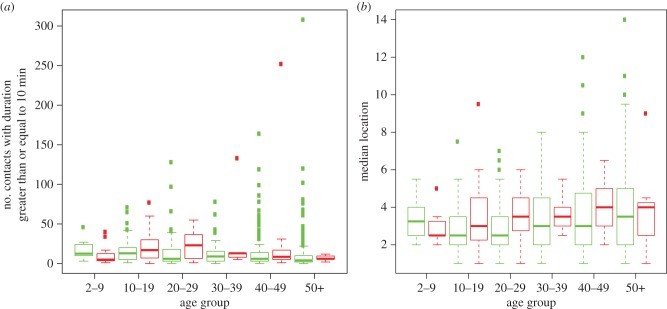
Infection, age, contacts and locations. (a) Distribution of number of contacts with duration greater than or equal to 10 min per age group and infection status. Inset same as main chart but with wider y-axis showing all outliers. (b) Distributions of numbers of locations per age group and infection status. In both parts: green denotes not infected and red infected; features follow the usual convention for box and whisker plots [14].

References

    1. Loehle C. 1995. Social barriers to pathogen transmission in wild animal populations. Ecology 76, 326–335. ( 10.2307/1941192) - DOI
    1. Vicente J, Delahay RJ, Walker NJ, Cheeseman CL. 2007. Social organization and movement influence the incidence of bovine tuberculosis in an undisturbed high-density badger Meles meles population. J. Anim. Ecol. 76, 348–360. ( 10.1111/j.1365-2656.2006.01199.x) - DOI - PubMed
    1. Beier JC, Killeen GF, Githure JI. 1999. Short report: entomologic inoculation rates and Plasmodium falciparum malaria prevalence in Africa. Am. J. Trop. Med. Hyg. 61, 109–113. - PubMed
    1. Koblin BA, et al. 2006. Risk factors for HIV infection among men who have sex with men. AIDS 20, 731–739. ( 10.1097/01.aids.0000216374.61442.55) - DOI - PubMed
    1. Wallinga J, Teunis P, Kretzschmar M. 2006. Using data on social contacts to estimate age-specific transmission parameters for respiratory-spread infectious agents. Am. J. Epidemiol. 164, 936–944. ( 10.1093/aje/kwj317) - DOI - PubMed

Publication types