


Decision-making about complementary and alternative medicine by cancer patients: integrative literature review
- PMID: 25009685
- PMCID: PMC4085086
Decision-making about complementary and alternative medicine by cancer patients: integrative literature review
Abstract
Background: Patients with cancer consistently report conflict and anxiety when making decisions about complementary and alternative medicine (CAM) treatment. To design evidence-informed decision-support strategies, a better understanding is needed of how the decision-making process unfolds for these patients during their experience with cancer. We undertook this study to review the research literature regarding CAM-related decision-making by patients with cancer within the context of treatment, survivorship, and palliation. We also aimed to summarize emergent concepts within a preliminary conceptual framework.
Methods: We conducted an integrative literature review, searching 12 electronic databases for articles published in English that described studies of the process, context, or outcomes of CAM-related decision-making. We summarized descriptive data using frequencies and used a descriptive constant comparative method to analyze statements about original qualitative results, with the goal of identifying distinct concepts pertaining to CAM-related decision-making by patients with cancer and the relationships among these concepts.
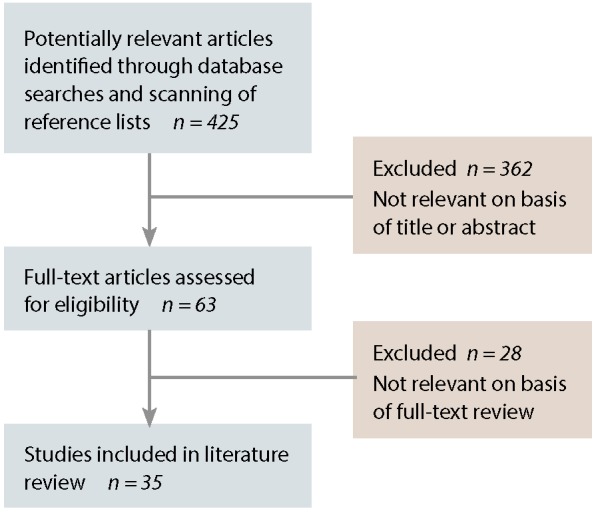
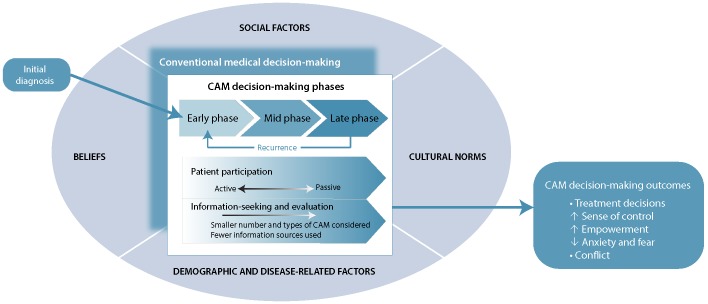
Results: Of 425 articles initially identified, 35 met our inclusion criteria. Seven unique concepts related to CAM and cancer decision-making emerged: decision-making phases, information-seeking and evaluation, decision-making roles, beliefs, contextual factors, decision-making outcomes, and the relationship between CAM and conventional medical decision-making. CAM decision-making begins with the diagnosis of cancer and encompasses 3 distinct phases (early, mid, and late), each marked by unique aims for CAM treatment and distinct patterns of information-seeking and evaluation. Phase transitions correspond to changes in health status or other milestones within the cancer trajectory. An emergent conceptual framework illustrating relationships among the 7 central concepts is presented.
Interpretation: CAM-related decision-making by patients with cancer occurs as a nonlinear, complex, dynamic process. The conceptual framework presented here identifies influential factors within that process, as well as patients' unique needs during different phases. The framework can guide the development and evaluation of theory-based decision-support programs that are responsive to patients' beliefs and preferences.
Conflict of interest statement
None declared.
Figures
References
-
- Balneaves LG, Bottorff JL, Hislop TG, Herbert C. Levels of commitment: exploring complementary therapy use by women with breast cancer. J Altern Complement Med. 2006;12(5):459–466. - PubMed
-
- Eng J, Ramsum D, Verhoef M, Guns E, Davison J, Gallagher R. A population- based survey of complementary and alternative medicine use in men recently diagnosed with prostate cancer. Integr Cancer Ther. 2003;2(3):212–216. - PubMed
-
- Molassiotis A, Fernadez-Ortega P, Pud D, Ozden G, Scott JA, Panteli V, et al. Use of complementary and alternative medicine in cancer patients: a European survey. Ann Oncol. 2005;16(4):655–663. - PubMed
-
- Gansler T, Kaw C, Crammer C, Smith T. A population-based study of prevalence of complementary methods use by cancer survivors: a report from the American Cancer Society's studies of cancer survivors. Cancer. 2008;113(5):1048–1057. - PubMed
Publication types
MeSH terms
LinkOut - more resources
Full Text Sources
Medical
Miscellaneous