


Protein quality control in the nucleus
- PMID: 25010148
- PMCID: PMC4192666
- DOI: 10.3390/biom4030646
Protein quality control in the nucleus
Abstract
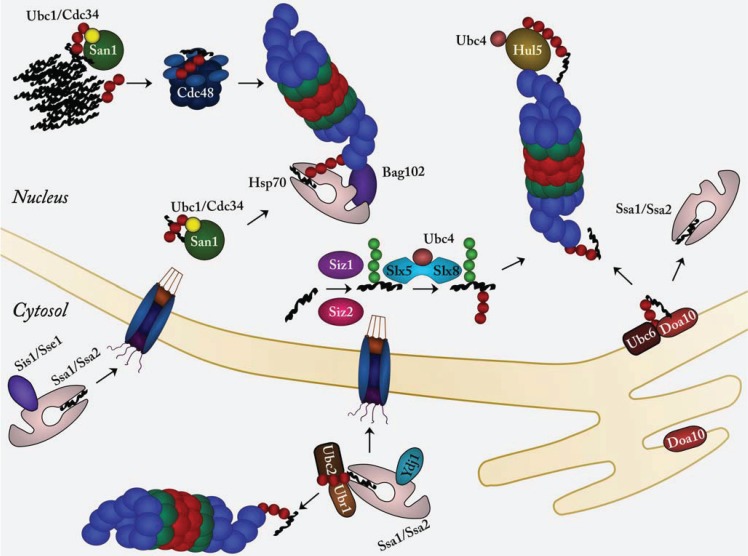
In their natural environment, cells are regularly exposed to various stress conditions that may lead to protein misfolding, but also in the absence of stress, misfolded proteins occur as the result of mutations or failures during protein synthesis. Since such partially denatured proteins are prone to aggregate, cells have evolved several elaborate quality control systems to deal with these potentially toxic proteins. First, various molecular chaperones will seize the misfolded protein and either attempt to refold the protein or target it for degradation via the ubiquitin-proteasome system. The degradation of misfolded proteins is clearly compartmentalized, so unique degradation pathways exist for misfolded proteins depending on whether their subcellular localization is ER/secretory, mitochondrial, cytosolic or nuclear. Recent studies, mainly in yeast, have shown that the nucleus appears to be particularly active in protein quality control. Thus, specific ubiquitin-protein ligases located in the nucleus, target not only misfolded nuclear proteins, but also various misfolded cytosolic proteins which are transported to the nucleus prior to their degradation. In comparison, much less is known about these mechanisms in mammalian cells. Here we highlight recent advances in our understanding of nuclear protein quality control, in particular regarding substrate recognition and proteasomal degradation.
Figures
References
-
- Hartl F.U., Hayer-Hartl M. Converging concepts of protein folding in vitro and in vivo. Nat. Struct. Mol. Biol. 2009;16:574–581. - PubMed
-
- Powers E.T., Morimoto R.I., Dillin A., Kelly J.W., Balch W.E. Biological and chemical approaches to diseases of proteostasis deficiency. Annu. Rev. Biochem. 2009;78:959–991. - PubMed
-
- Kettern N., Dreiseidler M., Tawo R., Hohfeld J. Chaperone-assisted degradation: Multiple paths to destruction. Biol. Chem. 2010;391:481–489. - PubMed
-
- Esser C., Alberti S., Hohfeld J. Cooperation of molecular chaperones with the ubiquitin/proteasome system. Biochim. Biophys. Acta. 2004;1695:171–188. - PubMed
Publication types
MeSH terms
Substances
LinkOut - more resources
Full Text Sources
Other Literature Sources
Molecular Biology Databases
