


On the correlation between reservoir metrics and performance for time series classification under the influence of synaptic plasticity
- PMID: 25010415
- PMCID: PMC4092026
- DOI: 10.1371/journal.pone.0101792
On the correlation between reservoir metrics and performance for time series classification under the influence of synaptic plasticity
Abstract
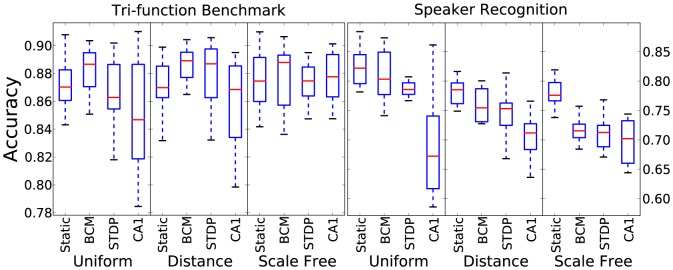
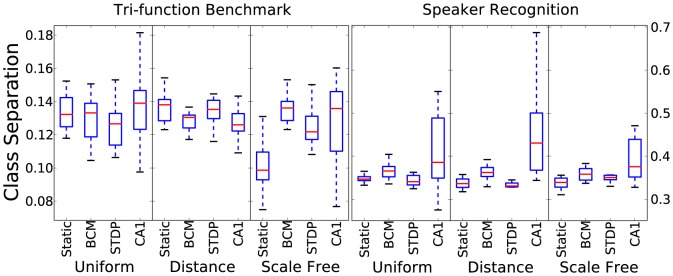
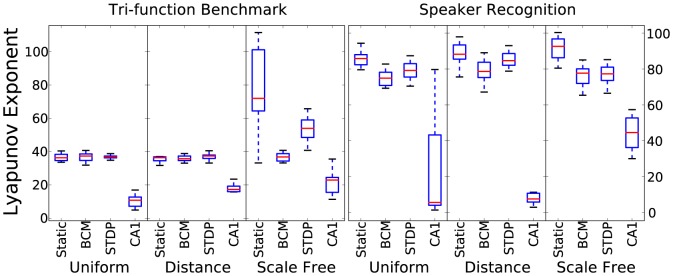
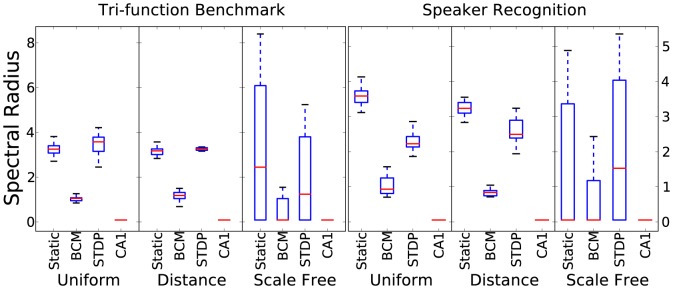
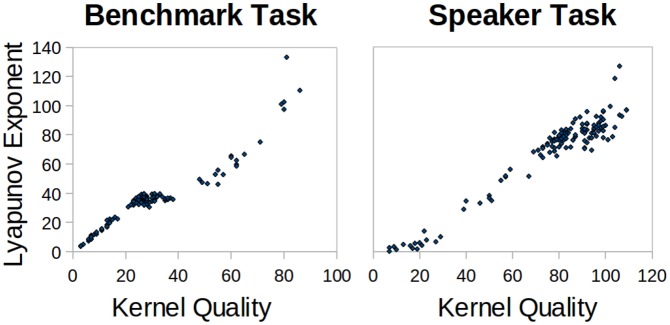
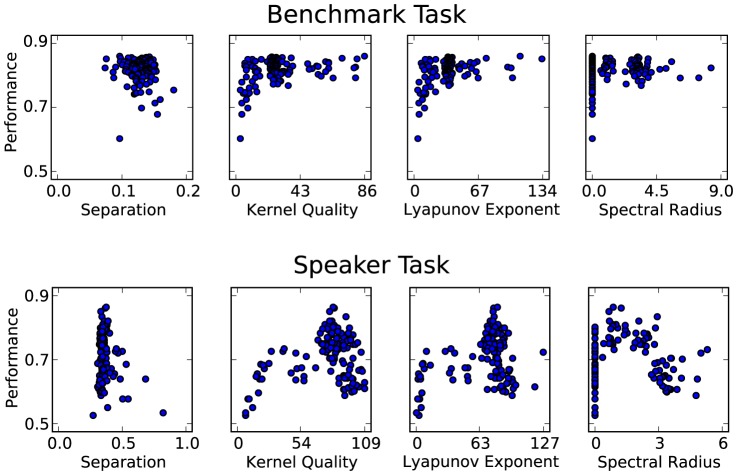
Reservoir computing provides a simpler paradigm of training recurrent networks by initialising and adapting the recurrent connections separately to a supervised linear readout. This creates a problem, though. As the recurrent weights and topology are now separated from adapting to the task, there is a burden on the reservoir designer to construct an effective network that happens to produce state vectors that can be mapped linearly into the desired outputs. Guidance in forming a reservoir can be through the use of some established metrics which link a number of theoretical properties of the reservoir computing paradigm to quantitative measures that can be used to evaluate the effectiveness of a given design. We provide a comprehensive empirical study of four metrics; class separation, kernel quality, Lyapunov's exponent and spectral radius. These metrics are each compared over a number of repeated runs, for different reservoir computing set-ups that include three types of network topology and three mechanisms of weight adaptation through synaptic plasticity. Each combination of these methods is tested on two time-series classification problems. We find that the two metrics that correlate most strongly with the classification performance are Lyapunov's exponent and kernel quality. It is also evident in the comparisons that these two metrics both measure a similar property of the reservoir dynamics. We also find that class separation and spectral radius are both less reliable and less effective in predicting performance.
Conflict of interest statement
Figures
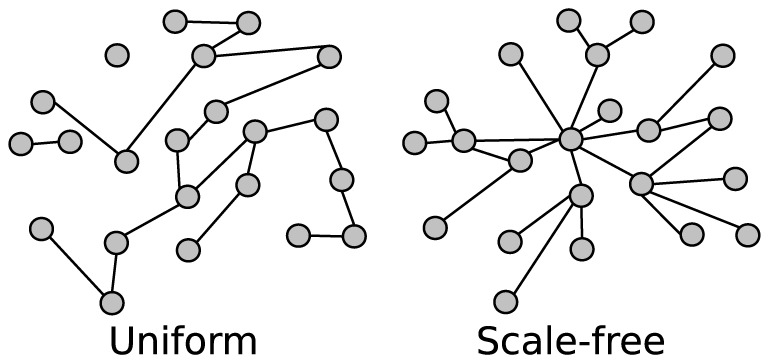
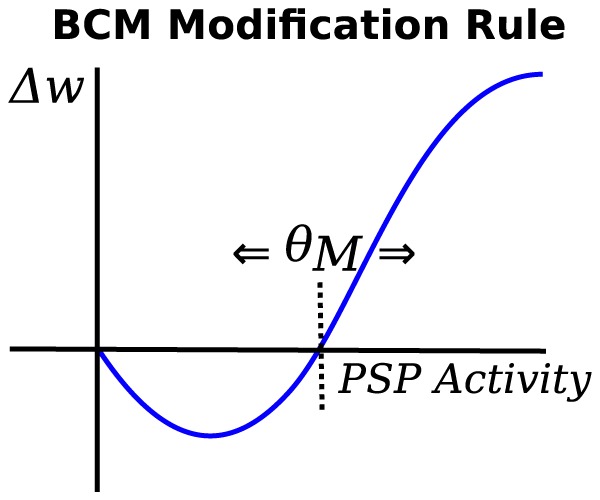
 is the sliding modification threshold that changes based on a temporal average of post-synaptic activity.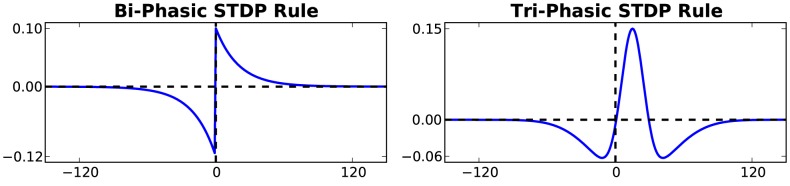
References
-
- Lukosevicius M, Jaeger H (2009) Reservoir computing approaches to recurrent neural network training. Computer Science Review 3: 127–149.
-
- Lukosevicius M, Jaeger H, Schrauwen B (2012) Reservoir computing trends. KI - Künstliche Intelligenz 26: 365–371.
-
- Maass W, Natschlager T, Markram H (2002) Real-time computing without stable states: a new framework for neural computation based on perturbations. Neural Computation 14: 2531–2560. - PubMed
-
- Jaeger H (2001) The echo state approach to analysing and training recurrent neural networks. Technical Report 148, GMD-Forschungszentrum Informationstechnik.
-
- Yin J, Meng Y, Jin Y (2012) A developmental approach to structural self-organization in reservoir computing. IEEE Transactions on on Autonomous Mental Development 4: 273–289.
Publication types
MeSH terms
LinkOut - more resources
Full Text Sources
Other Literature Sources
