


Advances in understanding the role of type I interferons in systemic lupus erythematosus
- PMID: 25010440
- PMCID: PMC4280994
- DOI: 10.1097/BOR.0000000000000087
Advances in understanding the role of type I interferons in systemic lupus erythematosus
Abstract
Purpose of review: Advances in understanding the genetic and molecular basis of innate immune system activation and function have supported the hypothesis that type I interferons (IFN-I), the essential mediators of antiviral host defense, are central contributors to the pathogenesis of systemic lupus erythematosus (SLE). This review addresses the recent data that support the rationale for therapeutic targeting of the IFN-I pathway in SLE.
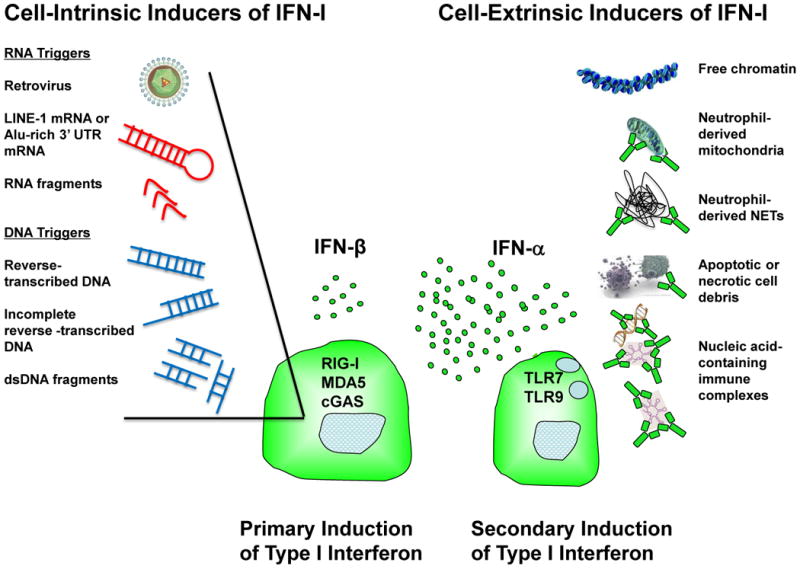
Recent findings: New insights into the mechanisms of cell-intrinsic innate immune system activation, driven by endogenous virus-like nucleic acids and potentially modified by environmental stressors, provide a model for the induction of IFN-I that may precede the clinically apparent autoimmunity in patients with lupus. Further amplification of IFN-α production, induced by nucleic-acid-containing immune complexes that activate endosomal Toll-like receptors, augments and sustains immune system activation, autoimmunity and tissue damage.
Summary: As demonstrated in the murine studies of persistent virus infection accompanied by sustained production of IFN-I, blockade of the IFN-I pathway may reverse the immune dysregulation and tissue damage that are the essential features of the immunopathogenesis of SLE. Recent research progress has identified numerous therapeutic targets, and specific candidate therapeutics relevant to the IFN-I pathway are under investigation.
Conflict of interest statement
Conflicts of Interest: Dr. Crow has consulted for Bristol Myers-Squibb, Eisai, EMD Merck Serono, GSK, Lilly, Takeda and UCB and she has received research grants from Novo Nordisk and Alliance for Lupus Research-Pfizer Centers for Therapeutic Innovation.
Figures
References
-
- Cherian TS, Kariuki SN, Franek BS, et al. Brief Report: IRF5 systemic lupus erythematosus risk haplotype is associated with asymptomatic serologic autoimmunity and progression to clinical autoimmunity in mothers of children with neonatal lupus. Arthritis and rheumatism. 2012;64:3383–7. - PMC - PubMed
-
- Rice GI, Forte GM, Szynkiewicz M, et al. Assessment of interferon-related biomarkers in Aicardi-Goutieres syndrome associated with mutations in TREX1, RNASEH2A, RNASEH2B, RNASEH2C, SAMHD1, and ADAR: a case-control study. Lancet neurology. 2013;12:1159–69. This large collaborative study documents expression of an IFN-I signature in nearly all patients bearing a mutation in one of the genes associated with AGS. - PMC - PubMed
Publication types
MeSH terms
Substances
Grants and funding
LinkOut - more resources
Full Text Sources
Other Literature Sources
Medical
Research Materials
