


Trophic facilitation or limitation? Comparative effects of pumas and black bears on the scavenger community
- PMID: 25010629
- PMCID: PMC4092109
- DOI: 10.1371/journal.pone.0102257
Trophic facilitation or limitation? Comparative effects of pumas and black bears on the scavenger community
Abstract
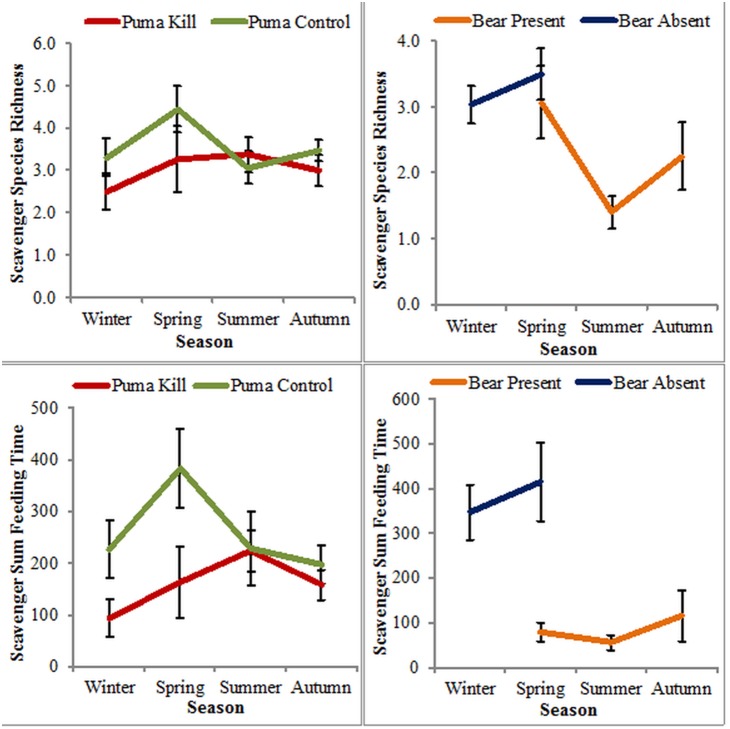
Scavenging is a widespread behaviour and an important process influencing food webs and ecological communities. Large carnivores facilitate the movement of energy across trophic levels through the scavenging and decomposition of their killed prey, but competition with large carnivores is also likely to constrain acquisition of carrion by scavengers. We used an experimental approach based on motion-triggered video cameras at black-tailed deer (Odocoileus hemionus columbianus) carcasses to measure the comparative influences of two large carnivores in the facilitation and limitation of carrion acquisition by scavengers. We found that pumas (Puma concolor) and black bears (Ursus americanus) had different effects on their ecological communities. Pumas, as a top-level predator, facilitated the consumption of carrion by scavengers, despite significantly reducing their observed sum feeding times (165.7 min ± 21.2 SE at puma kills 264.3 min ± 30.1 SE at control carcasses). In contrast, black bears, as the dominant scavenger in the system, limited consumption of carrion by scavengers as evidenced by the observed reduction of scavenger species richness recorded at carcasses where they were present (mean = 2.33 ± 0.28 SE), compared to where they were absent (mean = 3.28 ± 0.23 SE). Black bears also had large negative effects on scavenger sum feeding times (88.5 min ± 19.8 SE at carcasses where bears were present, 372.3 min ± 50.0 SE at carcasses where bears were absent). In addition, we found that pumas and black bears both increased the nestedness (a higher level of order among species present) of the scavenger community. Our results suggest that scavengers have species-specific adaptions to exploit carrion despite large carnivores, and that large carnivores influence the structure and composition of scavenger communities. The interactions between large carnivores and scavengers should be considered in future studies of food webs and ecological communities.
Conflict of interest statement
Figures
References
-
- DeVault TL, Rhodes Jr OE, Shivik JA (2003) Scavenging by vertebrates: behavioral, ecological, and evolutionary perspectives on an important energy transfer pathway in terrestrial ecosystems. Oikos 102: 225–234.
-
- Wilmers CC, Crabtree RL, Smith DW, Murphy KM, Getz WM (2003a) Trophic facilitation by introduced top predators: grey wolf subsidies to scavengers in Yellowstone National Park. Journal of Animal Ecology 72: 909–916.
-
- Barton PS, Cunningham SA, Lindenmayer DB, Manning AD (2013) The role of carrion in maintaining biodiversity and ecological processes in terrestrial ecosystems. Oecologia 171: 761–772. - PubMed
-
- Wilmers CC, Stahler DR, Crabtree RL, Smith DW, Getz WM (2003b) Resource dispersion and consumer dominance: scavenging at wolf– and hunter–killed carcasses in greater Yellowstone, USA. Ecology Letters 6: 996–1003.
Publication types
MeSH terms
LinkOut - more resources
Full Text Sources
Other Literature Sources
