Review
doi: 10.1371/journal.pntd.0002914.
eCollection 2014 Jul.
Immune regulation during chronic visceral leishmaniasis
Affiliations
- PMID: 25010815
- PMCID: PMC4091888
- DOI: 10.1371/journal.pntd.0002914
Item in Clipboard
Review
Immune regulation during chronic visceral leishmaniasis
PLoS Negl Trop Dis.
.
Abstract
Visceral leishmaniasis is a chronic parasitic disease associated with severe immune dysfunction. Treatment options are limited to relatively toxic drugs, and there is no vaccine for humans available. Hence, there is an urgent need to better understand immune responses following infection with Leishmania species by studying animal models of disease and clinical samples from patients. Here, we review recent discoveries in these areas and highlight shortcomings in our knowledge that need to be addressed if better treatment options are to be developed and effective vaccines designed.
Conflict of interest statement
The authors have declared that no competing interests exist.
Figures
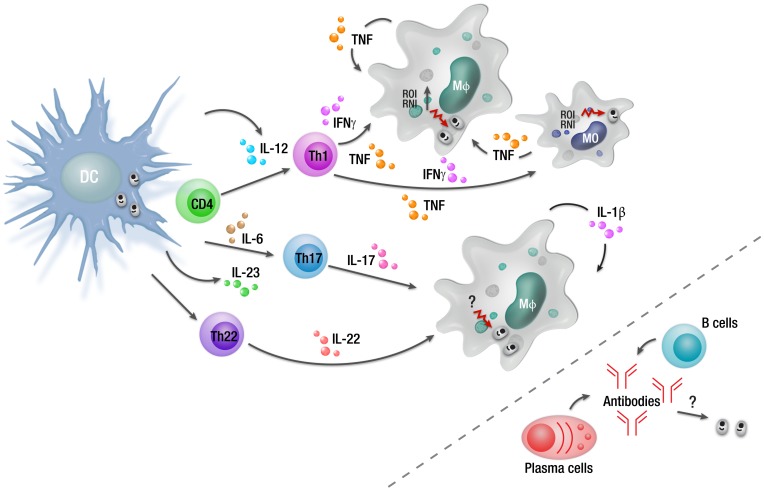
Infected macrophages can produce TNF and IL-1β in response to L. donovani infection as part of the innate immune response. However, DC IL-12 production in response to L. donovani infection is required to drive the differentiation of antigen-specific CD4+ T cells into IFNγ- and TNF-producing Th1 cells. These cells can activate infected macrophages and monocytes to produce ROI and RNI that kill intracellular parasites. There are also reports in humans that Th17 and Th22 cells develop in asymptomatic, infected individuals, possibly driven by IL-23 and IL-6. However, the antiparasitic mechanism mediated by these CD4+ T cell subsets following L. donovani infection remains unknown. Although parasite-specific antibodies are readily detected in asymptomatic individuals, their role, if any, in control of infection and protection against reinfection is unknown. Abbreviations: MO, monocyte; Mφ, macrophage.
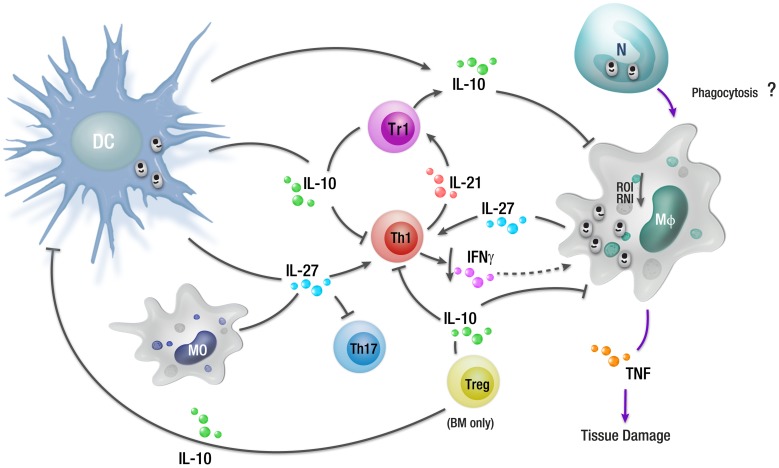
During an established L. donovani infection, a subset of regulatory DCs in the spleen can produce IL-10 that promotes the expansion of IL-10-producing regulatory T cells (Tr1), as well as inhibiting antimicrobial mechanisms in macrophages and other phagocytic cells (including suppression of ROI and RNI generation). IL-27 produced by regulatory DCs and macrophages, along with T cell–derived IL-21, can drive the differentiation of Th1 cells into Tr1 cells, as well as inhibit Th17 development. IL-10 produced by Tr1 cells can suppress antigen presentation, contributing to T cell dysfunction, as well as down-regulate CD4+ T cell IFNγ production. There has been a report that IL-10 can also be produced by Treg cells in the BM of VL patients. Although uptake of infected neutrophils undergoing apoptosis by macrophages contributes to the establishment of L. major infection in mice, no such mechanism has yet been described during L. donovani infection. Abbreviations: N, neutrophil.
References
-
- Nylén S, Eidsmo L (2012) Tissue damage and immunity in cutaneous leishmaniasis. Parasite Immunol 34: 551–561. - PubMed
-
- Singh S, Reddy D, Rai M, Sundar S (2006) Serious under reporting of visceral leishmaniasis through passive case reporting in Bihar, India. Trop Med Int Health 11: 899–905. - PubMed
-
- Ho M, Siongok T, Lyerly W, Smith D (1982) Prevalence and disease spectrum in a new focus of visceral leishmaniasis in Kenya. Trans R Soc Trop Med Hyg 76: 741–746. - PubMed
-
- Sacks D, Lal S, Shrivastava S, Blackwell J, Neva F (1987) An analysis of T cell responsiveness in Indian kala-azar. J Immunol 138: 908–913. - PubMed
Publication types
MeSH terms
Substances
LinkOut - more resources
Full Text Sources
Other Literature Sources