


Maternal satisfaction with a novel filtered-sunlight phototherapy for newborn jaundice in Southwest Nigeria
- PMID: 25012576
- PMCID: PMC4099408
- DOI: 10.1186/1471-2431-14-180
Maternal satisfaction with a novel filtered-sunlight phototherapy for newborn jaundice in Southwest Nigeria
Abstract
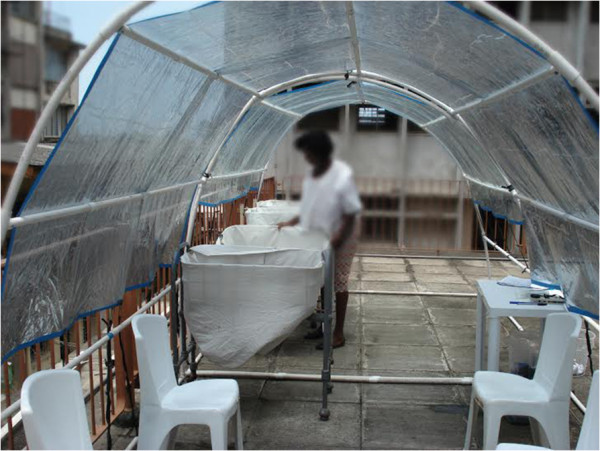
Background: In many resource-limited settings, the availability of effective phototherapy for jaundiced infants is frequently hampered by lack of, or inadequate resources to acquire and maintain conventional electric-powered phototherapy devices. This study set out to ascertain maternal experience and satisfaction with a novel treatment of infants with significant hyperbilirubinemia using filtered sunlight phototherapy (FSPT) in a tropical setting with irregular access to effective conventional phototherapy.
Methods: A cross-sectional satisfaction survey was conducted among mothers of jaundiced infants treated with FSPT in an inner-city maternity hospital in Lagos, Nigeria from November 2013 to March 2014. Mothers' experience during treatment was elicited with a pretested questionnaire consisting of closed and open-ended items. Satisfaction was rated on a five-point Likert scale. Correlates of overall maternal satisfaction were explored with descriptive and inferential non-parametric statistics.
Results: A total of 191 mothers were surveyed, 77 (40%) of whom had no prior knowledge of neonatal jaundice. Maternal satisfaction was highest for quality of nursing care received (mean: 4.72 ± 0.55, median: 5[IQR: 5-5]) and lowest for physical state of the test environment (mean: 3.85 ± 0.74, median: 4[IQR: 3-4]). The overall rating (mean: 4.17 ± 0.58, median: 4[IQR: 4-5]) and the observed effect of FSPT on the babies (mean: 4.34 ± 0.58, 4[IQR: 4-5]) were quite satisfactory. FSPT experience was significantly correlated with the adequacy of information received (p < 0.0005), test environment (p = 0.002) and the observed effect of FSPT on the child (p < 0.0005). Almost all mothers (98.4%) indicated willingness to use FSPT in future or recommend it to others, although some (30 or 15.7%) disliked the idea of exposing newborns to sunlight.
Conclusions: Mothers of jaundiced newborns in this population are likely to be satisfied with FSPT where it is inevitable as an alternative to conventional electric-powered phototherapy. Adequate information, good test environment and friendly nursing care must be ensured for satisfactory maternal experience.
Figures
References
-
- The Young Infants Clinical Signs Study Group. Clinical signs that predict severe illness in children under age 2 months: a multicentre study. Lancet. 2008;371:135–142. - PubMed
-
- Burke BL, Robbins JM, Bird TM, Hobbs CA, Nesmith C, Tilford JM. Trends in hospitalizations for neonatal jaundice and kernicterus in the United States, 1988–2005. Pediatrics. 2009;123:524–532. - PubMed
-
- Maisels MJ, McDonagh AF. Phototherapy for neonatal jaundice. N Engl J Med. 2008;358:920–928. - PubMed
-
- Bhutani VK, Cline BK, Donaldson KM, Vreman HJ. The need to implement effective phototherapy in resource-constrained settings. Semin Perinatol. 2011;35:192–197. - PubMed
Publication types
MeSH terms
LinkOut - more resources
Full Text Sources
Other Literature Sources
