


Survival after postoperative morbidity: a longitudinal observational cohort study
- PMID: 25012586
- PMCID: PMC4235571
- DOI: 10.1093/bja/aeu224
Survival after postoperative morbidity: a longitudinal observational cohort study
Abstract
Background: Previous studies have suggested that there may be long-term harm associated with postoperative complications. Uncertainty exists however, because of the need for risk adjustment and inconsistent definitions of postoperative morbidity.
Methods: We did a longitudinal observational cohort study of patients undergoing major surgery. Case-mix adjustment was applied and morbidity was recorded using a validated outcome measure. Cox proportional hazards modelling using time-dependent covariates was used to measure the independent relationship between prolonged postoperative morbidity and longer term survival.
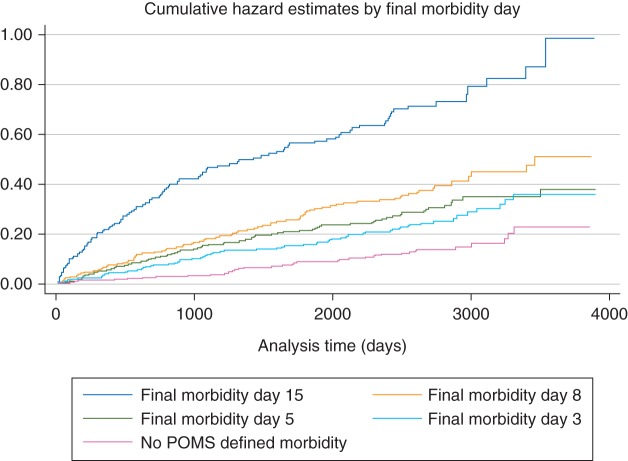
Results: Data were analysed for 1362 patients. The median length of stay was 9 days and the median follow-up time was 6.5 yr. Independent of perioperative risk, postoperative neurological morbidity (prevalence 2.9%) was associated with a relative hazard for long-term mortality of 2.00 [P=0.001; 95% confidence interval (CI) 1.32-3.04]. Prolonged postoperative morbidity (prevalence 15.6%) conferred a relative hazard for death in the first 12 months after surgery of 3.51 (P<0.001; 95% CI 2.28-5.42) and for the next 2 yr of 2.44 (P<0.001; 95% CI 1.62-3.65), returning to baseline thereafter.
Conclusions: Prolonged morbidity after surgery is associated with a risk of premature death for a longer duration than perhaps is commonly thought; however, this risk falls with time. We suggest that prolonged postoperative morbidity measured in this way may be a valid indicator of the quality of surgical healthcare. Our findings reinforce the importance of research and quality improvement initiatives aimed at reducing the duration and severity of postoperative complications.
Keywords: complications; complications, morbidity; complications, neurological; surgery, non-cardiac.
© The Author 2014. Published by Oxford University Press on behalf of the British Journal of Anaesthesia.
Figures
References
-
- Weiser TG, Regenbogen SE, Thompson KD, et al. An estimation of the global volume of surgery: a modelling strategy based on available data. Lancet. 2008;372:139–44. - PubMed
-
- Bennett-Guerrero E, Hyam JA, Shaefi S, et al. Comparison of P-POSSUM risk-adjusted mortality rates after surgery between patients in the USA and the UK. Br J Surg. 2003;90:1593–8. - PubMed
-
- Jones DR, Copeland GP, de Cossart L. Comparison of POSSUM with APACHE II for prediction of outcome from a surgical high-dependency unit. Br J Surg. 1992;79:1293–6. - PubMed
Publication types
MeSH terms
LinkOut - more resources
Full Text Sources
Other Literature Sources
Medical
