Chuanhu anti-gout mixture versus colchicine for acute gouty arthritis: a randomized, double-blind, double-dummy, non-inferiority trial
- PMID: 25013367
- PMCID: PMC4081309
- DOI: 10.7150/ijms.9165
Chuanhu anti-gout mixture versus colchicine for acute gouty arthritis: a randomized, double-blind, double-dummy, non-inferiority trial
Abstract
Background: The Chuanhu anti-gout mixture has been used for many years in the treatment of gout in Chinese Traditional Medicine, and current methods for treatments for acute gouty arthritis have been either less effective or have had serious side effects.
Methods: In this 12-week, double-blind, double-dummy, non-inferiority study, outpatient individuals with newly diagnosed acute gouty arthritis were randomly assigned to receive Chuanhu anti-gout mixture or colchicine. Both the study investigators and the participants were masked to the treatment assignments. The primary outcome was the recurrence rate of acute gouty arthritis, and the secondary outcomes were changes in white blood cells (WHC) and C-reactive protein (CRP). This trial is registered at ISRCTN.org as trial ISRCTN65219941.
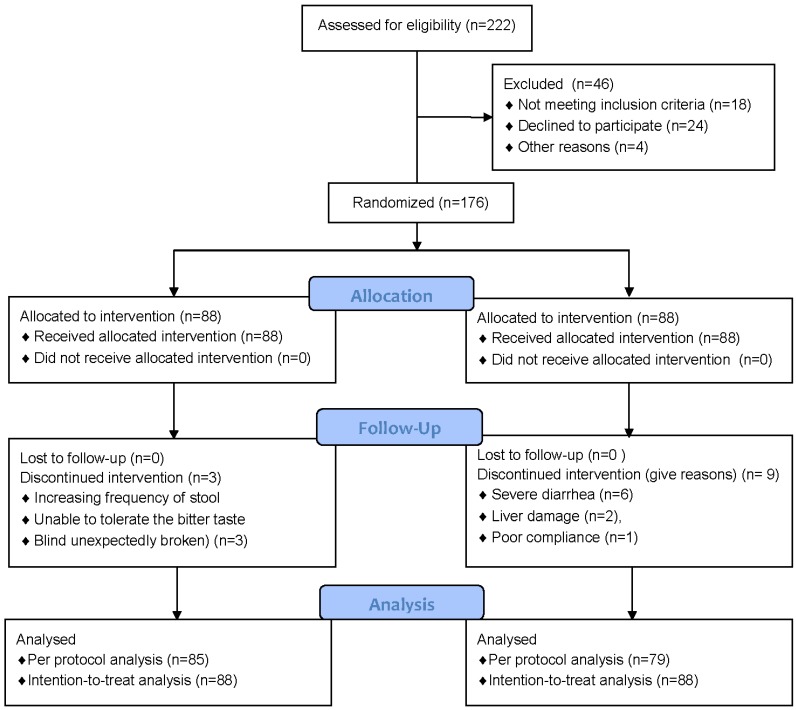
Results: A total of 176 patients were randomly assigned to receive either the Chuanhu anti-gout mixture or Colchicine. The overall recurrence rates in the Chuanhu anti-gout mixture group (CH group) and the Colchicine group (Col group) were 12.50% vs 14.77% (difference -2.22%, 95% confidence interval (95% CI): -10.78%~6.23%), meeting the predefined non-inferiority criterion of 15%, as did the data for WHC and CRP. The incidence of adverse events (mainly diarrhea) was less in the Col group than in the CH group (2.27% vs 28.41%, 95% CI 0.01~0.26). In addition, changes in blood uric acid, alanine aminotransferase, aspartate aminotransferase and creatinine in the CH group were significantly larger compared to those in the Col group (P<0.05).
Conclusions: The Chuanhu anti-gout mixture was non-inferior to colchicine for the treatment of acute gouty arthritis. The study suggested that the Chuanhu anti-gout mixture can be considered an alternative choice for the treatment of acute gouty arthritis because of its lower incidence of adverse events and its protection of kidney and renal function.
Keywords: Chuanhu; acute gouty arthritis.
Conflict of interest statement
Competing Interests: The authors declare that they have no competing interests.
References
-
- Roddy E, Zhang W, Doherty M. The changing epidemiology of gout. Nat Clin Pract Rheumatol. 2007;3:443–9. - PubMed
-
- Richette P, Bardin T. Gout. Lancet. 2010;375:318–28. - PubMed
-
- Miao Z, Li C, Chen Y. et al. Dietary and lifestyle changes associated with high prevalence of hyperuricemia and gout in the Shandong coastal cities of Eastern China. J Rheumatol. 2008;35:1859–64. - PubMed
Publication types
MeSH terms
Substances
LinkOut - more resources
Full Text Sources
Other Literature Sources
Medical
Research Materials
Miscellaneous