


Hepatitis C worldwide and in Brazil: silent epidemic--data on disease including incidence, transmission, prevention, and treatment
- PMID: 25013871
- PMCID: PMC4070442
- DOI: 10.1155/2014/827849
Hepatitis C worldwide and in Brazil: silent epidemic--data on disease including incidence, transmission, prevention, and treatment
Abstract
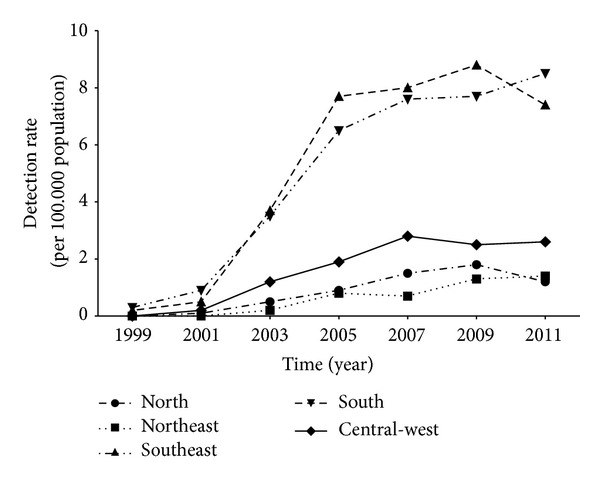
Hepatitis C virus (HCV) is endemic worldwide and according to the World Health Organization (WHO), there are about 150 million chronic carriers worldwide. The infection is a leading cause of liver diseases like cirrhosis and hepatocellular carcinoma (HCC); thus, HCV infection constitutes a critical public health problem. There are increasing efforts worldwide in order to reduce the global impact of hepatitis C through the implementation of programmatic actions that may increase the awareness of viral hepatitis and also improve surveillance, prevention, and treatment. In Brazil, about 1,5 million people have been chronically infected with HCV. The country has a vast territory with uneven population density, and hepatitis C incidence rates are variable with the majority of cases concentrated in the most populated areas. Currently, the main priorities of Brazilian Ministry of Health's strategies for viral hepatitis management include the prevention and early diagnosis of viral hepatitis infections; strengthening of the healthcare network and lines of treatment for sexually transmitted diseases, viral hepatitis, and AIDS; improvement and development of surveillance, information, and research; and promotion of universal access to medication. This review aims to summarize the available data on hepatitis C epidemiology and current status of efforts in prevention and infection control around the world and in Brazil.
Figures


References
-
- World Health Organization. Hepatitis C. Fact sheet no. 164. Geneva, Switzerland: World Health OrganizationMedia Centre; 2013. (Hepatitis C key facts). http://www.who.int/mediacentre/factsheets/fs164/en/index.html.
-
- World Health Organization. Prevention and Control of Viral Hepatitis Infection: Framework for Global Action. Geneva, Switzerland: World Health Organization; 2012. http://www.who.int/csr/disease/hepatitis/Framework/en/
-
- Terrault NA. Sexual activity as a risk factor for hepatitis C. Hepatology. 2002;36(5):S99–S105. - PubMed
-
- Brazilian Institute of Geography and Statistics. Maps of Brazil: Political Map. Brasília, Brazil: IBGE; 2014. Digital School Geographic Atlas, 2014 (Portuguese), http://atlasescolar.ibge.gov.br/images/atlas/mapas_brasil/brasil_politic....
-
- Brazil Ministry of Health. 2012 Epidemiological Bulletin on Viral Hepatitis. Brasília, Brazil: Health Surveillance Secretariat, Department of STD, AIDS and Viral Hepatitis, Ministry of Health; 2012 (Portuguese). http://www.aids.gov.br/sites/default/files/anexos/publicacao/2012/51820/....
Publication types
MeSH terms
LinkOut - more resources
Full Text Sources
Other Literature Sources
Medical
