


Improved identification of rapidly growing mycobacteria by a 16S-23S internal transcribed spacer region PCR and capillary gel electrophoresis
- PMID: 25013955
- PMCID: PMC4094492
- DOI: 10.1371/journal.pone.0102290
Improved identification of rapidly growing mycobacteria by a 16S-23S internal transcribed spacer region PCR and capillary gel electrophoresis
Abstract
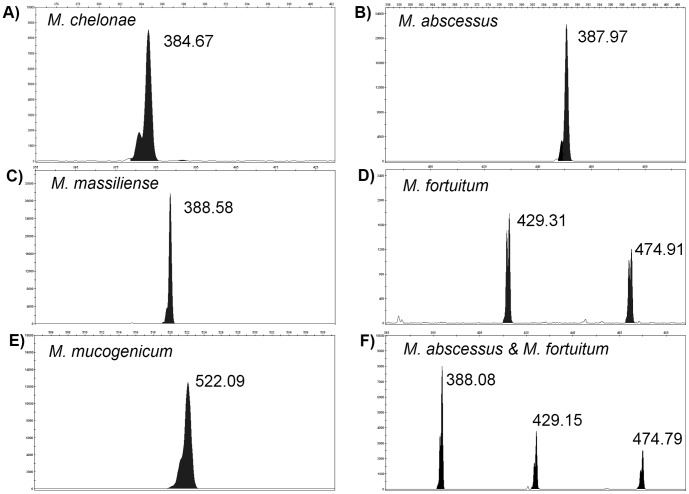
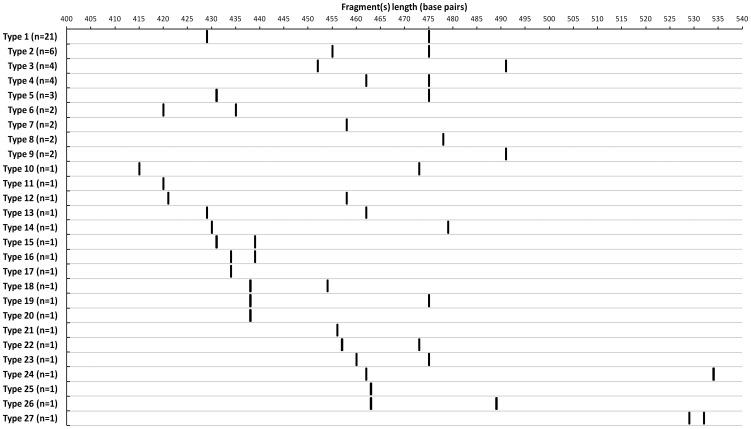
The identification of rapidly growing mycobacteria (RGM) remains problematic because of evolving taxonomy, limitations of current phenotypic methods and absence of a universal gene target for reliable speciation. This study evaluated a novel method of identification of RGM by amplification of the mycobacterial 16S-23S rRNA internal transcribed spacer (ITS) followed by resolution of amplified fragments by capillary gel electrophoresis (CGE). Nineteen American Type Culture Collection (ATCC) Mycobacterium strains and 178 clinical isolates of RGM (12 species) were studied. All RGM ATCC strains generated unique electropherograms with no overlap with slowly growing mycobacteria species, including M. tuberculosis. A total of 47 electropherograms for the 178 clinical isolates were observed allowing the speciation of 175/178 (98.3%) isolates, including the differentiation of the closely related species, M. massiliense (M. abscessus subspecies bolletii) and M. abscessus (M. abscessus sensu stricto). ITS fragment size ranged from 332 to 534 bp and 33.7% of clinical isolates generated electropherograms with two distinct peaks, while the remainder where characterized with a single peak. Unique peaks (fragment lengths) were identified for 11/12 (92%) RGM species with only M. moriokaense having an indistinguishable electropherogram from a rarely encountered CGE subtype of M. fortuitum. We conclude that amplification of the 16S-23S ITS gene region followed by resolution of fragments by CGE is a simple, rapid, accurate and reproducible method for species identification and characterization of the RGM.
Conflict of interest statement
Figures
References
-
- Redelman-Sidi G, Sepkowitz KA (2010) Rapidly growing mycobacteria infection in patients with cancer. Clin Infect Dis 51: 422–434. - PubMed
-
- Han XY, De I, Jacobson KL (2007) Rapidly growing mycobacteria: clinical and microbiologic studies of 115 cases. Am J Clin Pathol 128: 612–621. - PubMed
-
- Stout JE, Gadkowski LB, Rath S, Alspaugh JA, Miller MB, et al. (2011) Pedicure-associated rapidly growing mycobacterial infection: an endemic disease. Clin Infect Dis 53: 787–792. - PubMed
-
- Teng SH, Chen CM, Lee MR, Lee TF, Chien KY, et al. (2013) Matrix-assisted laser desorption ionization-time of flight mass spectrometry can accurately differentiate between Mycobacterium masilliense (M. abscessus subspecies bolletti) and M. abscessus (sensu stricto). J Clin Microbiol 51: 3113–3116. - PMC - PubMed
Publication types
MeSH terms
Substances
LinkOut - more resources
Full Text Sources
Other Literature Sources
Molecular Biology Databases
