


Artificial urinary sphincter placement in compromised urethras and survival: a comparison of virgin, radiated and reoperative cases
- PMID: 25014577
- PMCID: PMC4527678
- DOI: 10.1016/j.juro.2014.06.088
Artificial urinary sphincter placement in compromised urethras and survival: a comparison of virgin, radiated and reoperative cases
Abstract
Purpose: Although long-term outcomes after initial placement of artificial urinary sphincters are established, limited data exist comparing sphincter survival in patients with compromised urethras (prior radiation, artificial urinary sphincter placement or urethroplasty). We evaluated artificial urinary sphincter failure in patients with compromised and noncompromised urethras.
Materials and methods: We performed a retrospective analysis of 86 sphincters placed at a single institution between December 1997 and September 2012. We assessed patient demographic, comorbid disease and surgical characteristics. All nonfunctioning, eroded or infected devices were considered failures.
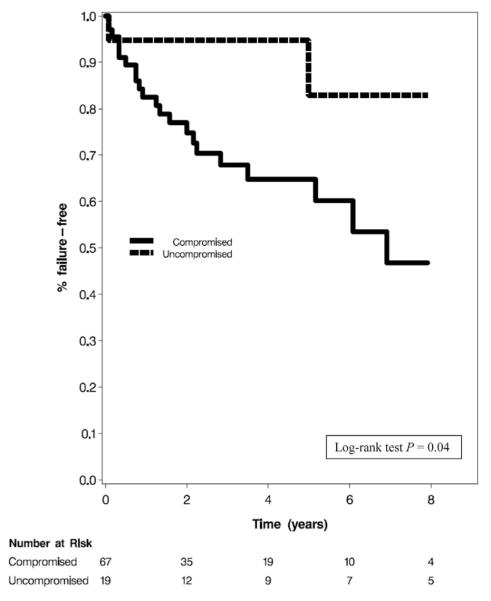
Results: Of the 86 patients reviewed 67 (78%) had compromised urethras and had higher failure rates than the noncompromised group (34% vs 21%, p=0.02). Compared to the noncompromised group, cases of prior radiation therapy (HR 4.78; 95% CI 1.27, 18.04), urethroplasty (HR 8.61; 95% CI 1.27, 58.51) and previous artificial urinary sphincter placement (HR 8.14; 95% CI 1.71, 38.82) had a significantly increased risk of failure. The risk of artificial urinary sphincter failure increased with more prior procedures. An increased risk of failure was observed after 3.5 cm cuff placement (HR 8.62; 95% CI 2.82, 26.36) but not transcorporal placement (HR 1.21; 95% CI 0.49, 2.99).
Conclusions: Artificial urinary sphincter placement in patients with compromised urethras from prior artificial urinary sphincter placement, radiation or urethroplasty had a statistically significant higher risk of failure than placement in patients with noncompromised urethras. Urethral mobilization and transection performed during posterior urethroplasty surgeries likely compromise urethral blood supply, predisposing patients to failure. Patients with severely compromised urethras from multiple prior procedures may have improved outcomes with transcorporal cuff placement rather than a 3.5 cm cuff.
Keywords: artificial; radiation; urinary incontinence; urinary sphincter.
Copyright © 2014 American Urological Association Education and Research, Inc. Published by Elsevier Inc. All rights reserved.
Comment in
-
Incontinence: Artificial urinary sphincter more likely to fail in compromised urethras.Nat Rev Urol. 2014 Aug;11(8):428. doi: 10.1038/nrurol.2014.183. Epub 2014 Jul 22. Nat Rev Urol. 2014. PMID: 25048861 No abstract available.
References
-
- Claudon P, Spie R, Bats M, et al. Male stress urinary incontinence: medium-term results of treatment by sub-urethral bone anchored sling InVance. Prog Urol. 2011;21:625. - PubMed
-
- Rehder P, Haab F, Cornu JN, et al. Treatment of postprostatectomy male urinary incontinence with the transobturator retroluminal repositioning sling suspension: 3-year follow-up. Eur Urol. 2012;62:140. - PubMed
-
- Hoda MR, Primus G, Fischereder K, et al. Early results of a European multicentre experience with a new self-anchoring adjustable transobturator system for treatment of stress urinary incontinence in men. BJU Int. 2013;111:296. - PubMed
-
- Tuygun C, Imamoglu A, Gucuk A, et al. Comparison of outcomes for adjustable bulbourethral male sling and artificial urinary sphincter after previous artificial urinary sphincter erosion. Urology. 2009;73:1363. - PubMed
-
- Elliott DS, Barrett DM. Mayo Clinic long-term analysis of the functional durability of the AMS 800 artificial urinary sphincter: a review of 323 cases. J Urol. 1998;159:1206. - PubMed
MeSH terms
Grants and funding
LinkOut - more resources
Full Text Sources
Other Literature Sources
