Review
. 2014 Nov;71(22):4325-46.
doi: 10.1007/s00018-014-1677-1.

Longevity, aging and rapamycin

Review

Longevity, aging and rapamycin

Dan Ehninger et al. Cell Mol Life Sci. 2014 Nov.

Abstract

The federal drug administration (FDA)-approved compound rapamycin was the first pharmacological agent shown to extend maximal lifespan in both genders in a mammalian species. A major question then is whether the drug slows mammalian aging or if it has isolated effects on longevity by suppressing cancers, the main cause of death in many mouse strains. Here, we review what is currently known about the effects that pharmacological or genetic mammalian target of rapamycin (mTOR) inhibition have on mammalian aging and longevity. Currently available evidence seems to best fit a model, wherein rapamycin extends lifespan by suppressing cancers. In addition the drug has symptomatic effects on some aging traits, such as age-related cognitive impairments.


Figures
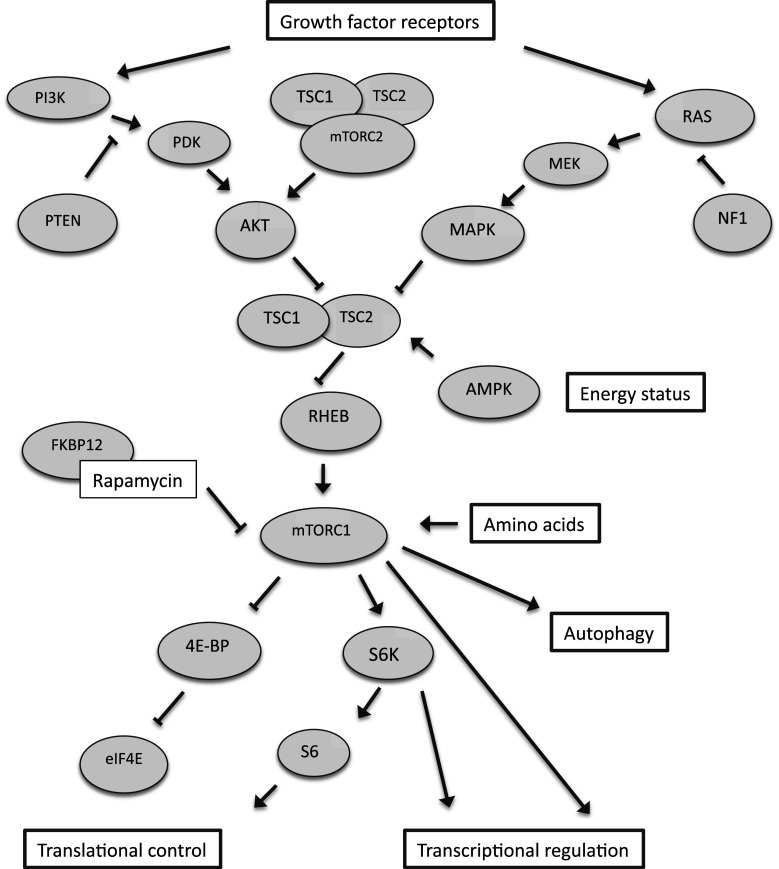
Fig. 1
Fig. 1
Schematic illustration of mTOR-related cell signaling. AKT serine/threonine protein kinase, AMPK AMP-activated protein kinase, FKBP12 12 kDa FK506-binding protein, eIF4E eukaryotic translation initiation factor 4E, 4E-BP eIF4E binding protein, MAPK mitogen-activated protein kinase, MEK mitogen-activated protein kinase kinase, mTORC1 mammalian target of rapamycin complex 1, mTORC2 mammalian target of rapamycin complex 2, NF1 neurofibromin, PDK phosphoinositide-dependent protein kinase, PI3 K phosphoinositide-3-kinase, PTEN phosphatase and tensin homolog, Ras G protein Ras, Rheb Ras homologue enriched in brain, S6 K S6 kinase, S6 ribosomal protein S6, TSC1 tuberous sclerosis protein 1, TSC2 tuberous sclerosis protein 2. Modified with permission from [79]
Fig. 2
Fig. 2
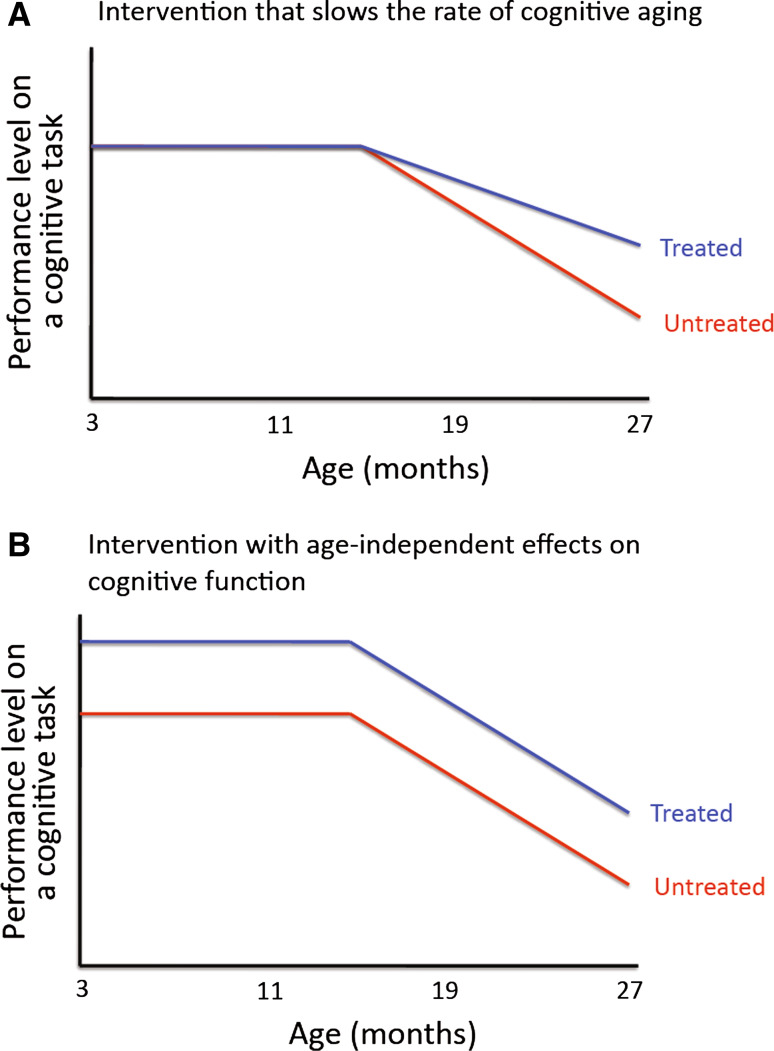
Causal versus symptomatic effects on aging traits. A putative anti-aging intervention could in principle exert its effects on a given aging trait causally, by slowing the rate of aging (a), or symptomatically via aging-independent effects (b). a and b show examples of age-related decline of performance on a cognitive task that progressively starts in the second year of life of the animal. A treatment (given throughout life) that slows the rate of cognitive aging would be expected to specifically affect performance on the task once age-related decline has started (a). A treatment (given throughout life) that symptomatically improves age-related cognitive decline would be expected to improve performance at all ages (b)

References

    1. Olshansky SJ, Perry D, Miller RA, Butler RN. In pursuit of the longevity dividend. Scientist. 2006;20:28–35.
    1. Blagosklonny MV. An anti-aging drug today: from senescence-promoting genes to anti-aging pill. Drug Discov Today. 2007;12(5–6):218–224. doi: 10.1016/j.drudis.2007.01.004. - DOI - PubMed
    1. Kapahi P, Chen D, Rogers AN, Katewa SD, Li PW, Thomas EL, Kockel L. With TOR, less is more: a key role for the conserved nutrient-sensing TOR pathway in aging. Cell Metab. 2010;11(6):453–465. doi: 10.1016/j.cmet.2010.05.001. - DOI - PMC - PubMed
    1. Blagosklonny MV. Aging and immortality: quasi-programmed senescence and its pharmacologic inhibition. Cell Cycle. 2006;5(18):2087–2102. doi: 10.4161/cc.5.18.3288. - DOI - PubMed
    1. Ehninger D. From genes to cognition in tuberous sclerosis: implications for mTOR inhibitor-based treatment approaches. Neuropharmacology. 2013;68:97–105. doi: 10.1016/j.neuropharm.2012.05.015. - DOI - PubMed