


Outcomes after hematopoietic stem cell transplantation for children with I-cell disease
- PMID: 25016194
- PMCID: PMC4194244
- DOI: 10.1016/j.bbmt.2014.06.019
Outcomes after hematopoietic stem cell transplantation for children with I-cell disease
Abstract
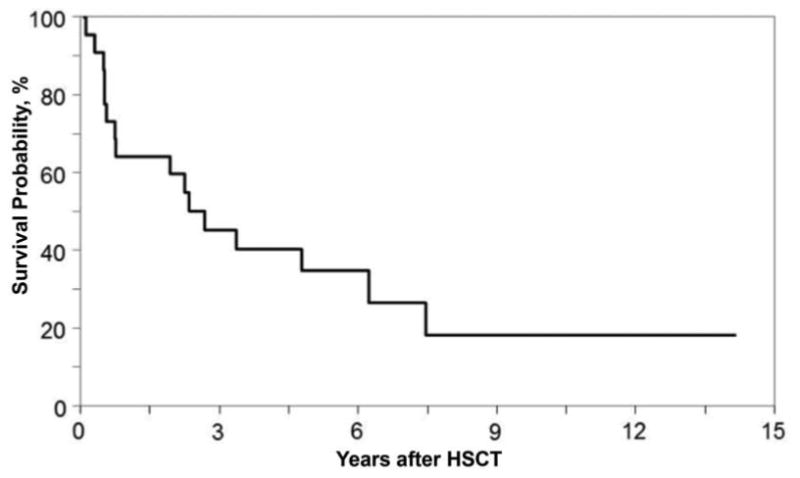
Mucolipidosis type II (MLII), or I-cell disease, is a rare but severe disorder affecting localization of enzymes to the lysosome, generally resulting in death before the 10th birthday. Although hematopoietic stem cell transplantation (HSCT) has been used to successfully treat some lysosomal storage diseases, only 2 cases have been reported on the use of HSCT to treat MLII. For the first time, we describe the combined international experience in the use of HSCT for MLII in 22 patients. Although 95% of the patients engrafted, overall survival was low, with only 6 patients (27%) alive at last follow-up. The most common cause of death post-transplant was cardiovascular complications, most likely due to disease progression. Survivors were globally delayed in development and often required complex medical support, such as gastrostomy tubes for nutrition and tracheostomy with mechanical ventilation. Although HSCT has demonstrated efficacy in treating some lysosomal storage disorders, the neurologic outcome and survival for patents with MLII were poor. Therefore, new medical and cellular therapies should be sought for these patients.
Keywords: Hematopoietic stem cell transplant; I-cell disease; Lysosomal storage disease; Mucolipidosis type II.
Copyright © 2014 American Society for Blood and Marrow Transplantation. Published by Elsevier Inc. All rights reserved.
Figures
References
-
- Cathey SS, Kudo M, Tiede S, et al. Molecular order in mucolipidosis II and III nomenclature. Am J Med Genet A. 2008;146A(4):512–513. - PubMed
-
- Wenger DA, Sattler M, Clark C, Wharton C. I-cell disease: activities of lysosomal enzymes toward natural and synthetic substrates. Life Sci. 1976;19(3):413–420. - PubMed
-
- Leroy JG, Spranger JW, Feingold M, Opitz JM, Crocker AC. I-cell disease: a clinical picture. J Pediatr. 1971;79(3):360–365. - PubMed
-
- Fratantoni JC, Hall CW, Neufeld EF. Hurler and Hunter syndromes: mutual correction of the defect in cultured fibroblasts. Science. 1968;162(3853):570–572. - PubMed
-
- Prasad VK, Kurtzberg J. Transplant outcomes in mucopolysaccharidoses. Semin Hematol. 2010;47(1):59–69. - PubMed
Publication types
MeSH terms
Grants and funding
LinkOut - more resources
Full Text Sources
Other Literature Sources
