


A text message alcohol intervention for young adult emergency department patients: a randomized clinical trial
- PMID: 25017822
- PMCID: PMC4254153
- DOI: 10.1016/j.annemergmed.2014.06.010
A text message alcohol intervention for young adult emergency department patients: a randomized clinical trial
Abstract
Study objective: Opportunistic brief in-person emergency department (ED) interventions can be effective at reducing hazardous alcohol use in young adult drinkers, but require resources frequently unavailable. Mobile telephone text messaging (short message service [SMS]) could sustainably deliver behavioral support to young adult patients, but efficacy remains unknown. We report 3-month outcome data of a randomized controlled trial testing a novel SMS-delivered intervention in hazardous-drinking young adults.
Methods: We randomized 765 young adult ED patients who screened positive for past hazardous alcohol use to one of 3 groups: SMS assessments+feedback (SA+F) intervention who were asked to respond to drinking-related queries and received real-time feedback through SMS each Thursday and Sunday for 12 weeks (n=384), SMS assessments (SA) who were asked to respond to alcohol consumption queries each Sunday but did not receive any feedback (N=196), and a control group who did not participate in any SMS (n=185). Primary outcomes were self-reported number of binge drinking days and number of drinks per drinking day in the past 30 days, collected by Web-based timeline follow-back method and analyzed with regression models. Secondary outcomes were the proportion of participants with weekend binge episodes and most drinks consumed per drinking occasion during 12 weekends, collected by SMS.
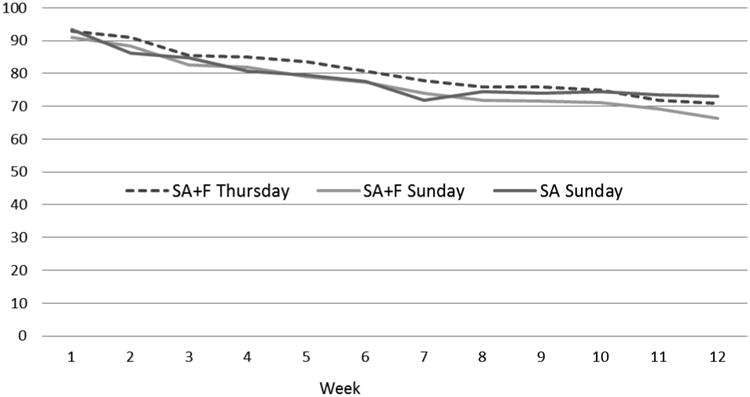
Results: With Web-based data, there were decreases in the number of self-reported binge drinking days from baseline to 3 months in the SA+F group (-0.51 [95% confidence interval {CI} -0.10 to -0.95]), whereas there were increases in the SA group (0.90 [95% CI 0.23 to 1.6]) and the control group (0.41 [95% CI -0.20 to 1.0]). There were also decreases in the number of self-reported drinks per drinking day from baseline to 3 months in the SA+F group (-0.31 [95% CI -0.07 to -0.55]), whereas there were increases in the SA group (0.10 [95% CI -0.27 to 0.47]) and the control group (0.39 [95% CI 0.06 to 0.72]). With SMS data, there was a lower mean proportion of SA+F participants reporting a weekend binge during 12 weeks (30.5% [95% CI 25% to 36%) compared with the SA participants (47.7% [95% CI 40% to 56%]). There was also a lower mean drinks consumed per weekend during 12 weeks in the SA+F group (3.2 [95% CI 2.6 to 3.7]) compared to the SA group (4.8 [95% CI 4.0 to 5.6]).
Conclusion: A text message intervention can produce small reductions in self-reported binge drinking and the number of drinks consumed per drinking day in hazardous-drinking young adults after ED discharge.
Copyright © 2014 American College of Emergency Physicians. Published by Elsevier Inc. All rights reserved.
Conflict of interest statement
Figures



References
-
- Schappert SM, Rechtsteiner EA. Ambulatory medical care utilization estimates for 2006. Natl Health Stat Report. 2008;(8):1–29. - PubMed
-
- Bernstein E, Bernstein JA, Stein JB, Saitz R. SBIRT in emergency care settings: are we ready to take it to scale? Acad Emerg Med. 2009 Nov;16(11):1072–7. - PubMed
-
- Alcohol Screening in the Emergency Department. [Accessed 11/01/12]; Approved April 2011. Revised and approved by the ACEP Board of Directors April 2011. http://www.acep.org/Clinical---Practice-Management/Alcohol-Screening-in-...
Publication types
MeSH terms
Grants and funding
LinkOut - more resources
Full Text Sources
Other Literature Sources
Miscellaneous
