


HPV vaccine hesitancy: findings from a statewide survey of health care providers
- PMID: 25017939
- PMCID: PMC4254028
- DOI: 10.1016/j.pedhc.2014.05.003
HPV vaccine hesitancy: findings from a statewide survey of health care providers
Abstract
Introduction: Health care provider recommendations are critical for human papillomavirus (HPV) vaccine uptake. We sought to describe providers' HPV vaccine recommendation practices and explore their perceptions of parental hesitancy.
Method: A statewide sample (n = 575) of Minnesota health care providers (20% pediatricians, 47% family medicine physicians, and 33% nurse practitioners) completed our online survey in April 2013.
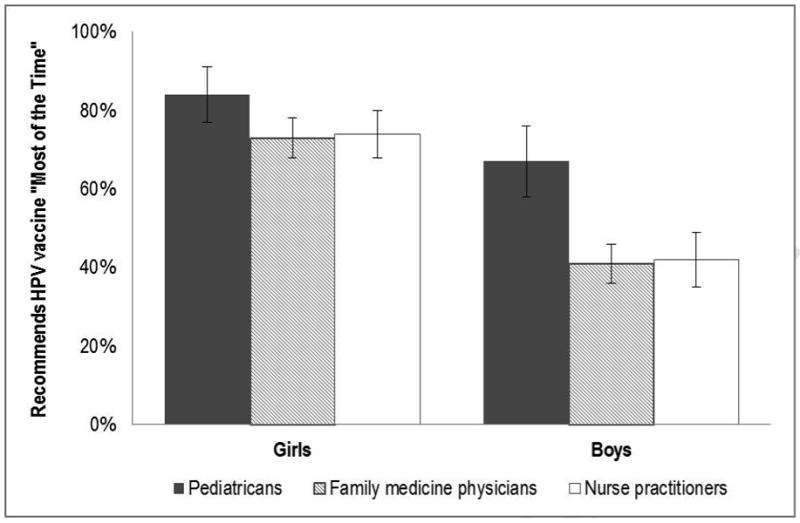
Results: Only 76% of health care providers reported routinely recommending HPV vaccine for girls ages 11 to 12 years, and far fewer (46%) did so for boys (p < .001). A majority of providers reported asking questions about parents' concerns (74%), but many lacked time to probe reasons (47%) or believed that they could not change parents' minds (55%). Higher levels of self-efficacy and outcome expectations were associated with routine recommendations (p < .05).
Discussion: Findings suggest that providers' perceptions of hesitancy may discourage them from routinely recommending the HPV vaccine. Improving providers' self-efficacy to address hesitancy may be important for improving vaccination rates.
Keywords: HPV vaccine; health care provider communication; vaccine hesitancy.
Copyright © 2014 National Association of Pediatric Nurse Practitioners. Published by Elsevier Inc. All rights reserved.
Conflict of interest statement
Figures
References
-
- Allen JD, Othus MK, Shelton RC, Li Y, Norman N, Tom L, del Carmen MG. Parental decision making about the HPV vaccine. Cancer Epidemiology, Biomarkers and Prevention. 2010;19(9):2187–2198. - PubMed
-
- American Association for Public Opinion Research (AAPOR) Standard Definitions: Final Dispositions of Case Codes and Outcome Rates for Surveys. 6th. AAPOR; 2009.
-
- Bandura A. Social Foundations of Thought and Action. Englewood Cliffs, NJ: Prentice Hall; 1986.
-
- Cabana MD, Rand CS, Powe NR, Wu AW, Wilson MH, Abboud PAC, Rubin HR. Why don't physicians follow clinical practice guidelines? Journal of the American Medical Association. 1999;282(15):1458–1465. - PubMed
Publication types
MeSH terms
Substances
Grants and funding
LinkOut - more resources
Full Text Sources
Other Literature Sources
Medical
Miscellaneous
